
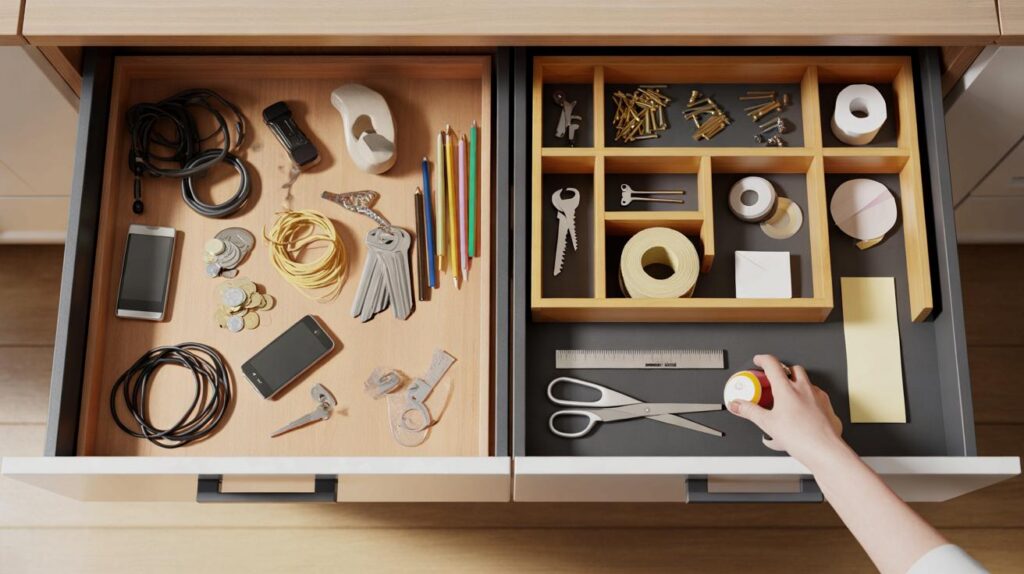
You open a drawer for a battery and end up swimming through coins, rogue keys and three different phone cables that fit nothing you own. That tiny mess steals seconds that add up to a quiet kind of stress. The solution isn’t a pristine showroom or a big clear-out you’ll never repeat. It’s lines. Simple dividers that turn a jumble into a map you can read at a glance. No heroic tidying. No guilt. Just shapes that tell your hands where things live. The day feels calmer when you can find the smallest object in one smooth move. Drawers become less like junk pockets and more like a dashboard.
The morning I realised my home was quietly working against me, I was kneeling by a kitchen drawer, elbow-deep in a nest of rubber bands and blunt pencils. Tea was going cold. Keys were nowhere. Above me, the kettle ticked like a slow metronome and I could feel that tiny surge of self-annoyance: you promised yourself you’d sort this. We’ve all had that moment when a two-minute task becomes a seven-minute hunt. Later that week, I slid in a set of cheap adjustable dividers and watched chaos split into neat lanes. *A drawer that used to sigh now clicked shut, clear and light.* The change felt embarrassingly quick. The difference was instant. The question was why.
Why drawer dividers change everything
Mess isn’t just visual; it’s cognitive. When items overlap in a drawer, your brain does a tiny scavenger hunt every time you open it. Dividers turn that hunt into a straight line. You’re not tidying so much as designing a route for your hands. Think of each section as a mini post code. Batteries here, Allen keys there, spare lightbulb caps in the narrow lane. You stop scanning and start reaching. The whole drawer becomes a story your brain can read in one glance. You feel it in small ways: the sigh you don’t make, the minute you don’t lose, the decision you don’t have to take.
In my flat, one drawer was a known trouble spot: tape measures, blister plasters, a lifetime of orphan screws. I timed ten everyday searches before and after adding dividers. Before: average 52 seconds to find the right bit. After: 14 seconds. That’s not science. It’s a small domestic diary. Yet the pattern was clear. I wasn’t getting better; the drawer was. The line of travel from oven to tape to scissors became smooth, almost automatic. Even guests could find things without asking. A plumber opened it, smiled at the tidy rows, and got exactly the tool he needed on the first try. That tiny win felt oddly generous.
What’s happening is simple. Dividers create constraints, and constraints create memory. When every category has an outline, your brain builds a “map by shape”. You don’t count items; you recognise a contour. A narrow slot screams cables, a square box whispers batteries, a long channel suggests rulers. The grid also stops migration, the slow slide of objects into the wrong corner. That matters more than it sounds. Small items are slippery. They roll, snag and hide. A structured drawer says no to drift. It also says yes to “good enough”: grab, drop, close, done. That’s the real magic of physical boundaries. They make maintenance almost invisible.
How to set up dividers that actually work
Start with what you reach for most. Empty the drawer onto a towel and group by natural families: power (batteries, chargers), repair (screws, tape, glue), dispatch (stamps, envelopes), personal (plasters, lip balm). Pick adjustable dividers you can cut or slide, and set a simple rule: items you grab weekly live front and centre, lower-frequency items slide to the sides. Create one long “runway” for tall tools like scissors or a ruler. Give tiny pieces a smaller bay so they don’t drift. If the drawer is deep, stack shallow trays like mezzanine floors. The goal isn’t perfection. It’s a **visual grid** you can read in half a second.
Common mistakes start with overcomplicating it. Twenty micro-compartments look clever and then drive you mad. Keep categories chunky. Leave one empty slot as a buffer for randoms you’ll sort later. Add soft liners if things slide, and pick high-contrast dividers so items pop at a glance. Labels help, but only if they’re short and obvious. Tape that says “CABLES” beats a pretty tag that says “Misc. Devices”. And be kind to your future self: keep the lids off small boxes so one hand can drop and go. Let’s be honest: nobody really does that every day.
If you share the drawer, bake in habits with tiny rituals: a **one-minute reset** after dinner, a playful rule that batteries go left, fasteners go right. This isn’t about discipline. It’s about friction so low that tidy wins by default.
“Order isn’t about control. It’s about making the helpful choice the easy one.”
- Front row: items used weekly
- Left-to-right: power, repair, post, personal
- One empty bay: the pressure valve
- High-contrast dividers and a grippy liner
- Labels only where needed
Living with your new drawers
Once the lanes are set, the drawer starts teaching you. You’ll notice categories that don’t earn their space, and others that deserve a promotion to the front. Rotate without drama. Move the plasters closer during school term, swap in travel plugs before summer, bump down the spare picture hooks when the gallery wall is done. Small seasonal tweaks keep the grid honest. And here’s the quiet win: your sense of home shifts. Little tasks finish sooner. You feel a notch calmer. Friends can help themselves without a guided tour. The drawer becomes a tiny social contract: this is where small things live, so **nothing gets lost**. You might even start eyeing the bathroom cabinet next.
| Key points | Details | Interest for reader |
|---|---|---|
| Divide by function and frequency | Front-and-centre for weekly items, side lanes for occasional tools | Faster grabs with less thinking |
| Choose adjustable, high-contrast dividers | Cut-to-fit pieces, dark or light against item colour, add a grippy liner | Easy setup and instant visual clarity |
| Keep it flexible with one empty bay | Acts as a buffer for new bits, prevents overflow and clutter creep | Maintenance without effort or guilt |
FAQ :
- How many dividers do I actually need?Start with four to six sections per drawer. If you still fish around, add one more. If you hesitate when filing, remove one.
- What material works best?Bamboo looks smart, plastic wipes clean, foam inserts stop sliding, and acrylic shows every crumb. Pick what suits your drawer and mood.
- Will dividers work in very small drawers?Yes. Use slim trays for width and one long channel for tall tools. In tiny spaces, fewer categories beat fiddly grids.
- How do I organise kids’ drawers?Use big categories and icons. Balls, blocks, crayons. No lids, bright colours, and a large “messy bay” to toss in a hurry.
- Do I need labels?Only if you share the drawer or you forget new zones. Short words beat pretty phrases. If a label feels forced, skip it.



Instantly calmer drawer, instantly calmer brain. 🙂