
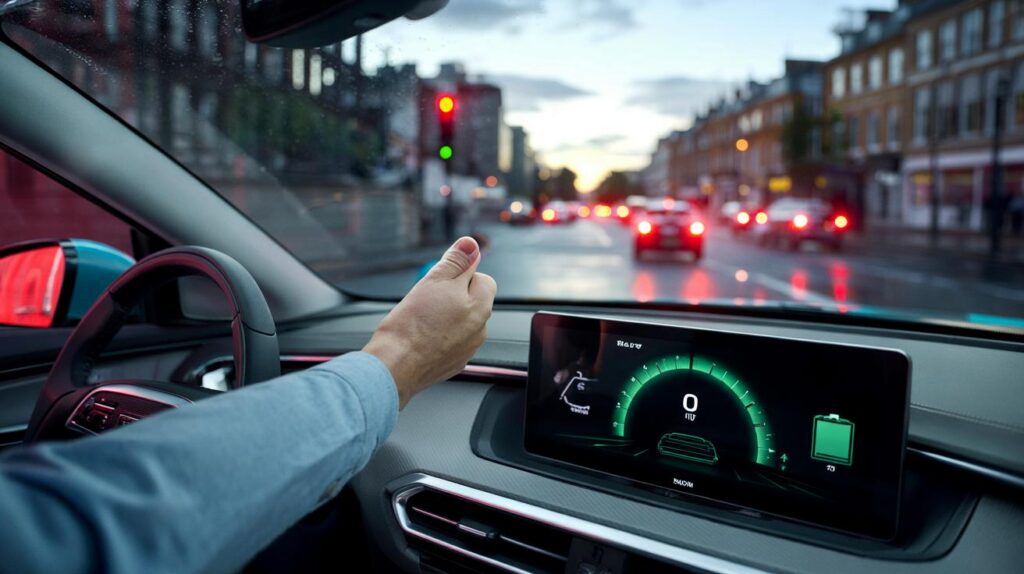
A quiet shift in how we slow down is reshaping rush-hour habits and car maintenance bills across the UK today.
Many drivers still treat the right-hand pedal as a simple on–off switch for speed. Newer cars let it do more. Lift your foot, and the car can slow, light the brake lamps and push power back into the battery, often without touching the left pedal at all.
What your right foot can do
In modern electric and many hybrid cars, easing off the accelerator engages regenerative braking. The motor becomes a generator, converting the car’s motion into electricity and topping up the battery. The sensation is smooth, predictable deceleration that you control with millimetre movements of your foot.
This is not the gentle engine braking familiar from petrol or diesel models. Regeneration can deliver meaningful stopping force, frequently between 0.1 g and 0.25 g in everyday settings, enough to handle most urban slowing. Because the system harvests energy that would otherwise heat the brake discs, city range often stretches by a noticeable margin.
Lift to slow, and lift to recharge: regenerative braking can add roughly 5–20% to urban range, model and conditions permitting.
How it works behind the scenes
When you back off the pedal, the inverter commands the drive motor to resist rotation. That resistance slows the wheels while generating current. The battery’s state of charge and temperature limit how much current can flow, so deceleration and energy recovery vary from one moment to the next. If the battery is near full or cold, regen is reduced and the car blends in hydraulic brakes to maintain a consistent feel.
Most cars now illuminate the brake lights automatically when regeneration exceeds a threshold deceleration, often around 0.1 g. Following traffic should see the car slowing, even if your foot never touches the brake pedal.
Why drivers are leaning on one-pedal driving
Energy that returns to the battery is energy you do not have to buy from the grid. Short, frequent decelerations in town make the biggest difference, because stop–start traffic offers the most opportunities to recuperate. Motorway cruising offers less benefit, as you rarely slow.
Mechanical brakes work less hard when regeneration does more of the stopping. Pads and discs tend to last longer, and brake dust emissions drop. Many owners report sharply reduced wear in urban use, along with a calmer driving rhythm that lowers fatigue in heavy traffic.
Expect smoother progress, fewer pedal swaps and quieter stops. The car feels more settled, and your eyes lift further down the road.
Remember the limits
- Emergency stops still require the brake pedal; regeneration alone will not deliver maximum deceleration.
- Cold weather and a full battery can suppress regeneration, lengthening stopping distances if you rely only on lift-off slowing.
- Steep descents may saturate the system; the car will fade in hydraulic braking to maintain control.
- On low-grip surfaces, stability systems moderate regeneration to prevent wheel slip.
Settings by car: what you can adjust
Manufacturers label the feature in different ways and offer a range of strengths. Some cars provide paddles behind the wheel to change regeneration on the fly. Others have a dedicated one-pedal mode that brings the car to a stop when you fully lift.
| Model (example) | Mode name | Typical peak regen | Brake light behaviour | Deceleration feel |
|---|---|---|---|---|
| Nissan Leaf | e-Pedal | ~30–50 kW | Lights on at higher lift-off decel | Strong town slowing, can stop the car |
| Tesla Model 3/Y | Regenerative braking + hold | ~60–85 kW | Automatic based on decel level | Firm, consistent, one-pedal to standstill |
| Hyundai Kona Electric | Levels 0–3 + auto | ~50–70 kW | Automatic based on decel level | Adjustable, with paddle control |
| Kia e‑Niro | Levels 0–3 + auto | ~50–70 kW | Automatic based on decel level | Adjustable, can hold on slopes |
| BMW i3 | One-pedal by default | ~40–50 kW | Lights on at higher lift-off decel | Linear, natural, town-friendly |
Figures vary with state of charge, temperature and battery size. Peak regeneration shows up after a few miles when the pack is warm and has room to accept charge.
Safety, etiquette and the Highway Code
The Highway Code expects brake lights to signal deceleration, which these systems now handle automatically under stronger lift-off. That said, leave adequate gaps and modulate your lift to avoid abrupt slowdowns that surprise drivers behind. On wet or icy roads, make gentler inputs. Regeneration can feel like engine braking to passengers; warn those prone to motion sickness and keep it smooth.
Who benefits most, and when it falls short
Urban commuters see the largest gains, with frequent opportunities to harvest energy. Hilly routes help as well, as long downhill sections allow steady regeneration. Motorway runs at steady speed give little back, and a near-full battery at the start of a descent reduces the effect. Towing, heavy loads and very cold mornings can all limit regeneration. Expect the car to adjust automatically, and build a margin into your following distance until you learn the feel in each scenario.
How to get started in minutes
- Activate the strongest regeneration or the dedicated one-pedal mode in the vehicle settings.
- Practise in an empty car park: lift to coast, lift further to slow, reapply pedal to maintain speed.
- Watch the energy or power gauge to see when current flows back into the battery.
- Check for a “hold” option that brings the car to a complete stop without pressing the brake.
- On day one, keep a bigger gap and expect different stopping distances with a cold or full battery.
The numbers behind the feel
A quick back-of-the-envelope calculation shows why this matters. A 1,500 kg car travelling at 50 km/h carries around 0.04 kWh of kinetic energy. Regeneration recovers only part of that because of motor, inverter and battery losses. If two thirds return to the pack, that is roughly 0.025 kWh each time you slow from 50 km/h to a stop. Do that a hundred times on a cross‑town run and you are looking at about 2.5 kWh back in the battery, enough for several extra miles in many EVs.
This translation from motion to charge is why one-pedal driving shines in cities, where speeds are modest and stops are frequent. It also explains the sensation on a cold day: a chilly battery resists charge, so the car dials down regeneration until the pack warms up. Expect the stopping feel to strengthen after a few miles.
Beyond the buzzword
Terminology can confuse. Regenerative braking is the energy recovery process. One‑pedal driving is the control strategy that lets you modulate that recovery with the accelerator and, in some cars, come to a standstill without touching the brake. Both can coexist with strong hydraulic braking when you demand it, and the car blends the systems seamlessly in the background.
For drivers coming from petrol or diesel cars, the habit shift is small but meaningful. Look further ahead. Time your lift-offs to reach junctions and traffic lights with minimal friction braking. Use lower regeneration on slippery surfaces and higher settings on familiar urban routes. Practised well, the technique reduces wear, saves energy and takes stress out of stop–go traffic, all by learning to lift earlier and smoother.



“18% at every stop?” That sounds a bit genrous. Do you have measured data by model and temperature, or is this a best‑case estimate?