
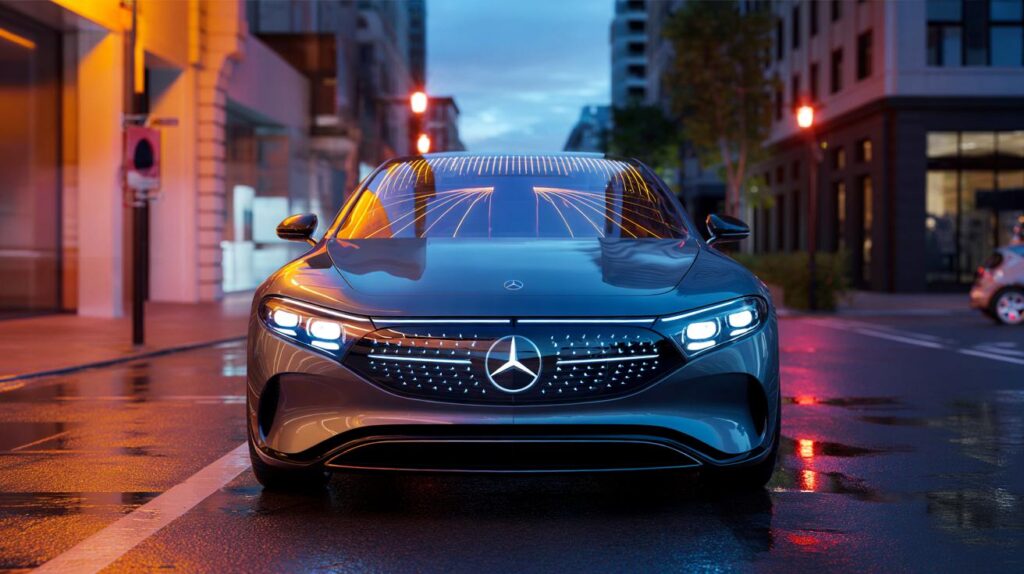
Screens keep swelling in new cars as designers chase theatre and tech. A bold move from Stuttgart now raises far bigger questions.
Leaked paperwork points to a plan that swaps old-fashioned glazing for a pillar-to-pillar television. Engineers pitch radical vision tech, regulators sharpen pencils, and drivers wonder what happens when rain, glare or software gremlins arrive.
What the documents claim
Internal briefings reviewed by industry sources describe a full-width LCD display replacing the front windscreen on future Mercedes models. The panel would show a live feed of the road ahead captured by a belt of cameras mounted around the nose, mirrors and roofline. The idea follows the brand’s steady march towards bigger dashboards, including a recent 39.1‑inch screen spanning much of the cabin in upcoming models.
Pillar-to-pillar pixels would stand in for laminated glass, with an ultra-bright, high‑refresh image showing the outside world in real time.
The proposal sketches extensive digital overlays. Drivers would see highlighted lane edges, speed limits, junction prompts and hazard markers. The same display would also host typical vehicle menus, with volume, climate and navigation controlled by voice and hand gestures to keep the surface clean.
How the system would work
Early technical notes describe an eight‑camera array with overlapping fields of view for redundancy. Each sensor would shoot high‑dynamic‑range video to manage shadows, headlights and low winter sun. Processing units behind the dashboard would stitch and stabilise the feed before it reaches the main panel.
- Brightness target: about 3,000 nits to remain readable in summer glare.
- Refresh rate: 120 Hz or higher to reduce motion blur at motorway speed.
- Latency: sub‑20 ms end‑to‑end to avoid a disorienting lag between reality and display.
- Camera cleaning: heated lenses and hydrophobic coatings to shed water and salt spray.
- Controls: natural‑language voice plus simple, repeatable hand gestures for common actions.
- Backup: a reduced‑power mode with minimal overlays if the main interface fails.
Engineers outline multiple failsafes. A separate power rail would keep the image alive during a 12‑volt outage. A second video pipeline would take over if the primary GPU crashes. A driver‑monitoring camera would dim overlays the moment eyes wander from the road image.
Everything hinges on low latency, eye‑safe brightness and graceful failure. If the picture drops, the car must still steer to safety.
Safety, legality and the rulebook
Road law was written for glass. UNECE Regulation 43 governs glazing in many markets. It demands shatter resistance, optical clarity and unobstructed view. UNECE Regulation 125 defines fields of vision from the driver’s seat. Replacing the windscreen with a display moves from direct to indirect vision, which current rules reserve for mirrors and camera systems. That gap raises a hard question: can a television legally become your windscreen?
Legal departments will try a narrow path. They may argue the display is an “indirect vision device” similar to camera mirrors allowed under UNECE R46, scaled up to the front. Type approval bodies will push back. They will test for flicker, image persistence, washout in sun, night-time halation, rain performance, and electromagnetic resilience. Insurers will ask about impact survivability and the cost of a cracked panel after a stone strike.
| Aspect | Conventional windscreen | Pillar‑to‑pillar LCD |
|---|---|---|
| Visibility in bright sun | Good with visor and coatings | Needs 3,000‑nit peak; risk of washout if under‑driven |
| Night glare | Controlled by glass and tint band | Tunable; risk of halation from camera bloom |
| Failure mode | Cracks but remains transparent | Black screen if power or panel fails |
| Maintenance | Wipers and washer fluid | Lens cleaning, firmware updates, cooling fans |
| Replacement cost | £300–£1,200 with sensors | Estimated £2,000–£4,500 plus calibration |
| Energy draw | Negligible | Roughly 150–300 W depending on brightness |
Why chase screens at all
Mercedes has leaned into digital interiors. Buyers respond to clean surfaces and rich graphics. Bigger panels make new features visible, such as augmented reality prompts and intelligent cruise control cues. They also enable software bundles and monthly services that help pay for the hardware. Component suppliers, from panel makers to chip designers, stand ready with brighter, tougher automotive displays. That supply makes a radical idea feel less distant.
The business case and the bill
A pillar‑to‑pillar LCD brings weight and cost. A panel spanning roughly 1.3 metres by 0.3 metres needs robust housing, laminated protective glass, and active cooling. Power draw climbs on hot days when the system must punch through glare. Engineers talk about shedding weight elsewhere by deleting wiper motors, washer tanks and sun visors. That offsets some mass, but the electronics still add complexity.
There is a revenue angle. A digital windscreen enables paid navigation layers, premium night vision and tailored driver profiles. The temptation to sell features will trigger scrutiny from consumer groups, who will demand clear rules on what remains available if you stop paying.
What drivers and safety groups are asking
Early reactions mix curiosity and doubt. Some drivers like the idea of night vision and fog‑piercing enhancement. Others worry about motion sickness and eye fatigue. Cyclists’ groups ask about low‑light performance and contrast when small lights approach at speed. Fleet managers focus on downtime after a cracked display and the price of recalibration.
- What happens in heavy rain when cameras are plastered with spray?
- Can the display dim fast enough when you exit a tunnel at noon?
- Does the car remain controllable with a partial image loss?
- How does the system handle smearing from oncoming LED headlights?
- Who pays if a software update degrades visibility?
No safety case will pass without a mechanical or visual contingency. Regulators tend to demand a path to a safe stop without perfect screens.
Timeline, trials and what to watch
Test mules on closed tracks are the likely next step. Engineers will log thousands of kilometres at dawn, noon and dusk to validate brightness and colour mapping. Cold‑weather work will attack lens icing and panel warm‑up. Hot‑weather cycles will measure image retention and thermal ageing. Any public pilot in 2026 would be small and closely monitored, probably with geofencing and strict conditions.
Until lawmakers sign off, production cars will keep glass. But suppliers now have the brightness, contrast and processing speed to make the idea technically plausible. The legal work, the failure analysis and the consumer trust piece will decide whether it reaches showrooms.
If you are tempted by a screen‑heavy car
Ask your dealer to show the display in direct midday sun and night rain. Check how fast menus vanish when you change focus. Confirm the warranty on panel burn‑in and dead pixels. Look for a physical control for demist and hazards, as these remain critical in an emergency. Ask what the car does if the main screen browns out at speed, and whether the navigation layer can be fully disabled while driving.
The rule of thumb is simple: the car must be driveable with the pixels off and the driver fully in charge.
Extra context for readers
“Nit” is the common unit for brightness; most smartphones peak around 1,500–2,500 nits, while bright outdoor billboards reach 3,000–5,000. A windscreen‑sized panel must hit the higher end to remain readable in summer glare. High refresh rates reduce blur when your eyes scan road texture at 70 mph, so 120 Hz is a sensible minimum. Variable refresh helps match camera output to the panel to cut artefacts.
You can run a quick home test. Stand outside at noon and compare your phone’s viewfinder with direct vision of the same scene. Notice the lag as you pan, the way bright clouds clip, and how shadows crush detail. Now imagine that as your only forward view at 30 mph in drizzle. That exercise clarifies why engineers obsess about HDR, low latency and robust de‑fogging for every lens.
There are potential upsides if hurdles fall. Augmented warnings could outline a dark‑clad pedestrian. Snow mode could boost contrast on rutted lanes. The system could mask oncoming headlight glare while preserving the rest of the scene. These are real benefits. The trade‑offs revolve around power use, repair cost, cyber security and the need for a proven escape route when the pixels misbehave.



If they can guarantee sub-20 ms latency and 3,000 nits, sign me up. Night vision + glare suppression could be a lifesaver. But please keep physical hazard/demist controls.
Black screen of death at 70 mph? Great, what could possibly go wrong 😅