
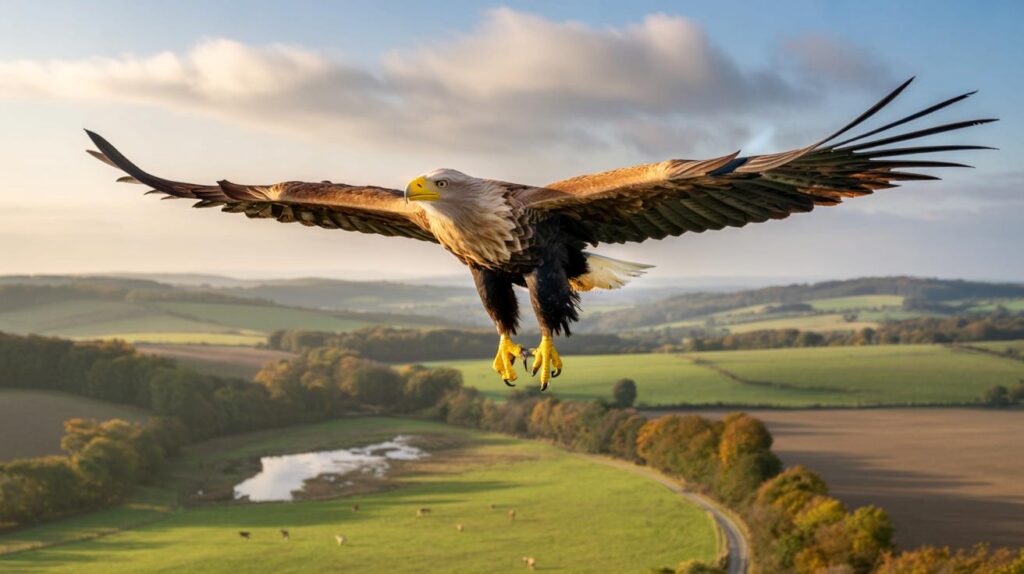
A quiet autumn afternoon turned heads across East Sussex as a vast, silent shape carved slow circles high above hedgerows.
By early evening, talk among walkers and farm workers near Robertsbridge centred on one thing: a huge bird with plank-like wings banking low over the fields. A local farmer, Will Hoad, watched it pass over his land at about 4pm on 22 September, sparking a rush of messages and photos as people checked whether they had glimpsed the same giant.
What witnesses reported
Hoad described a broad-winged raptor gliding purposefully over pasture, barely flapping as it surveyed ditches and ponds. The outline looked outsized against grazing cattle and hedgerow oaks. He suspects it travelled up the south coast from the Isle of Wight, where young sea eagles have been released since 2019.
Spotted around 4pm over farmland near Robertsbridge, the bird’s wings stretched to a span comparable to a small family car.
Several residents remarked on the slow, heavy wingbeats and the way it held its wings straight, not in a shallow V like a red kite. Others noted the short, wedge-like tail. A few minutes later it was gone, slipping west along the valley.
Why this matters for East Sussex
White-tailed eagles — also known as sea eagles — are Britain’s largest birds of prey, with a wingspan reaching 2.5 metres (8.2 feet). They vanished from England in the late eighteenth century after decades of persecution. The last English breeding pair raised young on Culver Cliff, Isle of Wight, in 1780.
In 2019, six juvenile eagles were released on the Isle of Wight, the first step in a five‑year programme led by Forestry England and the Roy Dennis Wildlife Foundation to restore the species to southern England after roughly 240 years away. Since then, satellite‑tagged birds have ranged widely, with regular forays across the Solent and along the south coast, testing estuaries, reservoirs and farmland for feeding opportunities.
The return of sea eagles to southern skies signals a rare conservation comeback built on careful releases and patient monitoring.
Scotland now supports more than one hundred breeding pairs, while in England the reintroduction is still at an early stage. As immature birds wander, occasional sightings in Sussex, Kent and Hampshire have become part of a new seasonal pattern.
How to recognise a white-tailed eagle
Scale and shape bring the quickest clues. Think barn-door wings, held broad and flat, and a short, blunt tail. Adults show a pale head and gleaming white tail; immature birds are more mottled overall, with a brown tail that whitens as they age. Their flight is powerful but unhurried, with deep, measured wingbeats between long glides.
| Feature | Value |
|---|---|
| Wingspan | Up to 2.5 m (8.2 ft) |
| Weight | Typically 3.5–6.5 kg |
| Diet | Fish, ducks and other waterbirds, rabbits and hares, carrion |
| Nesting | Cliff ledges or large trees, used repeatedly over many years |
| Pairing | Long-term pair bonds with strong site fidelity |
What they eat and how they hunt
Sea eagles specialise in fish, often drifting along coasts or lakes before dropping talons-first to lift prey from the surface. They will take waterfowl and scavenge carcasses on shorelines and fields, especially in colder months. That flexibility helps them exploit estuaries, reservoirs and lowland river valleys — exactly the habitats dotted across East Sussex.
Expect a low, purposeful glide along rivers and lakes, a sudden drop, and a powerful climb with prey clutched in yellow talons.
Could this bird have come from the Isle of Wight?
It’s a strong possibility. Juvenile and sub‑adult white-tailed eagles regularly roam long distances in their first years, criss‑crossing the south coast while learning the landscape. The journey from the Isle of Wight to the High Weald is well within a day’s flight for a bird built for soaring on thermals and sea breezes. Early autumn often prompts fresh movement as young birds fan out in search of rich feeding grounds and safe night roosts.
Local geography lines up too. The Robertsbridge area sits within easy reach of the River Rother and its tributaries, and not far from fish-rich waters such as Bewl Water. On warm afternoons, rising air over ploughed fields can carry a huge eagle for miles with barely a flick of its wings.
How to be sure it wasn’t a buzzard or a red kite
- Size: a white-tailed eagle dwarfs buzzards; if it looks improbably large, it probably is.
- Tail: short and wedge-shaped on sea eagles; long and forked on red kites.
- Wing shape: broad, rectangular “planks” on sea eagles; narrower, more angular wings on kites and buzzards.
- Flight style: long glides and few, deep wingbeats; buzzards flap more and circle tighter.
- Habitat: often near large water bodies, coastal flats or wide river valleys.
What to do if you see one
- Keep your distance and let the bird feed or rest undisturbed; use binoculars or a long lens.
- Note the time, exact location, direction of flight and behaviour; this helps build a picture of its movements.
- Avoid posting precise nest sites on social media; sea eagles are protected under the Wildlife and Countryside Act 1981.
- On farmland, keep dogs close around livestock and ground‑nesting birds.
- Never bait or approach birds to stage photographs.
What this means for farmers, walkers and anglers
Concerns about livestock predation surface whenever sea eagles appear inland. Evidence from Scotland shows they mainly target fish and wild birds and will take carrion, which can help tidy landscapes after storms or lambing losses. Healthy lambs are rarely at risk; vigilance around birthing time remains wise for any large scavenger or predator in the area.
Walkers can enjoy memorable views with simple care: stick to paths near nesting woods in spring, give perched birds a wide berth, and avoid flushing flocks of waterfowl. For anglers and birders, the best chance often comes at first light or late afternoon, when eagles patrol shorelines and reservoir margins for an easy meal.
Additional context to deepen your understanding
Two behaviours matter for interpreting sightings. First, “dispersal”: after fledging, young eagles may wander hundreds of kilometres before settling, sampling coastlines and inland lakes in search of reliable food. A September report over Robertsbridge fits that pattern. Second, “site fidelity”: once a pair forms, they tend to return to the same nest area year after year, either on a cliff ledge or in a mature tree. That loyalty is why quiet, undisturbed locations matter so much as this southern population grows.
For anyone keeping a local notebook, try an informal watch plan. Scan wide skies over the Rother valley, the marshes towards Rye, and big waters such as Bewl Water during calm, bright spells. Note wind direction, cloud cover and whether the bird was carrying prey. Over time, those small details reveal where a sea eagle can refuel and rest — and whether East Sussex is becoming part of its regular circuit.



Pretty sure I saw it from the footpath north of Robertsbridge at around 4.05pm — huge, flat “barn‑door” wings and a short, wedgey tail. It barely flapped, just cruised over the pasture and spooked the crows. At first I thought red kite, but the wings were dead straight, not V‑shaped, and the size was honestly ridiculous, like a glider. Definately white‑tailed eagle in my book. Anyone else catch photos from the Rother bridge?
Not convinced. Evening light plays tricks; big buzzards can look enormous. Did anyone get a cleer shot of the tail to be sure?