
A whisper-thin chip, smart glasses and patient training are reshaping how older people live with central vision loss across Europe.
An international team now reports early but striking gains after fitting an electronic retinal implant to people with advanced age-related macular degeneration. The findings, published in the New England Journal of Medicine, suggest a new route back to reading and recognising shapes when standard care has run out of options.
What the trial found
Researchers enrolled 38 people with severe central vision loss due to dry age-related macular degeneration (AMD). The average participant was 79 years old. Surgeons at 17 centres across five European countries placed a tiny, light-sensitive implant under the retina in one eye. One year later, 80 percent achieved what clinicians class as a “clinically meaningful” improvement in vision.
In a 38-person study of advanced dry AMD, 8 in 10 improved vision one year after a subretinal electronic implant.
AMD affects an estimated 200 million people worldwide, most of them over 50. The condition gradually damages photoreceptors in the macula, the part of the retina responsible for sharp central vision. The study focused on dry AMD, the more common form, because many patients still retain some retinal cells that can pass on signals if stimulated.
Participants did not walk out of theatre reading fine print. They completed months of structured rehabilitation. Therapists taught them how to interpret the new electrical signals and combine them with residual vision. Several regained usable reading ability using large print and controlled lighting.
How the bionic vision system works
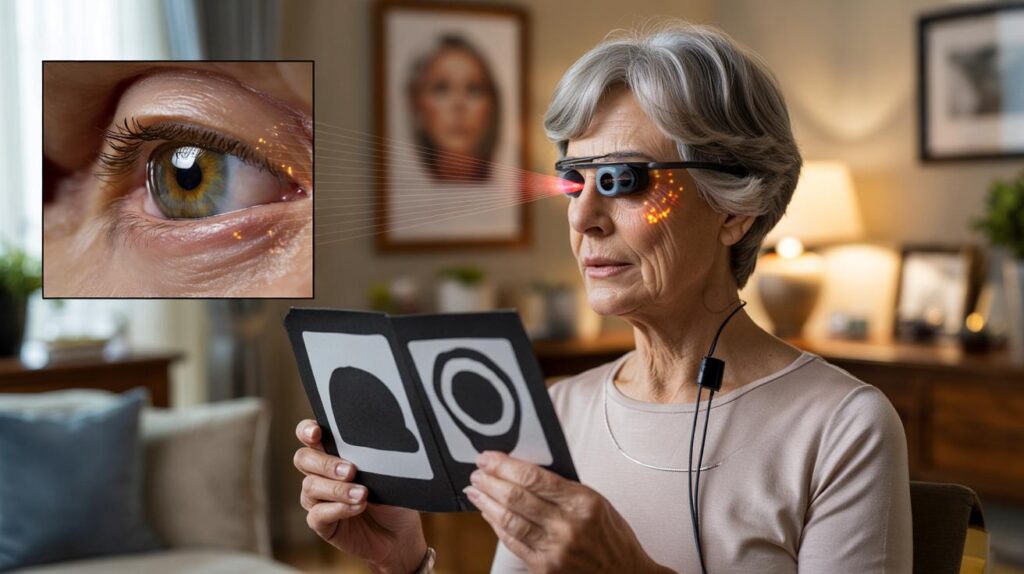
The system marries an ultra-thin implant with wearable gear:
- Implant: a subretinal microelectronic chip about half the thickness of a human hair.
- Glasses: a camera embedded in augmented reality frames captures the scene.
- Processor: a small waist-worn computer converts images into infrared patterns.
- Projection: the glasses project those patterns onto the implant as infrared light.
- Neural encoding: on-board electronics convert light into electrical signals that activate surviving retinal cells.
The camera sees, the computer encodes, the implant stimulates, the brain learns to see again.
The signals reach the brain via the optic nerve, much as natural sight does. Early users reported monochrome vision, reminiscent of high-contrast black-and-white images. Engineers plan software updates to enrich grey scales. The team aims to support face recognition, which matters for social connection and independence.
What patients could and could not do
Performance varied. Many detected door frames, tablet icons and printed words at large font sizes. Some navigated unfamiliar rooms more confidently. Others described better object localisation and improved light perception. The system did not restore normal colour vision. Fine detail remained limited by the current resolution of the implant and by the health of remaining retinal tissue.
Full 20/20 vision is not the target today; clearing the legal blindness threshold and restoring daily tasks is.
Investigators said they are testing ways to boost resolution and refine image processing. Laboratory work in animals suggests room for improvement in pixel density and power management. Future software may prioritise faces and text, delivering adaptive contrast that fits low-vision needs.
Caveats and questions
Enthusiasm met healthy scepticism. The study did not include a randomised placebo group with sham surgery. Participants also received intensive training and attention, which can lift performance in visual tasks. Independent specialists said a larger, controlled trial would strengthen the case for routine use.
Safety always matters with eye surgery. The report did not claim perfect outcomes. Any subretinal operation brings risks such as infection, inflammation, retinal detachment or device failure. Centres with experienced vitreoretinal surgeons can mitigate many complications, but patients still need careful screening and follow-up.
Cost, access and equity sit close behind. A system that requires surgery, advanced imaging, bespoke glasses, a wearable processor and months of rehabilitation will test public and private payers. Health services will ask whether the gains justify the outlay for people with profound vision loss. Regulators will examine durability, real-world performance and training requirements.
Why this matters to you
AMD risk rises with age, and families often face it together. Knowing the numbers helps you plan care and monitor vision changes.
Key numbers at a glance
- Global burden: about 200 million people live with AMD.
- Age pattern: roughly 2 percent of 40–44-year-olds have AMD.
- Late life: about 42 percent of people in their late eighties and 60 percent in their late nineties are affected.
- Trial snapshot: 38 participants, five countries, 17 surgical sites, mean age 79, 80 percent improved at one year.
Who might qualify when such devices reach clinics
Candidates are likely to include people with advanced dry AMD affecting central vision in one or both eyes, with enough residual retinal cells to carry signals. Motivation matters because rehabilitation takes time and effort. Cognitive health, hand–eye coordination and the ability to attend frequent follow-up visits also weigh in the balance.
How the implant fits into AMD care today
Current options differ by AMD type. Wet AMD, caused by abnormal blood vessels, often responds to anti-VEGF injections, which can slow or halt acute damage. Dry AMD lacks a widely effective sight-restoring treatment. Lifestyle changes, nutritional supplements based on AREDS2 formulations and low-vision aids help many, but central vision often continues to fade. The implant targets that gap with an assistive, neuroprosthetic approach rather than a biological cure.
| AMD type | Main issue | Typical care | Where the implant may fit |
|---|---|---|---|
| Dry AMD | Loss of photoreceptors in the macula | Monitoring, AREDS2 supplements, low-vision rehabilitation | Potential option for advanced central loss with remaining retinal cells |
| Wet AMD | Leaky, abnormal vessels under the retina | Anti-VEGF injections, imaging-guided follow-up | Not the target of this study |
What to ask your eye care team
- Do I have dry or wet AMD, and how advanced is it?
- Would low-vision rehabilitation improve my reading and mobility now?
- Are there clinical trials nearby for AMD implants or vision restoration devices?
- How might lighting, contrast and magnification tools complement any future implant?
- What training commitment would a device like this require from me and my family?
What comes next
Researchers plan larger studies with clearer comparison groups. Engineers will push for higher resolution, better power efficiency and smarter image processing aimed at faces and text. Clinicians will refine surgical techniques and postoperative care pathways. Training programmes will need scale-up, possibly with home-based modules and remote coaching.
Health systems will ask big practical questions. How long does the implant last? Can software updates extend performance without new surgery? Will people use the glasses and processor all day, or only for reading and navigation? How will services support users who face arthritis, dementia or hearing loss as well as poor sight?
Data and privacy deserve attention. The camera and processor capture the world continuously. Clear policies must set limits on storage and sharing. People need simple controls to pause capture when they want privacy.
For now, the case for hope looks grounded. An implant thinner than a hair, paired with everyday wearable tech and patient grit, has moved a group of older adults from profound central darkness to functional sight. The next trials will show how far this approach can carry people back into print, faces and public space.



This is the first AMD story that feels like real progress. 8/10 gaining “clinically meaningful” vision after a year is huge. Kudos to the team and to the patients who did the tough rehab.
No randomized or sham-surgery control? That makes it hard to separate training/placebo effects from the implant. When is a controlled trial starting, and what will the primary endpoints be—reading speed, mobility, face recognition?