
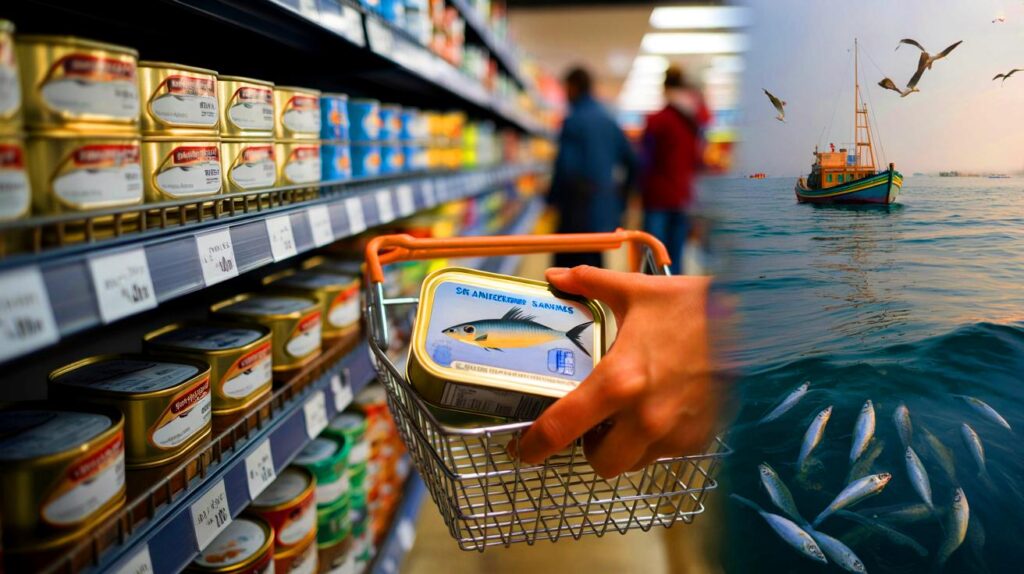
This autumn brings lighter baskets and heavier bills, as familiar pantry staples make surprise exits from supermarket shelves nationwide.
Shoppers across France have started clocking gaps where budget sardines once stood, with price stickers creeping upward and value lines missing. What looks like a simple stock hiccup hides a far bigger story that stretches from Moroccan ports to the Bay of Biscay, and from household budgets to ocean physics.
Why the cheap tins are missing
The value tier has taken the first hit because it leans on the most fragile part of the supply chain. For years, private-label sardines relied on massive volumes from Morocco, where labour costs sat far below western Europe and canneries kept prices down. That model worked while the fish kept coming and waters stayed stable. Neither has held.
French households bought roughly 16,000 tonnes of tinned sardines at an average of about €11 per kilogram (around £9.50/kg), according to fisheries data. That volume makes the category sensitive to any squeeze at the source. Turn down the tap, and the cheapest tins disappear first.
Value sardines depend on high-volume, low-cost landings. When the catches drop, the budget shelf empties before the premium one.
Morocco’s boom turned to squeeze
Over two decades, Morocco overtook traditional European processors on price and scale. The country’s coastal fleet expanded fast, canneries ran hot, and low-cost tins flooded French aisles. Then catches began to slide. Official figures point to a stark fall: from about 950,000 tonnes in 2022 to around 525,000 tonnes in 2024. That is a near-halving in two seasons.
| Year | Morocco sardine landings | Change |
|---|---|---|
| 2022 | ~950,000 tonnes | Baseline |
| 2024 | ~525,000 tonnes | -46% |
Less fish forces factories to ration labels and markets. Export contracts get trimmed. Retailers outside Morocco feel it as missing pallets, late deliveries and fewer promo runs. Shelf prices then rise to reflect tighter supply and higher raw-fish bids.
In two years, Moroccan sardine landings fell by roughly 425,000 tonnes — a loss larger than total annual consumption in several EU markets combined.
Warmer seas mean smaller fish
The climate signal pushes in the same direction. Sardines feed on plankton, which shifts with warmer water and altered currents. When the base of the food web changes, sardines grow more slowly, mature earlier and produce fewer, smaller offspring.
Recent observations are blunt. In the Atlantic, the average sardine length has slid from about 17 centimetres to roughly 14. In the Mediterranean, from about 15 to near 11. Average weights have about halved. Life expectancy, once up to a decade in favourable conditions, now often hovers around a single year. Smaller fish mean fewer canning-grade specimens and less flesh per tin, which magnifies price pressures along the line.
France’s coastal stocks under strain
Closer to home, the Bay of Biscay has seen its sardine population shrink to roughly a third of levels reported two decades ago. Scientists classify the status as degraded, and skippers report harder fishing for canning sizes. Traditional processors around Marseille and on the Atlantic coast have slowed shifts at times, protecting raw material and margins rather than pushing volume at any cost.
All that reaches the consumer as thinner aisles, pricier tins and fewer value labels. The mid-range and premium jars hold on longer because they draw on broader sourcing, maintain tighter supplier ties and accept higher fish prices. The cheapest packs lack that cushion.
What this means for your weekly shop
Price rises do not come from a single lever. Think of five moving parts hitting at once: fewer Moroccan landings, smaller fish in multiple basins, higher bids for canning-grade sardines, logistics costs that never fully fell back to pre-pandemic levels, and retailers trimming deep discounts to protect availability. If you buy value sardines for the protein hit and long shelf life, you will feel each of those pressures at the till.
- Expect fewer promotions on entry-level tins through autumn and winter.
- Watch multipacks: some keep the ticket price but cut pack size or fish weight per tin.
- Check origin labels: Morocco dominates, but Iberian or French lots may appear at higher prices.
- Compare proteins by edible weight: mackerel, sprats and tuna spreads may offer better value per gram.
How retailers and canneries are adapting
Retailers are diversifying sources where contracts allow, tapping Spain and Portugal for short runs. Canneries are reformulating brines and oil fills to stabilise costs while meeting taste expectations. Some value lines pause rather than ship erratic quality. Private-label buyers are negotiating longer commitments with fleets that can deliver mixed sizes, accepting higher raw-fish prices to keep shelves active.
On the water, fisheries managers face a tightrope. Open quotas boost short-term landings but add long-term risk, especially when small cohorts dominate. Stricter limits can rebuild biomass, yet they tighten the retail pipeline for months. Either way, shoppers feel the lag between decisions at sea and tins on shelves.
Will prices ease soon
Two conditions need to align: stronger cohorts of canning-size sardines and consistent landings from main supplying fleets, especially in Morocco. A cooler upwelling season can help plankton blooms and juvenile growth, but those gains take time to show in factories. If catches stabilise through late 2025, retailers could restore basic ranges in early 2026, with prices settling above last year’s but below today’s spikes.
What you can swap in tonight
Budget-minded cooks can protect the weekly shop without losing the quick-meal convenience of a tin. Mackerel in oil remains abundant and rich in omega‑3s. Herring and sprats carry a similar flavour profile to sardines and often undercut them on price. Mussels and squid in brine bring protein at competitive costs and pair well with pasta or rice.
For a like-for-like swap in classic recipes:
- Toast topper: replace sardines with smoked sprats; add lemon and parsley to lift the briny notes.
- Salad bowl: use mackerel flakes with white beans, red onion and sherry vinegar.
- Pasta night: herring in tomato sauce stands in for sardines; finish with capers and chilli.
A quick bill check for families
Picture a family buying four 120 g tins per week. At €1.30 per tin last year, that was about €5.20 weekly. At €1.70 today, the same basket hits €6.80. Over 52 weeks, the difference is roughly €83. If two of those tins switch to mackerel at €1.35, the weekly spend drops to about €6.10, saving around €36 across a year while keeping two sardine nights.
What to watch through the season
Keep an eye on three markers that signal where prices may head next:
- Moroccan monthly landings: a steady climb into winter would ease pressure on import prices.
- Size grades in shops: more “small” labels mean yields per tin are tight.
- Private-label shelf space: the return of value packs usually precedes broader price softening.
For curious readers, the biology behind the label matters. Sardines bunch near nutrient-rich upwellings. When wind patterns or water temperatures shift, plankton communities change, and sardines either move or shrink. That is why the same tin on your shelf can depend on winds along the Moroccan coast or temperature bands in the Bay of Biscay months earlier. Understanding this chain helps make sense of a €0.40 jump on a midweek staple.



€0.40 more a tin and fewer promos—yep, noticed that.
Are supermakets using the 46% drop as cover to pad margins? Could you show gross margin and promo-depth trends 2022–2024, plus factory-gate fish price indices, to validate the pass‑through? Otherwise this feels a bit one‑sided.