
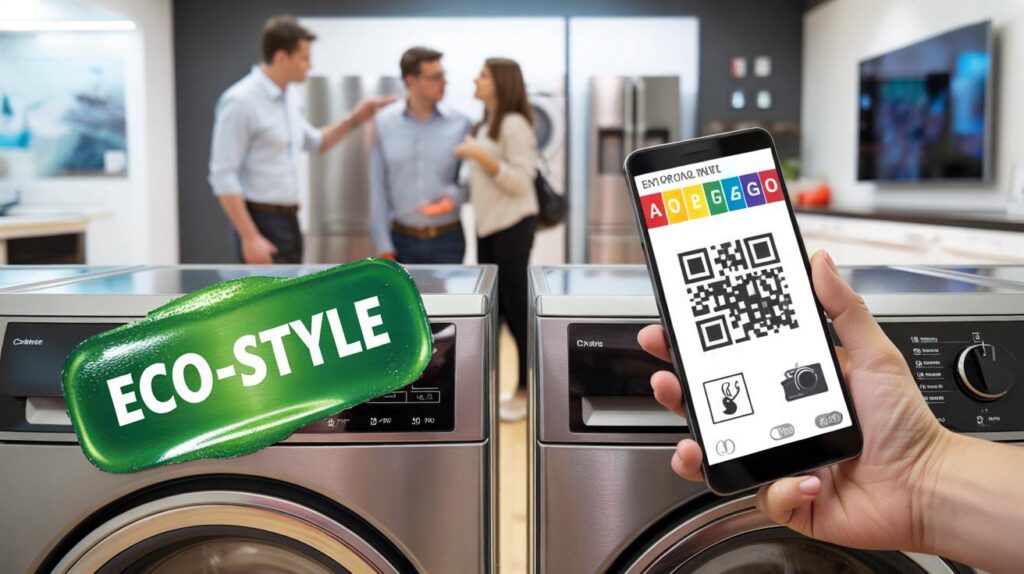
That green A+++ sticker used to feel like a forcefield against high bills. Today it’s a maze. Shops mix old labels with new letters, sales tags shout “super eco,” and your real-life usage rarely matches a lab’s tidy script. The result: people overpay or underperform, thinking the label will carry them home. It won’t. Here’s the uncomfortable truth hiding in plain sight.
I watched a couple in a London appliance aisle, whispering over two dishwashers. One wore the proud A+++, the other a modest C. The A+++ had a glossy badge and a too-good-to-be-true discount; the C looked like it had apologised for existing. A salesman hovered, pointing at the letters like they were destiny.
They didn’t know that the alphabet changed in 2021. That the quiet “C” might actually sip less power than the “A+++” in their everyday routine. That the little QR code on the newer label can tell you more than a neon sticker ever will. The label isn’t the whole story.
The label that outgrew itself
Energy labels had a grade inflation problem. Over the years, many appliances crept up to A+, A++, A+++ until the top of the scale was crowded and meaningless. Europe and the UK rescaled from A to G in 2021 for fridges/freezers, washing machines, dishwashers and displays. Most genuinely efficient products suddenly sat in B, C or D. It wasn’t a step backwards. It was a clean slate.
Yet you’ll still see A+++ shouted in marketing, on old stock, or on comparison charts mixing eras. That’s where confusion bites. A 2019 A+++ fridge might use 260 kWh a year. A 2024 “C” fridge of similar size might use 170–190 kWh. At 25–35p per kWh, that gap is £17–£31 a year. Over a decade, it adds up more than the letter suggests.
Rescaling also tightened test methods. Washing machines now declare kWh per 100 cycles on the Eco 40–60 programme, with partial-load testing that reflects smaller households. Displays carry separate values for SDR and HDR. Noise is shown with a letter as well as decibels. The point is simple: you cannot compare old A+++ to new A–G at a glance. Different yardsticks. Different ladders.
From lab tests to your kitchen
Start by reading the small numbers, not the big letter. Annual kWh for fridges and freezers, kWh per 100 cycles for washers, kWh per 1,000 hours for TVs. Look at water per cycle, the Eco programme duration, and the noise class. If there’s a QR code on the label, scan it. **Scan the QR code.** It can open the official database entry (EU’s EPREL) with the test assumptions and exact model data.
Real life rarely matches the lab. Quick-wash cycles often burn more energy and water than Eco. Overloading a dryer makes it run longer, underloading a dishwasher wastes heat on air. Wi‑Fi “smart” modes can sit there sipping a watt or two all night. We’ve all had that moment when we promise to clean the filters monthly… then forget for a season. Let’s be honest: nobody actually does that every day.
Think about size and routines before you fall for the letter. A huge “efficient” fridge that’s half-empty wastes cold space; a compact model you open 40 times a day can also overspend. *Labels are guides, not gospel.*
“The class tells you how a product performed in a defined test. Your bill tells you how it lives in your home.”
- Compare absolute kWh between models of similar size.
- Check Eco programme length; long can be cheaper, short can be costly.
- Right-size capacity to your household and habits.
- Look for spare parts availability and a long warranty.
- Turn off network standby you don’t use.
A smarter way to choose appliances now
If you’re replacing an appliance, skip the letter chase. Compare the annual or per‑cycle kWh, side by side, for models with similar capacity. Normalise when you can: kWh per litre for fridges; kWh per cycle per kilogram for washers. Factor in noise, water, and the cycle lengths you’ll actually use. **Compare kWh, not just the letter.**
Then zoom out. Durability and repairability aren’t on the front of the label, yet they shape the true footprint and your wallet. Ask about spare parts for ten years, motor type (brushless tends to last), and real warranties, not just “parts only”. Heat‑pump dryers often save dramatically in flats where venting is tricky. For TVs, a smaller, brighter‑at‑lower‑settings screen can beat a hulking panel on yearly kWh. **A+++ is not a guarantee.** It’s a snapshot from a lab. Your home writes the end of the story.
Resisting the siren song of a green badge takes a minute of quiet comparison. But once you know to chase the numbers behind the letter, you start to see the pattern. A fridge that sips 180 kWh a year will always beat one gulping 260, no matter how they dress on the shelf. A washing machine that genuinely cleans at 30 °C on Eco will save more than the one you keep bumping to “Quick” out of habit.
Buying better isn’t about perfection. It’s about removing the blindfold. Ask the right question — how many kilowatt-hours will this use for me? — and a simple, boring truth falls into place. The label is a clue. Your usage is the verdict.
| Key points | Details | Interest for reader |
|---|---|---|
| Old A+++ vs new A–G can’t be compared | 2021 rescale changed tests and emptied top classes; many “C” models beat old A+++ | Avoid buying on a misleading badge and save over the product’s life |
| Read absolute kWh and water, not just letters | Check kWh/year or kWh/100 cycles, Eco duration, noise, and QR‑code data | Pick the model that truly cuts your bills at home |
| Right-size and use features well | Match capacity to household, use Eco, manage standby, maintain filters | Turn label promises into real‑world savings |
FAQ :
- Is A+++ still valid anywhere?For many categories in the EU and UK, A+++ was replaced by A–G from 2021. You may still see A+++ on older stock, other product groups not yet rescaled, or in non‑EU markets.
- Can I compare an old A+++ to a new C?Not by the letter. Compare absolute energy figures: kWh/year for fridges, kWh/100 cycles for washers, etc. Normalise for size where possible.
- Why is the Eco cycle so long?Eco uses lower temperatures and longer run times to reduce energy. It often saves power and water overall, even though it takes more time.
- Does standby really matter?One or two watts 24/7 adds 9–18 kWh a year per device. A few “always‑on” appliances can silently add £10–£40 to annual bills.
- What upgrade saves the most energy?Fridge/freezer and tumble dryer replacements often deliver big wins, especially moving to a modern heat‑pump dryer and a low‑kWh fridge of the right size.



So a “C” can beat an old A+++? Feels like marketing whiplash. How do we stop retailers mixing labels from different eras?
The alphabet changed and nobody told my fridge. It’s still bragging about A+++ like it’s 2016. Guess I’ve been buyng letters, not kWh.