
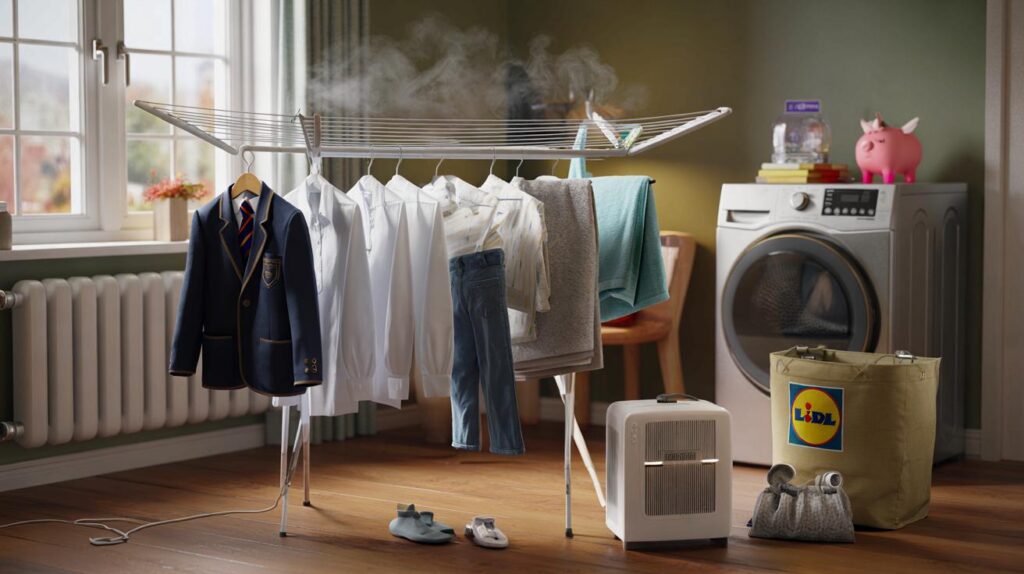
Autumn’s damp returns, radiators groan and washing piles up. Households face a prickly choice between space, time and cost. The stakes feel domestic yet real.
With windows misting and school uniforms on rotation, many homes need a smarter drying plan. A powered clothes airer now sits in the spotlight, promising lower bills and kinder treatment of fabrics than a frantic tumble-dry cycle.
What a heated airer adds to a busy home
The concept is simple. Take a standard folding airer, add low-watt heat across the rails, and speed up evaporation without blasting garments. That means fewer hours draped over radiators and less disruption in shared spaces. It folds flat when finished, then slips behind a door or under the stairs. You plug in, position the rails, and let the gentle warmth do its work.
Lidl’s current offer centres on the Minky 12m Heated Airer. It brings 12 metres of hanging space and a rated capacity of up to 16kg of wet laundry. In practice, that covers two average loads, provided you spread items out and avoid clumping heavy pieces. Five rails sit on each wing, with eight longer rails across the middle, so shirts, jeans and smalls all find a sensible perch.
Headline numbers: £39.99 shelf price at Lidl, around 8p per hour to run, up to 16kg of wet laundry across 12m of rails.
Lidl’s price play and the numbers behind it
The price tag is the immediate draw. At £39.99, Lidl undercuts the same model listed elsewhere at £59.99. For households edging towards a tumble dryer purchase, the saving at checkout matters before you even switch it on. Then comes the running cost.
Minky estimates roughly 8p an hour to run. That figure assumes a typical unit price for electricity and suggests a power draw of about 300W. If your tariff sits higher or lower, the hourly cost shifts with it. Even so, you’re dealing with pennies per hour rather than pounds per cycle.
Radiators, tumble dryers and the heated airer: how they stack up
Drying on radiators costs more than you think. You force your boiler to run hotter and longer, you hamper room heat circulation, and you risk condensation. Tumble dryers deliver speed but can chew through energy and wear fabrics faster, especially with cottons that shrink or wool that felts when mistreated.
A heated airer slots in between. It trades peak speed for thrift and fabric care. You’ll still want airflow in the room, but the focused warmth lifts moisture steadily without cooking delicate fibres.
| Method | Typical running cost | Time per load | Fabric care | Notes |
|---|---|---|---|---|
| Heated airer (c.300W) | ≈ 8p/hour | 3–6 hours, garment dependent | Gentle on delicates | Works best with space between items and some ventilation |
| Tumble dryer (vented/condenser) | ≈ £1.50 per cycle | 60–120 minutes | Can be tough on fibres | Fast but energy-hungry; risk of shrinkage if overheated |
| Heat pump dryer | ≈ 65p per cycle | 90–180 minutes | Kinder than standard dryers | Lower energy use; higher purchase price |
| Radiators only | Hidden boiler cost | Unpredictable | Varies | Blocks heat output; can drive condensation and damp |
How to calculate your real running cost
You can estimate your own hourly cost in under a minute. Take the airer’s approximate power draw, divide by 1000 to convert to kW, then multiply by your unit rate.
- Assumed draw: 300W → 0.3 kW
- Unit rate example: 24p per kWh
- Hourly cost: 0.3 × £0.24 = 7.2p per hour
If your tariff is 30p per kWh, expect about 9p per hour. That puts a four-hour session at roughly 29p–36p. Against a £1.50 dryer cycle, the difference mounts quickly.
A week in the life: what families could save
Consider two average loads on a Sunday and two midweek top-ups. Four loads either go through a dryer at £1.50 each (£6 total) or spend five hours each on the heated airer at 8p per hour. That’s 20 hours on the rails, costing about £1.60. Weekly difference: roughly £4.40. Over 40 busy weeks, that’s about £176 back in your pocket. If you currently own no dryer and lean on radiators, you cut the moisture burden at home while still spending pennies per hour.
Swap four weekly dryer cycles for airer sessions and you could trim around £150–£200 a year, depending on your tariff and habits.
Practical tips to speed drying without stress
- Use a high spin on the washing machine, ideally 1200–1400rpm, to start with less water.
- Give each item breathing room. Overlapping sleeves slows evaporation.
- Hang shirts and dresses on hangers across the middle rails to maximise airflow.
- Flip heavy items after two hours to even out drying.
- Crack a window or run a small dehumidifier nearby to reduce humidity.
- Lay wool and knitwear flat on a towel across the wings to maintain shape.
- Keep cords tidy and the unit stable, especially around children and pets.
Fabric care: why gentle heat matters
Repeated tumble cycles can stress elastics, pucker seams and fade prints. A heated airer uses a lower, steadier temperature that helps wool, silk and technical fabrics hold their shape. Sportswear with elastane benefits from slower drying. Towels need more time but come off softer if you finish them on the rails rather than cooking them dry.
Where Lidl’s offer stands today
The price at Lidl sits at £39.99. Similar listings elsewhere show £59.99 for what appears to be the same model. That £20 gap buys a stack of extra drying hours before you even count ongoing savings. Stock in the middle aisle often shifts fast, so local availability can vary by store and week. If you plan to rely on it through the colder months, consider picking up spare hangers and a compact laundry basket to streamline the flow from machine to rails.
The condensation question
Any indoor drying puts moisture into the air. The heated airer limits drying time, which helps, but you still need a plan. A cracked window, trickle vents, or a small dehumidifier nearby will protect walls and ceilings. If you see persistent condensation on windows, move the airer to a room with ventilation or run short bursts of extraction after showers and cooking.
Is this the right fit for your home?
If speed tops your list and you have space for a dryer, a heat pump model remains the low-energy route in the tumble camp. If you want low running costs, kinder treatment of fabrics and a compact footprint under £40, Lidl’s Minky 12m Heated Airer makes a strong case. It carries up to 16kg of wet clothes over 12m of rails and drinks pennies per hour, not pounds per cycle.
Extra notes for savvy savers
Night-time tariffs and smart plugs can sharpen savings. If you’re on a time-of-use plan with cheaper off-peak electricity, set the airer to run during those windows. A simple energy monitor plug will show your actual watt draw and confirm the pennies per hour for your home. If you pair the airer with a small dehumidifier, choose a model with low standby and an auto-off water tank to avoid wasted power.
For households battling tight turnarounds—school kits, sports kits, office shirts—consider a hybrid routine. Spin hard, hang on the heated airer for two to three hours, then finish a few urgent items in a short, cool tumble if needed. You’ll keep bills tame while hitting deadlines. And when spring returns, the airer still works unpowered as a standard rack, so it earns its keep year-round.



£39.99 nationwide or middle-aisle lottery?