
A farm holiday with your dog sounds idyllic — fresh air, open fields, slow mornings. Yet working land has rules, rhythms and risks that don’t pause for weekend guests. Here’s the real-world guide UK pet owners wish they’d had before the first excited tail wag at a pasture gate.
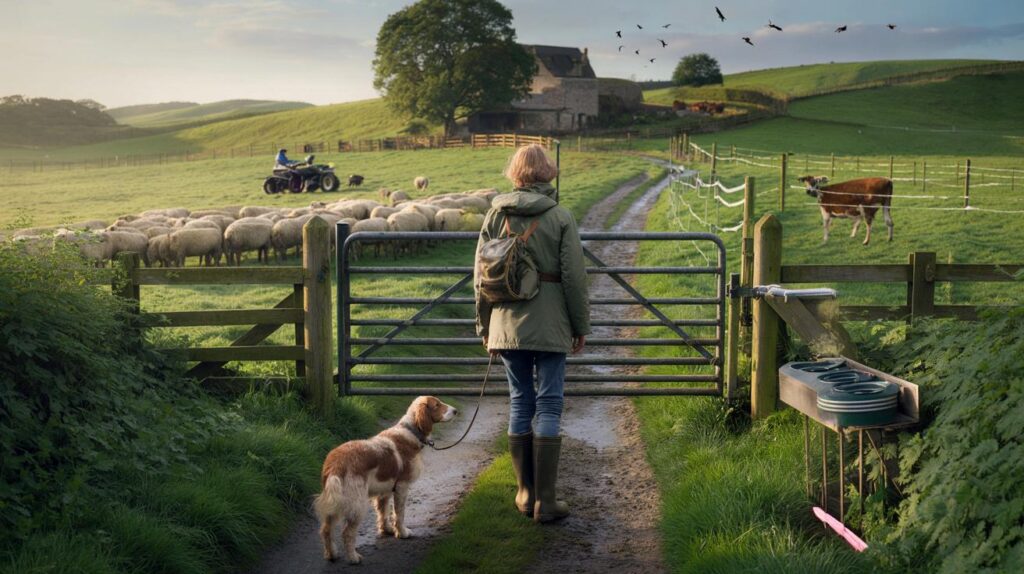
I arrive at dawn with a coffee that’s already gone cold, my spaniel panting fog onto the window as the farmyard yawns into life. Swallows skim the barn roof, a quad bike coughs into gear, and a line of ewes melt across a field like drifting cloud. My dog strains, sniffing a story in every hoofprint.
The owner appears with a cheerful wave and a firm glance at the lead, and the pace of the place becomes clear. This is not a park. It hums. You can feel the land working around you. A few minutes later we’re on a public footpath, nettles brushing, a stile ahead, silence behind us.
Then the gate clicked.
The countryside dream meets real working land
Farms look wide open to us, and even wider to a dog whose nose maps the world. Big views invite big zoomies. Sheep smell like playmates, cow pats like treasure, and that crackle of turf under an electric fence has a tug all of its own. It’s tempting to let the lead slip a little because the lane looks empty and the hills look kind.
We’ve all had that moment when the path feels safe, the dog trots sweetly, and you forget there might be a bull with cows over the hedge. Then a sheep lifts its head and your dog lifts its speed. NFU Mutual reported that dog attacks on livestock cost farmers several million pounds in 2023, a sum that hides the heartbreak of dead lambs, stressed ewes and long nights. One chase is all it takes to harm animals and livelihoods.
Here’s the blunt bit. **Dogs and livestock do not mix.** It’s not about your dog being “friendly” or “never doing that”. Livestock are prey animals, and the very act of chasing is a kind of attack. UK law under the Dogs (Protection of Livestock) Act 1953 treats “worrying” — chasing, barking at or attacking — as an offence. Farmers are allowed to protect animals, including using force as a last resort if a dog is actively worrying their stock. The rural code isn’t optional theatre; it’s how people and animals stay safe.
Leads, paths, poo and calm heads
Use a short lead near livestock and during nesting season (1 March–31 July) on access land — think no longer than 2 metres. A long line is brilliant for recall practice in open fields with no stock, but it’s not a free pass: scan for sheep, calves and horses before you even unclip. At stiles, clip on, pass the dog over or under, then cross yourself. Leave gates as you find them. Stick to marked rights of way rather than cutting corners across pasture.
Pack like a pro: tick remover, spare lead, collapsible bowl, poo bags, torch, and a vet number local to your stay. Wipe paws after fields where slurry’s been spread, and steer clear of barns, feed stores and water troughs — that’s biosecurity, not fuss. Dog poo isn’t “natural” in a field; parasites in faeces can abort calves and sicken sheep. Let’s be honest: nobody really does that every day. But picking up every time on a farm isn’t a nicety — it’s part of the bargain for being there.
When in doubt, ask the farmer which fields have cows with calves, whether rams are in, and where they’d prefer you walk today. If cattle approach, stay calm, face them, and keep your dog on the outside of you as you move away. If you feel threatened, drop the lead so the dog can run clear and protect yourself first.
“If your dog is near sheep, it’s on a lead — that’s the beginning and the end of it.”
- Choose paths that avoid cows with calves and freshly turned-out heifers.
- Keep dogs out of lambing sheds, poultry areas and barn yards — even if doors are open.
- Check for ticks after every walk; carry a remover and use preventatives your vet recommends.
- Watch for blue-green algae in ponds and slow streams; don’t let dogs swim or drink if water looks scummy.
- Learn an emergency recall cue and practise it before you travel.
Make your farm stay work for everyone
Before you book, read listings with dog eyes. Are gardens fully enclosed or just “pretty hedged”? Is there a private dog field or a safe off-lead spot that’s actually fenced, not wishful? Ask where livestock graze in season, how close the footpaths run, and whether the farm moves cattle daily past the cottage. A quick message saves a sticky moment later on the yard.
On arrival, walk the immediate loop on lead and map the hazards: electric fences, tractor tracks, ponds, permissive paths that look like public ones. **Treat every gate beyond your garden as a workplace door.** Feed once you’re back at base to minimise scavenging on walks. If your dog vacuums up anything, muzzle-train kindly at home first so you’re not trying new kit when a fox carcass is doing its best perfume ad in the ditch.
Recall and calm are your best friends. Practise the “middle” position — dog between your legs — for moments when horses or a quad passes close. Swap the ball for a sniffing game; it slows the heart and keeps eyes on you. Farm holidays are richer when the dog’s brain is busy and their body language soft. **A farmer can legally shoot a dog that is worrying livestock.** That single sentence focuses the mind more than any poster on a gate.
What lingers after a good farm stay isn’t the list of rules but the rhythm you slip into. You notice the weather not just as sky, but as work. You time walks between stock moves, keep leads short without thinking, and nod at a shepherd a field away because you’re part of the flow for a week. Share your best routes with the next guest, and ask the host what’s changing on the land this month — lambs out, hay in, cows calving, moor birds nesting. Your dog learns this dance too, easing into heel when the track narrows, pausing at gates without being told, snoozing deeper than in the city because the day had a job. The countryside gives you all this when you meet it halfway.
| Key points | Details | Interest for reader |
|---|---|---|
| Leads and legalities | Short lead near livestock and during nesting season; livestock worrying is an offence under UK law | Clear rules that prevent harm and legal trouble |
| Biosecurity and health | Pick up poo everywhere; avoid barns and troughs; watch for ticks and algae; consider Leptospirosis risk from farm water | Protects your dog, farm animals and your holiday plans |
| Choosing the right stay | Check fencing, stock locations, safe off‑lead areas, and daily farm routines | Makes the trip relaxing instead of reactive |
FAQ :
- Do I have to keep my dog on a lead on farms?Yes near livestock, and on access land during 1 March–31 July. Use a lead no longer than 2 metres in these areas. If cattle crowd you, drop the lead so your dog can get clear while you walk away.
- What is “livestock worrying” and what can happen?Chasing, barking at, or attacking livestock counts as worrying. You could face prosecution and costs. Farmers can legally protect their animals if a dog is actively worrying them.
- Is dog poo really a problem in fields?Yes. Parasites in faeces can trigger abortions in cattle and disease in sheep. Pick up everywhere — even on rough pasture and field edges — and bin it or take it out.
- Can my dog swim in farm ponds or streams?Best to avoid. Risks include blue‑green algae, slurry run‑off and Leptospirosis. Carry water and let your dog drink from a clean bowl instead of ditches and troughs.
- What should I pack for a dog‑friendly farm holiday?Short lead and long line, tick remover, poo bags, towel, torch, portable bowl, high‑value treats, a well‑fitted harness, and the number of a local vet. A muzzle is useful for scavengers once trained positively.



Terrific read—clear, firm, fair. Thanks for not sugar‑coating the legal bits.
Quick question: if cattle start following us on a right of way, is it always best to drop the lead or only if they run? Guidance seems mixed.