
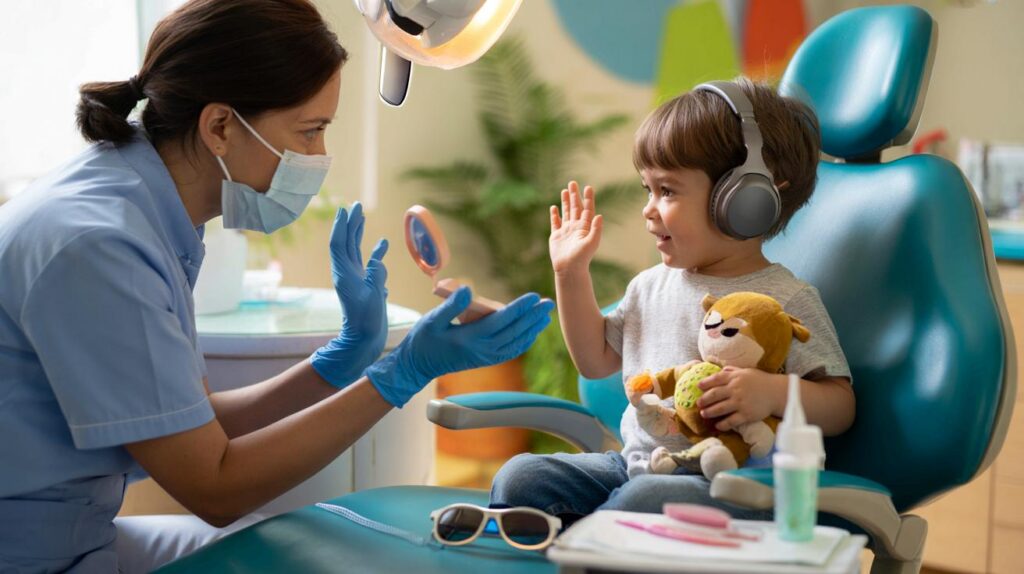
There’s a quiet kind of dread that creeps in before a child’s dental check-up. Not because they don’t understand, but because the chair, the gloves, the whirr of a drill feel strangely bigger than they are. Parents feel it too, watching tiny shoulders tense at the first smell of mouthwash and rubber. Fear can become a habit if it’s not met with something warmer, lighter, more predictable. A few simple psychological moves change the whole room.
It starts with a waiting room chair, plastic and too bright, where a mother traces circles on her son’s palm. He keeps counting posters on the wall like they might run out, breathing in shallow sips. A dentist passes, visors up, friendly eyes. The boy’s foot thumps like a metronome on the floor tiles. She shows him the tiny mirror from a distance, gives it a name, “Flash.” He watches. He isn’t sure yet. One small thing tips the moment.
Why dental fear sticks to small shoulders
Children don’t fear “the dentist” as an abstract. They fear unfamiliar sounds, new faces leaning close, and a spotlight that feels like an interrogation. Their brains are busy sorting “safe or not safe?” in under a second. We’ve all had that moment when a room felt wrong without knowing why. Kids live in that moment longer.
Think of Mia, seven, who loves school but wilts at the surgery door. Last time, a suction tube surprised her and her body remembered it too well. Her dad tried jokes, then promises, then sugary bribes. The jokes floated past. The bribe turned the appointment into a high-stakes gamble. What finally worked was a choice: sunglasses or no sunglasses, earphones or no earphones.
The nervous system calms fastest when it can predict what comes next. That’s why “tell-show-do” works: tell what will happen in simple words, show the tool at a safe distance, then do the brief step. Novelty drops. Control rises. *This is not about bravery; it’s about predictability.* When a child learns a stop-signal—like a raised hand—and sees it honored, their brain files “dentist” under “I have a say,” not “I get trapped.” Memory follows that label.
Practical tools that shrink the fear
Start with a micro-rehearsal at home. Play “dentist” for two minutes with a spoon as a mirror, a lamp as a light, a teddy as the patient. Use the same simple script the dentist might use: “Open like a crocodile, we count to five, then rest.” Build a tiny ritual before you leave—three slow breaths, pick a song, choose a comfort item. Rituals make chaos less chaotic.
Watch your words. Saying “It won’t hurt” trains the brain to listen for pain. Swap in “You might feel tickles or pressure, and you can stop me with your hand.” Sit at the child’s eye level. Keep your face relaxed even if their lip trembles. Let’s be honest: nobody actually does that every day. If your own dental memories get loud, step out for a minute, sip water, reset your shoulders. Kids borrow our calm faster than we think.
Pair sensation with grounding. Try “feather breathing”: imagine balancing a feather on the lip for five slow breaths, so air is gentle. Offer earphones with a familiar playlist. A cool flannel behind the neck. A squishy ball to squeeze during the count.
“An anxious child isn’t being difficult; they’re doing their best to stay safe in a world that suddenly feels too close.”
- Pre-visit script: “We count to five, we rest, you signal stop.”
- Sensory kit: sunglasses, earphones, soft toy, lip balm, squishy ball.
- Choice menu: chair up or down first, mirror name, where to rest hands.
- After-care: one specific praise—“You held still for two counts.”
Leaving the surgery a little braver
Your child doesn’t need to love the dentist. They need to trust that the next appointment won’t ambush them. Small wins stack: a visit that ends on time, a tool that’s explained, a signal that stops the action instantly. Trust is built by a hundred tiny predictabilities. Over weeks, the story shifts from “I hate it” to “I can handle it,” which is the quiet foundation of resilience. Share your family’s version of these tools with the clinic before you go. Most teams will gladly meet you halfway.
| Key points | Details | Interest for reader |
|---|---|---|
| Reframe the visit as predictable, not heroic | Use tell-show-do with a simple, repeatable script. Agree a clear stop-signal and have the dentist reflect it back: “If you raise your hand, I’ll pause and count with you.” Book early-day slots when kids are less tired, and keep the appointment short when possible. | Gives you a realistic, repeatable method rather than vague reassurance. Reduces surprises, which is what drives most dental anxiety in children. |
| Build a tiny toolkit for sensory comfort | Create a “dentist bag” with sunglasses, earphones, a soft toy, lip balm for dry lips, and a small fidget. Pair it with grounding: feather breathing, counting ceiling tiles, or tapping knees left-right to rhythm. | Actionable items you can pack today. Helps a child stay present without white-knuckling through the entire appointment. |
| Coach your language and your body | Swap “It won’t hurt” for sensation words like “press,” “buzz,” or “cold.” Keep your shoulders unlocked, jaw unclenched, and breath slow. After the visit, praise a specific behaviour: “You opened for three counts,” not “You were brave.” | Shifts the focus from fear to skill, which is more motivating for kids and easier for parents to reinforce at home. |
FAQ :
- What if my child flat-out refuses to sit in the chair?Try a step-ladder approach: sit on your lap first, then perch on the chair together, then a quick count to two with no tools. Stop while it still feels manageable, and celebrate that micro-step.
- Should I promise a big reward after the appointment?Keep it small and predictable, like choosing a song on the way home. Giant prizes raise the stakes and can make the child think the visit is a monster to defeat.
- Is it better if I stay in the room or wait outside?Stay if your presence calms them and you can keep a soft, steady tone. Step out if your child mirrors your tension. You know which version brings more calm to the space.
- What can I ask the dentist to do differently?Ask for tell-show-do, a stop-signal, and a short first slot. Many dentists can dim the light, offer sunglasses, explain sounds, and break the visit into tiny steps.
- When should we consider extra support like sedation?If gentle techniques still leave your child overwhelmed, discuss graded desensitisation or specialist services. Sedation can be a bridge, not a first step, and should sit alongside long-term confidence-building.



Love the focus on predictabilty over bravery. The tell–show–do + clear stop-signal combo is gold, especially the “raise your hand and I’ll pause” line. I’m stealing the “dentist bag” idea (sunglasses, lip balm, fidget). Tiny ask: could you share a printable parent script?
Do you have refs (RCTs/meta-analyses) showing reduced pediatric dental anxiety with tell‑show‑do, choice menus, and stop‑signals vs standard care? Curious about effect sizes and whether gains persist past the first few visits. Not trying to nitpick, just want the evidence‑base.