
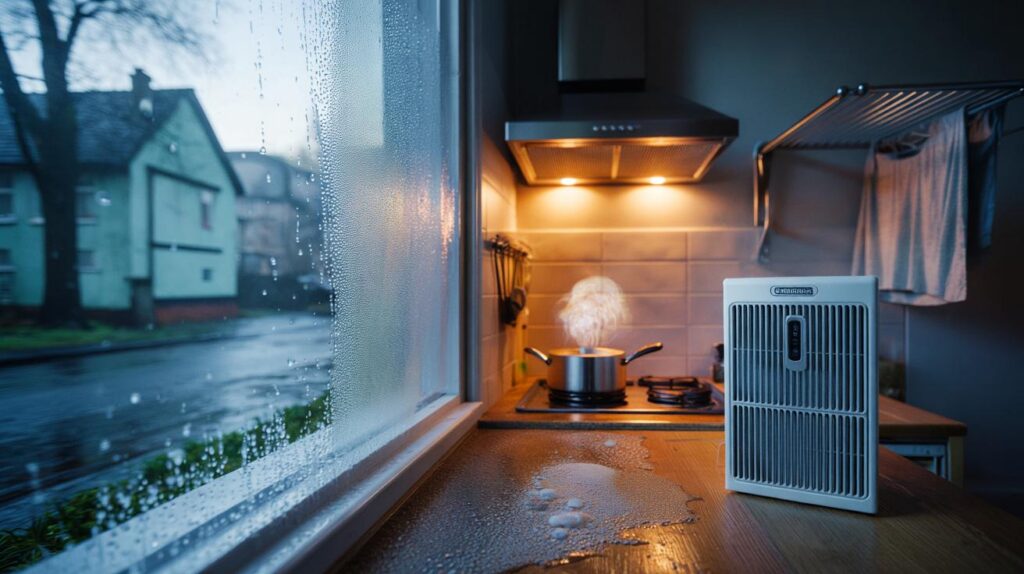
Fogged-up windows in November aren’t just annoying. They hint at trapped moisture, rising energy bills, and the quiet creep of mould behind curtains and under paint. The glass isn’t failing you; it’s telling you something about the air inside your home. And once you learn to read that message, the fixes get far simpler — and cheaper — than you’d think.
It’s 7.12am, the street is still blue-grey, and the kettle coughs into life. You pad to the kitchen window and it’s already a murky mirror, beaded with fat droplets that race each other to the sill. You draw a small smiley face with your finger and it vanishes under a fresh mist before you’ve turned away.
I wipe a circle clear with my sleeve and watch it mist back over. Breakfast throws steam, the shower hisses, the radiator ticks, the glass sweats. We’ve all had that moment where you catch a whiff of damp and feel a flicker of worry. The odd thing is, the cure isn’t where you think it is. A simple truth sits behind the fog.
What’s really behind November window fog
The glazed pane is just the coldest surface in the room. Warm, moist air hits that chill, cools, and leaves its water behind as droplets. On a hard November morning, your indoor air might be cosy at 20°C, but the window is flirting with single digits. The gap between those two numbers is the stage where condensation performs.
Think about a typical day. Two showers, a pot of pasta, a load of laundry drying on a rack, and a closed-up home holding it all in. A family of four can pump out 10–15 litres of water into the air in 24 hours — the equivalent of a big watering can, floating around as invisible vapour. No surprise the windows cry it out at dawn.
There’s a name for the tipping point: the dew point. When humid air cools to that temperature at the glass, water condenses. Double glazing keeps the inner pane warmer, so droplets are fewer, while single glazing turns into a cold trap. Airtight homes are brilliant at holding heat, but they also hold moisture unless you give that vapour a way out. That’s why trickle vents exist, and why extractor fans aren’t a “nice to have”.
How to stop it for good
Start with a daily two-minute routine. Open two windows on opposite sides for a quick cross-breeze, or crack one wide and count to 120 while the room exhales. Run the kitchen and bathroom extractors during and for 15 minutes after steam-making jobs. Fit or open trickle vents. Condensation isn’t a window problem — it’s an air problem. A £10 hygrometer tells you when you’re winning: aim for 40–60% relative humidity.
Small habits pay back in dry sills and calmer walls. Shut the bathroom door while you shower, then keep the fan running; keep lids on pans; dry washing in a room you can ventilate, or use a dehumidifier next to the clothes. Let’s be honest: nobody runs the fan long enough every single time. So make it automatic where you can — a timer on the extractor, a dehumidifier on a smart plug, a daily window purge while the kettle boils.
When the basics are in place, upgrades go further without breaking the bank. Balance steady, lower heating with short bursts of ventilation, rather than yo-yoing the thermostat. Check for hidden moisture-makers like unvented tumble dryers or blocked vents behind heavy curtains. Moisture out, heat in: that’s the winter mantra. Then remember the golden rule — water always finds somewhere to go.
“If damp air can’t leave the building, it will settle inside the building — in your walls, in your wardrobe, and on your glass.”
- Run extractors during and 15 minutes after showers and cooking.
- Dry clothes in one ventilated room, or pair a dehumidifier with an airer.
- Open trickle vents; don’t block them with blinds or tape.
- Use a hygrometer: keep 40–60% RH; act if you see 65%+ for days.
- Purge ventilate daily for 2–5 minutes with opposite windows.
Take a breath, then take action
Foggy windows aren’t a character flaw in your home. They’re a soft alarm telling you the air is saturated, that heat is hitting a cold edge, that a few small rituals will save you money and grief. Small daily habits beat expensive fixes. People love to skip to gadgets, and yes, a decent dehumidifier is brilliant, but it works best when the home’s lungs are open. The old rhythm of winter — heat a bit, ventilate a bit — still holds, even in a modern flat above a busy road.
There’s an odd comfort once you know what you’re looking at. The mist on the pane is a physics lesson written in water, not a mystery. Change the script the air follows and the glass behaves. You don’t have to live with sills that drip, musty curtains, or that creeping fear of mould in the corners. Neighbours will tell you it’s just the season. It isn’t fate. It’s choices.
The best part? Most of those choices cost pennies: lids on pans, doors closed during steamy moments, fans that stay on longer, windows cracked for a short, sharp purge. If you rent, you can still win with a plug-in dehumidifier, a hygrometer, and smarter habits. If you own, look at repairs that warm the inner face — secondary glazing film, new seals, thermal blinds. Dry air feels lighter, cleaner. You’ll sleep better, and your home will thank you.
| Key points | Details | Interest for reader |
|---|---|---|
| Condensation is about air, not glass | Warm humid air meets cold surfaces; hit the dew point and water appears | Explains the “why”, helps you pick fixes that work |
| Daily habits beat damp | Purge ventilation, extractor use, controlled drying, 40–60% RH target | Actionable steps that cost pennies and save on energy |
| Smart upgrades help | Dehumidifier by the airer, trickle vents, secondary glazing, timer fans | Quick wins without major renovation |
FAQ :
- Why do my windows fog up more in the morning?Night-time cools the glass while your home keeps breathing out moisture. When warm air hits cold panes at dawn, it condenses fast.
- Will a dehumidifier fix condensation on its own?It helps a lot, especially near drying racks, but it works best alongside extractor fans and short, sharp ventilation.
- Is condensation a sign of a leak?Not usually. It’s more often indoor humidity. Persistent wet patches on walls or ceilings need checking for leaks or penetrating damp.
- What’s the ideal indoor humidity in winter?Keep it between 40% and 60% relative humidity. Under 35% feels dry on skin; over 65% for days invites mould.
- Should I turn the heating up to stop condensation?Warmer air holds more moisture, so heat helps a little, but without ventilation you just store more vapour. Balance gentle heat with airflow.



Loved the “moisture out, heat in” mantra. Bought a £10 hygrometer and finally understand what 40–60% RH feels like. Clear, actionable advice—cheers.
Genuine question: with energy prices up, does a 2–5 min purge really save more than it loses? Seems counterintuitve to dump warm air in November.