
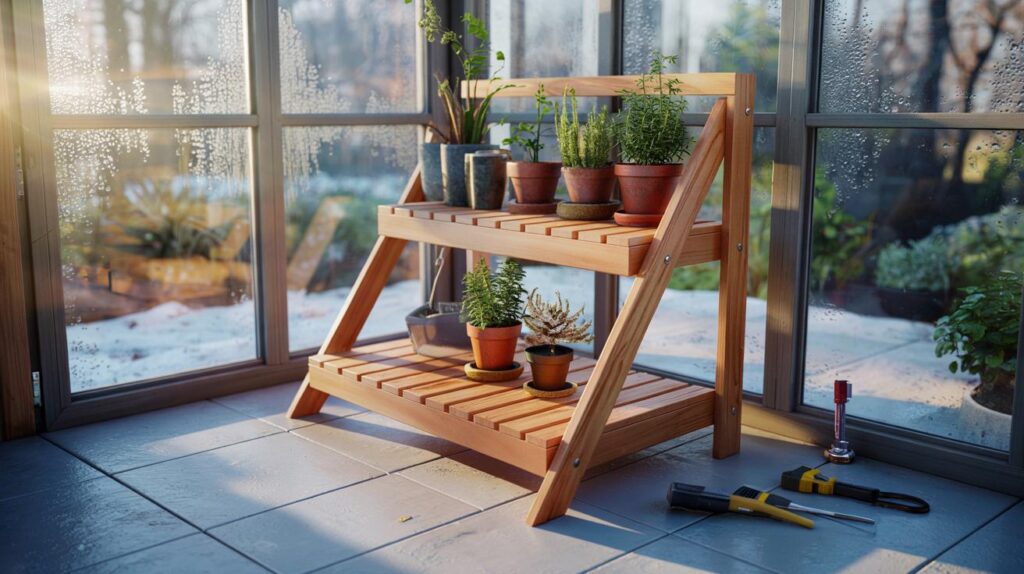
Winter hits, and suddenly the conservatory turns into a crowded waiting room for every plant you promised to keep alive. Kits pop up in your feed, glossy and pricey, yet never quite the right size or style. There’s a simpler route: a wooden shelf you build yourself, tailored to your sun patches and your pot sizes, that costs a fraction and looks like it belongs.
On a grey Sunday, you carry a mug into the conservatory and breathe out a small cloud. The cheap metal stand by the window lists to one side, and a row of terracotta pots trembles when the washing machine spins. The glass is smudged with dried rain, the ficus leans, and the winter sun sneaks in low, kissing only the edge of a tray. You fetch a tape measure without thinking and sketch a ladder of shelves in the condensation on the pane. The trick is to give every plant its patch of light without turning the room into a garden centre. A quiet idea starts to warm the cold air. The fix isn’t a kit.
See the space first, then the shelf
The best wooden shelf is the one that fits your room like a handmade glove. Conservatories aren’t standard; the light is local, the corners quirky, and the sill heights are never quite level. Watch where the winter sun falls between 9 and 3, then design your tiers to catch it. A narrow top shelf gives your small pots a front-row seat, while deeper lower tiers anchor the weight and keep leggy herbs out of the draught. You’ll feel the room settle as soon as the frame slides into place.
We’ve all had that moment where a bargain stand wobbles under a tray of seedlings and the soil dusts the tiles like cocoa powder. Last January, Sarah in Bristol built a three-tier frame from 38 x 63 mm construction timber and 12 mm plywood offcuts for £42. The cheapest decent kit she’d seen was £129 and wasn’t even the right width for her bay. She cut the uprights at 1.5 m, set shelves at 35 cm, 70 cm, and 110 cm, and left a 3 cm gap at the back for airflow. Two weekends later, the shelf was part of the room, not a visitor.
There’s a quiet physics to this. Push the mass low and back; let the slats breathe; triangulate the corners so racking doesn’t twist the frame. Light comes in at a shallow angle in winter, so a stepped profile beats a flat plank. Shelf depth often equals pot diameter plus two fingers for saucers; leave 50–70 mm between back edge and glass to dodge condensation. It’s not precious joinery. It’s a simple structure tuned to sunlight and weight.
Build it with basic tools and a steady cup of tea
Start with a cut list and a pencil that still has a sharp point. For a 1.2 m wide, three-tier shelf, you’ll need four uprights at 1.5 m, six shelf rails at 1.2 m, and six cross rails at 30–35 cm, plus slats or 12 mm ply strips for decking. Softwood battens (18 x 44 mm) keep weight down; construction timber adds heft if your pots are heavy. Pre-drill, then drive 4.5 x 60 mm exterior screws through the rails into the uprights, forming two L-frames before joining them into a rectangle. Add a diagonal brace at the back. Sand the edges and wipe on a thin coat of oil. **No fancy tools.** *You’ll be surprised how quick it starts to look like furniture.*
Little choices make or break the feel. Skip MDF, as edges swell in damp air; go for softwood or birch ply. Set the top shelf shallow so it doesn’t shade the middle tier. Leave 8–10 mm between slats for airflow and for overwatered moments. Let’s be honest: nobody wipes down every leaf each day. If your floor slopes, add stick-on levelling pads, then lock the stance by fixing a back strip that bites in slightly against the wall skirting. If you paint, use a breathable stain, not a gloss skin.
When screws start to bite straight and the frame squares up, confidence arrives with a thud you can feel through your wrist. The shelf stops being an idea and starts being your room’s working spine.
“I thought I wanted a kit, then realised I wanted control,” says Mark, an allotment keeper who built his shelf in two early mornings before work.
- Quick upgrades: hook screws for hanging planters on the sides.
- Stick-on cork coins where pots sit to stop cold transfer.
- A narrow lip at the front to catch runaway water droplets.
- Wheels only if you add a lower stretcher to spread the load.
https://youtu.be/m0tqV6Yw3i0
Make it yours, then let winter do the rest
Your shelf will gather stories quickly. A nick from a slipped spanner. A ring where a basil sulked and then finally loved the morning light. Place your thirstiest plants where you naturally reach with the watering can, high-need herbs near the door where the air moves, succulents up top in the brass of the sun. Label one tier as the “recovery ward” for cuttings and scorched leaves. Share a photo, then force yourself to look away for a week and just live. **A wooden shelf under £50 that fits your bay like a tailor’s chalk line and gives every leaf a lane is not a stunt.** It’s a small domestic win that makes winter feel a fraction easier, and it’s built from straight lines and ordinary screws.
| Key points | Details | Interest for reader |
|---|---|---|
| Custom fit beats kits | Design to sun angles, pot sizes, and awkward corners | Better plant health and a cleaner, calmer room |
| Simple structure, strong bones | Softwood frame, diagonal brace, slatted shelves | Stable, breathable, easy to maintain |
| Budget-friendly build | Common timber, exterior screws, wipe-on oil | Save £60–£100 over retail kits |
FAQ :
- What wood should I use in a damp conservatory?Pine or spruce softwood works if you oil it; birch ply for slats stays flat. If your space is very wet, go larch or cedar for extra resilience.
- How much weight can it handle?A 38 x 63 mm frame with decent screws and a rear brace will carry several dozen kilos. Keep heavy pots on the bottom tier, light pots up top.
- Do I need power tools?A handsaw, a drill-driver, and a sanding block are plenty. A mitre saw speeds things up, but accurate marking does the heavy lifting.
- How do I stop mould and warping?Leave gaps between slats, keep a 5–10 cm gap off glass, and use a breathable oil. Wipe up spills and crack a window after watering.
- Can I make it modular or add wheels?Yes. Build two narrow units that butt together, or fit locking castors on a stout lower stretcher. Bolt-on side panels let you add hooks later.



Loved the “recovery ward” tier idea 🙂 The stepped profile and diagonal brace tips are gold. Going to try the 38 x 63 mm frame with 12 mm ply slats this weekend—under £50 sounds doable, even for my wobbly Victorian conservatory. Any reason to prefer birch ply over softwood for decking beyond staying flatter?
Sounds easy until the floor isn’t level and the uprights twist—been there. The piece skims past wood moisture and acclimation; oil alone won’t stop cupping if the timber’s too wet. Feels a bit optimstic to promise “several dozen kilos” without load calcs. Still, the rear brace call-out is solid.