
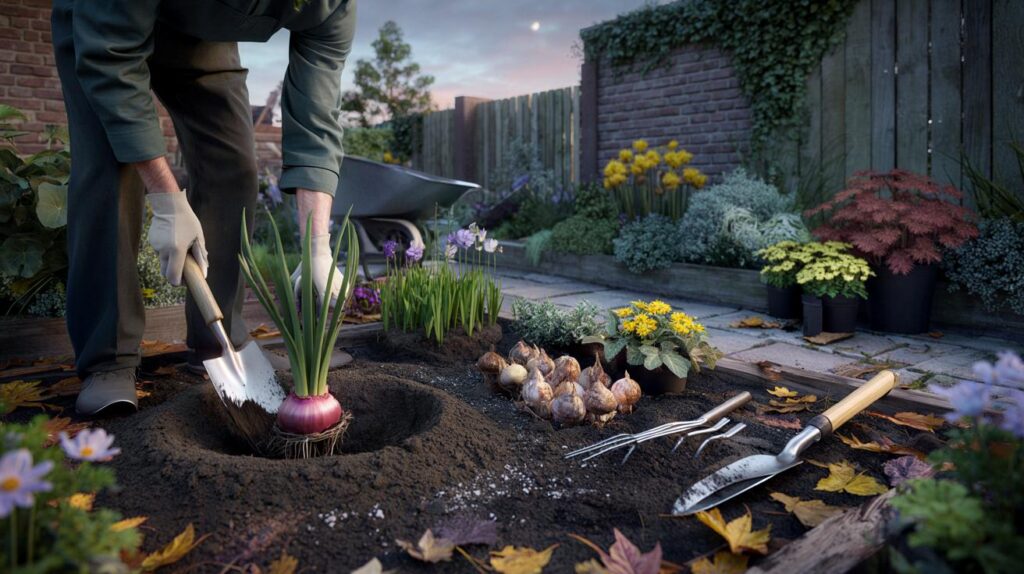
A quiet week on the calendar hides a make-or-break decision for next spring’s borders, lawns and pots across Britain.
As nights draw in and soil stays mild, a short October window offers you a rare chance to set perennials and bulbs up for years of colour. Ignore it and you risk stunted growth, bare patches and wasted money when the season turns.
Why a late October window changes everything
Between 25 and 31 October, soils across much of the UK sit cool but workable, with moisture levels that help roots knit into place. Air temperatures dip, slowing top growth, while ground warmth, often 6–12°C, nudges root systems into action. That balance reduces transplant shock and builds resilience before winter hits.
Plant between 25 and 31 October when soil is cool, moist and still easy to work. You bank root growth before the first hard frosts.
This seven-day slot also beats spring rush. In spring, rising heat and erratic dry spells push young plants to leaf before they root deeply. Autumn planting flips that script: roots first, growth later. You get earlier flowers, tougher foliage and fewer losses.
The moon question: what believers do in 2025
Working with a descending moon
Many British gardeners time root work for a descending moon phase, when sap movement is thought to favour below-ground development. In the last week of October 2025, that pattern aligns neatly with the calendar. Use it if you follow lunar gardening; it pairs with the soil conditions already in your favour.
Focus on root tasks in a descending moon: perennials bed in fast, bulbs settle cleanly, and spring growth starts strong.
Evidence varies and not everyone is convinced. The practical gains here still come from the season itself: cool ground, steady moisture, and fewer pests. If moon timing motivates you to plant on time, you win either way.
Bulbs plus perennials: a two-pronged plan that lasts
Perennials that shrug off drought and frost
Pick stalwarts that reward you for years. Hardy geraniums, rudbeckias, Salvia nemorosa, yarrow and heucheras cope with dry spells, late snaps and missed waterings. They spread, knit borders together and handle full sun or light shade by a wall or fence.
Bulbs that naturalise without fuss
Pair those perennials with bulbs that return and spread: botanical tulips, narcissi for dry soils, crocosmias for colour into late summer, and alliums for structural bursts in early summer. Place bulbs in clumps through perennial matrices to fill gaps before perennials hit their stride.
| Plant | Type | Planting depth (cm) | Spacing (cm) | Aspect | Notes |
|---|---|---|---|---|---|
| Hardy geranium | Perennial | Top of rootball at soil level | 35–45 | Sun/part shade | Spreads to blanket bare ground; cut back after first flush. |
| Salvia nemorosa | Perennial | Soil level | 30–40 | Sun | Free-draining soil; trim spent spikes to extend bloom. |
| Achillea (yarrow) | Perennial | Soil level | 40–50 | Sun | Handles drought; excellent for pollinators. |
| Heuchera | Perennial | Crown at soil level | 30–40 | Part shade | Good under light canopy; avoid waterlogged spots. |
| Narcissus (daffodil) | Bulb | 15–20 | 10–15 | Sun/part shade | Reliable in dry spring lawns if foliage can die back naturally. |
| Botanical tulip | Bulb | 12–15 | 8–12 | Sun | Best on poor, well-drained soil; leave dry in summer. |
| Allium | Bulb | 10–15 | 20–30 | Sun | Feed with compost; leaves die back before perennials fill. |
| Crocosmia | Corm | 8–10 | 20–30 | Sun/part shade | Multiply over time; lift and divide if clumps thin in centre. |
Groundwork that pays off in spring
Soil prep, drainage and the right depth
Loosen soil to 20 cm, remove stones and weed roots, then fold in 3–5 litres of mature compost per square metre. On heavy clay, blend in sharp sand or fine grit to improve winter drainage. Waterponds around roots kill plants faster than frost.
Set bulbs at two to three times their own height, points up. Space perennials so mature leaves just meet, not overlap; airflow reduces disease through winter damp. Firm lightly so roots contact soil, then water once to settle pockets.
Seven steps to nail your late October planting
- Target 25–31 October, aiming for cool, workable soil after a dry day.
- Mark curves for borders and drifts under trees or along fences.
- Loosen soil to 20 cm and remove old roots and compaction.
- Add compost where growth has been weak; avoid fresh manure.
- Plant bulbs and perennials at correct depth and spacing; label groups.
- Water once to settle, not to soak; avoid late-evening deluges.
- Mulch 5 cm with leaves, straw or chipped bark to buffer frost and conserve moisture.
Common mistakes that stall your display
What to dodge when the clock is ticking
Avoid digging when ground is saturated or frozen; smearing destroys structure. Do not bury crowns of perennials; crown rot thrives in cold, wet soil. Do not cram plants. Crowding traps moisture and weak light, inviting mildew and slugs.
Skip high-nitrogen feeds now. They push soft growth that winter cuts down. A thin, even mulch protects without smothering emerging shoots in late winter.
What you should see by March and April
Earlier colour, stronger roots and less watering
Beds planted on this schedule often flower one to three weeks earlier. Rooted plants need less water from May onwards because root systems tapped winter moisture. Lawns stay tidier where bulbs naturalise, because foliage ripens and disappears just as mowing routines start.
Side-by-side comparisons are stark. Perennials set in this window show thicker crowns and more stems. Bulbs throw taller, steadier blooms. Losses drop, which means lower costs next year.
Extra gains for small spaces and tough sites
Pots, slopes and shade edges
On balconies or small terraces, the same timing holds. Use a free-draining mix: two parts peat-free compost, one part fine grit. Raise pots on feet to clear winter water. On slopes, mulch across the fall line to stop wash-outs. At the dry shade edge of a wall or hedge, favour daffodils, hardy geraniums and heucheras, which cope with rain shadows.
Risk check and quick calculator
Frost, rainfall and spacing maths
If your area takes hard frosts before 5 November, cloche new perennials on clear nights and lean on a 5–7 cm mulch. If forecasts show 25 mm of rain in 48 hours, pause digging for two days to save soil structure. To estimate plant numbers, divide bed area by the square of spacing. A 4 m² patch at 40 cm spacing takes roughly 25 plants; add 10% for losses and gaps.
What to try next week if you start late
Plan B for early November starters
Missed the week? You still have options. In mild regions, bring forward drainage tweaks and mulch first, then plant on the next dry spell. In colder spots, pot up perennials into 3-litre containers, keep them sheltered and plant out in late February as ground thaws. Bulbs can still go in until the ground sets; they may flower later in year one, then settle.



Great breakdown—this explains why my spring plantings struggle. I’ll definately try the 25–31 Oct window for Salvia nemorosa and alliums this year. Love the roots-first logic and the spacing calculator tip. Thanks!
Not sold on the moon stuff, tbh. Is there any peer-reviewed evidence for the descending moon affecting sap flow, or is this just tradition? The rest—cool soil, steady moisture—makes sense, but the lunar bit feels like cargo cult.