
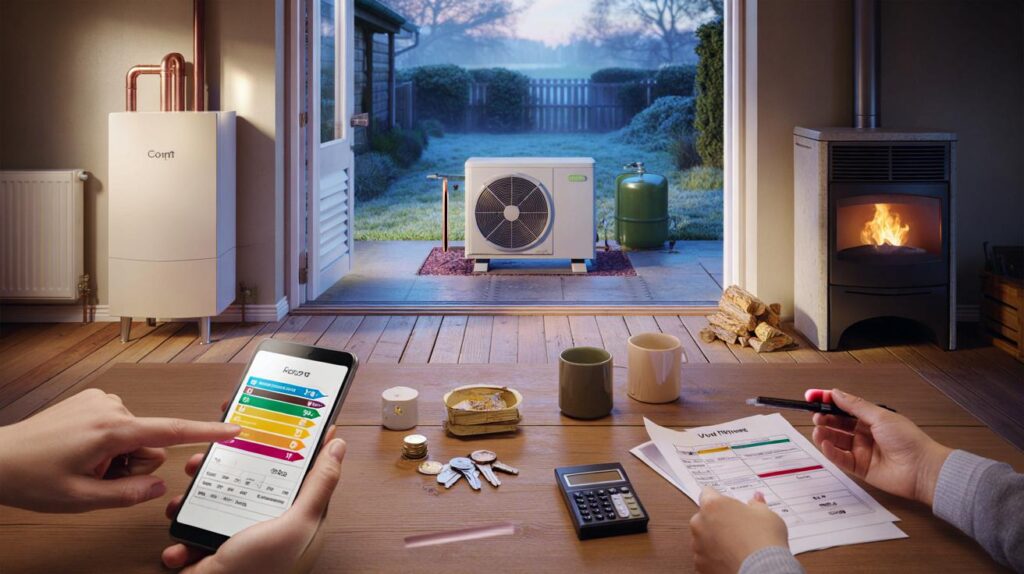
You turn the new keys, flick on the hallway light, and feel that soft thrum of possibility. Then the first cold snap arrives, the radiators cough, and your group chat erupts: gas loyalists, heat-pump evangelists, a pellet guy who swears by his delivery calendar, and an uncle who mutters about oil being “proper heat”. You want facts, not folklore. You want numbers that belong to 2026, not 2006.
I’ve been in kitchens like yours this autumn, watching people do napkin maths with quotes and tariffs. The decision doesn’t happen in a showroom; it happens at the table, between a mortgage payment and a council tax reminder. *The quiet cost is the standing charge you forget to count.*
Here’s the bit everyone dodges: the winner changes based on the home, the tariff, and how you actually live. The trap is hidden in the tariff lines.
The 2026 heating maths, without the spin
A decent rule of thumb for a typical three-bed UK home is about 12,000 kWh of heat a year. A modern gas boiler turns cheap kilowatts into warmth at roughly 90% efficiency. A heat pump doesn’t “make” heat; it moves it, so its efficiency is expressed as a COP, often between 2.5 and 3.5 in real homes.
If retail energy sits near its recent range in 2026, think in bands: electricity 22–30p/kWh, gas 6–8p/kWh. Oil has danced between 70–90p per litre, and wood pellets often land around £300–£400 per tonne. None of this is gospel. It’s a way to sketch the year ahead without holding your breath every time Ofgem blinks.
Put that together and you get usable comparisons. A gas boiler needing about 13,300 kWh of gas to deliver 12,000 kWh of heat might land around £900–£1,100 in fuel. A heat pump at COP 3 pulls roughly 4,000 kWh of electricity, so think £900–£1,200 unless you exploit time-of-use. Oil at 1,280–1,350 litres could hover near £900–£1,200. Pellets at 2.7–3.0 tonnes often sit in the £850–£1,200 bracket.
The homeowner reality check: examples and edges
Take Tasha in Leeds. New baby, 1930s semi, cavity walls filled a decade ago. She switched to a heat pump last winter with a smart tariff that drops to 14p/kWh off-peak and averages near 18p across the day. With a COP around 3.2, her heating electricity sat close to 3,750 kWh, so roughly £675 for space and water heat. Gas would likely have cost a little more on fuel alone, and more once she added the annual boiler service.
Now picture Ben and Priya in a draughty stone cottage in Cumbria, off the gas grid. They priced oil and pellets, then trialled a heat pump with a COP that fell on cold nights. Their electricity averaged 27p/kWh; the annual bill felt heavy. They nudged the flow temperature down, sealed floorboards, and moved to a two-rate tariff. The result wasn’t magic, but it trimmed hundreds. That’s the rhythm of real homes: tweak, learn, save.
Heat pump gains grow with insulation and clever tariffs. If your average price drops under 20p/kWh and your COP kisses 3.5, the math swings. Gas still looks tempting where unit rates stay low, yet carbon policy keeps nudging the scales. Oil follows global moods; pellets follow supply chains and storage space. This choice isn’t ideology; it’s arithmetic plus habits.
Upfronts, grants, and the costs you don’t see on the quote
Start with a 10-year lens. Count install, grants, maintenance, and fuel. A straightforward gas boiler might run £2,000–£3,500 installed; oil with a compliant tank can reach £4,000–£6,000. Heat pumps vary wildly: £8,000–£14,000 before support, minus the Boiler Upgrade Scheme grant that’s up to **£7,500** for air-source in England and Wales. Biomass boilers often sit £10,000–£16,000, with grants available off the gas grid in limited cases.
Maintenance matters. Gas service around £80–£120 a year; oil can be a bit more, with a tank inspection cycle and occasional sludge drama. Pellets need a clean and a friendly supplier; storage is half the battle. Heat pumps like a light annual check and clean filters. We’ve all had that moment when you vow to babysit the thermostat every hour in January. Let’s be honest: nobody really does that every day.
Common pitfalls? Oversizing a heat pump, under-sizing radiators, and ignoring flow temperatures. Big radiators or underfloor loops let a heat pump purr at low temps, which lifts COP. Gas and oil prefer hot water; pumps like warm, not scalding.
“Buy the envelope first; then the machine.” An efficient shell is the one upgrade that pays every single winter.
- Annual heat demand: use 8,000–15,000 kWh for most three-beds; EPC or smart meter data refines it.
- Unit rates: model a low and a high case for gas and electricity, plus standing charges.
- Heat pump COP: 2.5–3.5 for radiators; 3.5–4+ with well-designed underfloor and low flow temps.
- Grants: **Boiler Upgrade Scheme** for heat pumps; biomass grants off-gas with conditions.
- Space and logistics: pellet store, oil tank compliance, outdoor unit placement for a pump.
Choosing for your home, not the headlines
There’s a simple way to get clarity that doesn’t involve spreadsheets with 20 tabs. Calculate your home’s heat demand from past winters if you can, then model two unit rate scenarios for 2026: a “calm” and a “spiky” one. Run the math for gas, oil, pellets, and a heat pump at two COPs. The winner will reveal itself with less drama than Twitter provides.
Smart tariffs are the wildcard. If you can shift heating and hot water into off-peak bands, a heat pump can undercut gas on fuel spend while trimming emissions. If you’re off-grid with room for a pellet store and like the tactile rhythm of deliveries, pellets can still sing. Oil remains a workhorse where budgets are tight and the tank already sits in the garden. Your house has a personality. Feed it the energy that matches its mood.
The 2026 twist? Electricity keeps getting cleaner; policy keeps nudging money toward electrification; decent insulation multiplies every saving. One bold move is to tackle the draughts first, then pick the system that thrives at lower flow temperatures. The quiet bold move is to switch to **smart tariffs** and let the grid do some lifting while you sleep. Your future bills will read like a calmer diary.
| Key points | Details | Interest for reader |
|---|---|---|
| Running cost hinges on tariffs and efficiency | Gas 6–8p/kWh; electricity 22–30p/kWh; heat pump COP 2.5–3.5 | See when a pump beats gas and when it doesn’t |
| Upfronts swing with grants | Heat pump support up to £7,500; biomass off-gas only | Cut payback time with the right scheme |
| House first, kit second | Insulation and emitter sizing unlock low flow temperatures | Make any system cheaper to run, every winter |
FAQ :
- Is a heat pump cheaper to run than gas in 2026?If your average electricity price drops below about 20p/kWh and your COP sits near 3.2 or higher, it often is. On flat tariffs above the mid‑20s, gas can still edge it on fuel spend.
- Will gas boilers be banned?No ban on existing boilers is set for 2026 in the UK. New‑build rules are tightening, and incentives favour heat pumps, but you can still replace a boiler in existing homes.
- What about hybrid systems?A hybrid pairs a small heat pump with a gas or oil boiler, letting the pump handle mild weather and the boiler cover cold snaps. It can be a useful bridge where radiators are small or budgets are staged.
- How noisy is a heat pump?A modern outdoor unit is comparable to a quiet dishwasher at a few metres. Placement matters; keep it off echoey corners and away from bedroom windows.
- Should I wait?If your boiler is dying, waiting risks emergency prices. If it’s healthy, spend this winter on insulation and tariff experiments, then buy the machine that suits the numbers you’ve proven.



Great breakdown. Question: in a leaky 1920s terrrace with small rads, would a hybrid (small ASHP + gas) actually beat straight gas on 2026 tariffs, once standing charges are counted?
This is the first article that explains COP without the hype—thank you! I finally get why flow temperature matters and why smart tariffs change the game 🙂