
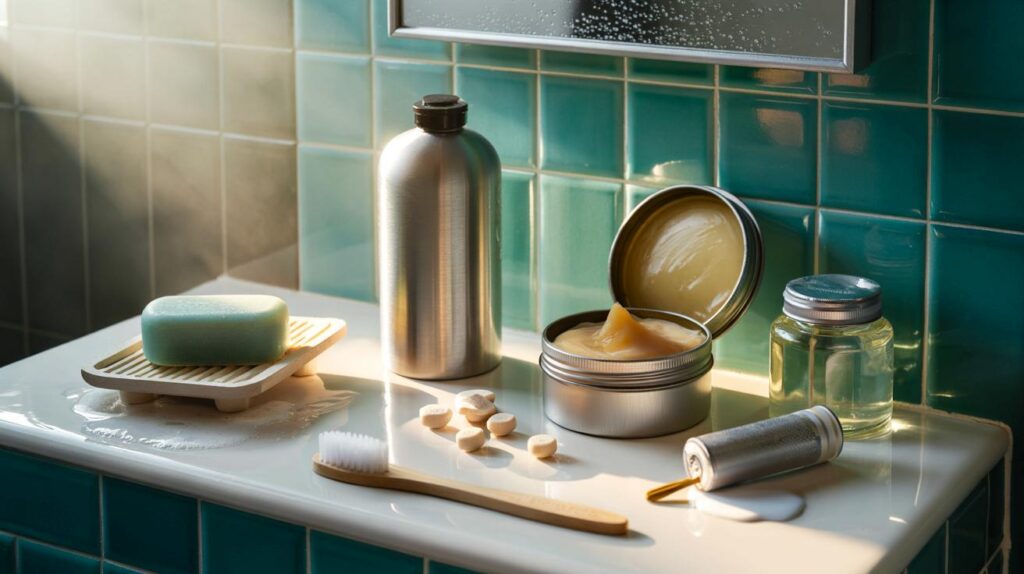
That shelf in the bathroom tells stories. Half-squeezed bottles, a skittish cap that never fits, a minty tube with its tail twisted like a wrung towel. You’re not wasteful, you’re busy, and plastic multiplies in the steam like it pays rent. The truth is, most of it can go.
At 7.12am the shower kicks on and the day’s tiny chaos begins. A child asks where their PE kit is, the mirror fogs, the shampoo bottle slumps on its side like it’s given up, and a used-up toothpaste tube lurks in the bin, guilty and shiny under the strip light; in these small domestic moments you get a sudden sharp urge to make less mess of it all, to stop buying things that become rubbish in a week, and to make your morning less plastic and more peace. **Small switch, big relief.** Now imagine the same shelf, almost empty.
Why plastic-free starts in the shower
The shower is the bathroom’s plastic hotspot because water-based products come in sturdy bottles by default, and they add up fast when each person in the house prefers a different scent or label. Shift the centre of gravity and everything else follows. Start with shampoo and toothpaste and you’ll feel the difference by the end of the week; they’re high-frequency habits, and habit is where waste hides.
I met a renter in Manchester who kept her empties in a tote by the laundry basket, just to see the scale of it, and within one month she had eight bottles, three tubes and a pump that had jammed forever, which is ridiculous when you think how little is left to show for the money and the plastic. She switched to a coconut shampoo bar and a jar of toothpaste tablets from a local refill shop, and the tote stayed empty. We’ve all had that moment when the bin is full and your patience is not.
Modern waterless formulas are better than the old-school bars your gran used to wrestle with, with pH-balanced solid shampoos that lather nicely even in hard water and enamel-friendly tablets that taste clean, not chalky. Brands like Lush, Ethique, Faith In Nature, Beauty Kitchen, Georganics and PÄRLA have turned what used to be a compromise into something that feels like a treat. It’s the same routine, minus the plastic tang that lingers in the back of your head.
Five swaps that actually stick
Swap 1: ditch the bottle for a shampoo bar that suits your scalp, then treat it like soap, not furniture; lather in your hands or glide it once or twice over your roots, rinse as usual, and sit the bar on a draining dish or a mesh bag so it dries between showers, which keeps it firm and lasting. Swap 2: if bars aren’t your vibe, go for a refillable aluminium bottle and top it up from a local milkman-style refill station or a pouch that can be returned and recycled; **buy once, refill forever** is the rhythm that keeps clutter down. That’s two bottles gone for good.
Swap 3: try a concentrated shampoo paste in a tin if you want that “salon” slip without the bottle; a pea-sized blob plus water equals full-lather wash, and one tin can outlast three standard bottles if you’re not heavy-handed. Swap 4: move toothpaste into tablets; bite, brush, watch the foam appear, and carry a tiny tin for weekends or flights without drama at security. Let’s be honest: nobody does this every day. The trick is to set your default at the sink and make it easy when you’re half-asleep.
Swap 5: if you want paste not tabs, pick an aluminium tube with a metal cap and a key to roll it flat, then pop the clean, empty tube into metal recycling with the rest of your tins. You’ll get the same fresh-brush feeling, minus the forever-plastic. Here’s what a refill-shop owner in Brighton told me:
“People think plastic-free means harder. It usually means simpler. The routine strips back, and that’s where it sticks.”
- Shampoo bar: lather in hands, keep dry, long-lasting.
- Refillable shampoo: aluminium bottle, local or postal refills.
- Concentrated shampoo paste: tiny tin, big lather.
- Toothpaste tablets: bite, brush, travel-friendly.
- Aluminium-tube toothpaste: key-roll, fully recyclable when clean.
A small room with big ripple effects
The bathroom is where repetition happens, morning and night, which means tiny reductions pay back faster than anywhere else in the house, and that momentum spreads to laundry, to kitchen, to days out. You start to notice what’s marketing and what’s habit, and you keep the things that actually make mornings easier while everything noisy falls away. **Start with one swap.** Tell someone it worked. Then swap another.
| Key points | Details | Interest for reader |
|---|---|---|
| Shampoo and toothpaste are high-impact swaps | Daily use items, easy to replace with bars, refills, tablets | Quick wins you’ll feel fast |
| Waterless formats cut plastic and freight | Bars and pastes remove the need for bottles and shipping water | Lower waste, often lower cost per wash |
| Care and storage make or break it | Drying dishes, roll keys, clean recycling keep routines smooth | Fewer frustrations, longer-lasting products |
FAQ :
- Do shampoo bars work on coloured or curly hair?Yes, pick a pH-balanced bar made for your hair type; many UK brands label bars for coloured, curly or sensitive scalps.
- How do I fly with toothpaste tablets?Carry them in a small tin or sachet; they’re not a liquid, so they skip the 100ml rules and breeze through security.
- I live in a hard-water area — will bars lather?They do if formulated for hard water; if lather is shy, add a little more water or try a chelating rinse once a week.
- Are aluminium toothpaste tubes really recyclable?Rinse and flatten them, remove any plastic cap, and put them with metal recycling; check your council guidance if unsure.
- How long does a shampoo bar last?Roughly 60–80 washes if you let it dry between uses, which often equals two or three standard bottles.



Just switched to a coconut shampoo bar and toothpaste tabs last month and my shower shelf looks almost empty — in the best way 🙂 The tip about letting the bar dry on a draining dish is gold; mine lasts way longer now. Any fave hard-water bars from Ethique or Faith In Nature?
I get the logic, but isn’t shipping aluminium refills in pouches just moving the waste around? Do those return schemes actually hit high return rates, or do most pouches end up in the bin?