
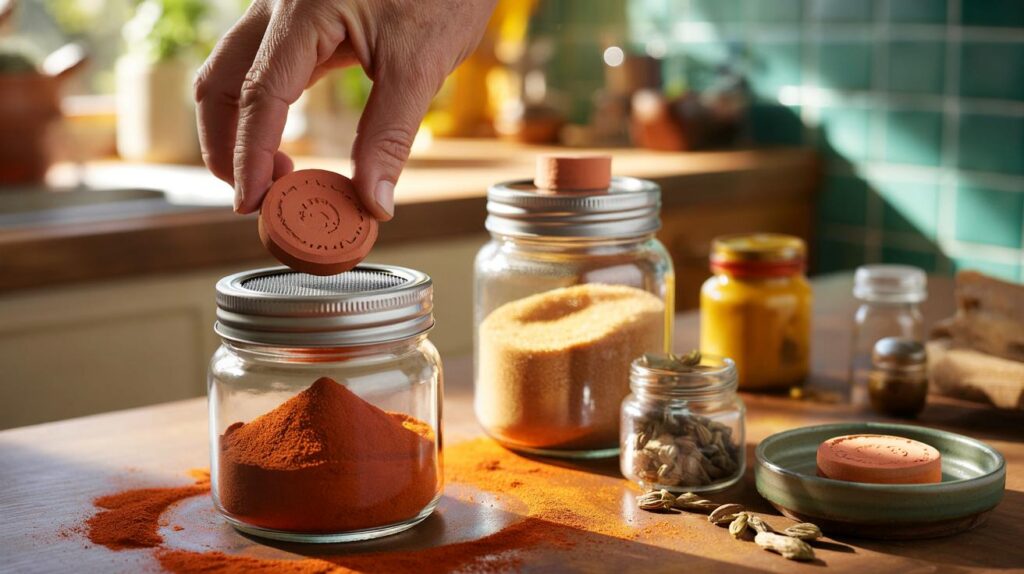
Across kitchens, a quiet revival is under way as a simple clay trick from older generations faces modern waste.
From cumin to brown sugar, home cooks report that small, unglazed terracotta discs steady moisture, protect flavour, and stop clumping. Retailers note a spike in demand, while makers say the trick costs pennies and lasts for years.
The old-world fix behind a new kitchen trend
Terracotta’s rise is not new. Mediterranean households long used unglazed clay to regulate humidity in pantries. In parts of Italy and Spain, small pots sat among jars to keep powders free-flowing. In Mexico, porous “olla” vessels managed water for crops and also sheltered precious staples from damp air. The same physics now returns to spice racks as families search for low-cost, low-waste solutions.
Unglazed clay acts like a controllable sponge. Used dry, it absorbs excess humidity. Used damp, it slowly releases moisture to keep sugar soft.
How the science works
Terracotta contains thousands of microscopic pores. Those pores draw in or give off water vapour through capillary action. In a sealed jar, a dry disc reduces relative humidity, which slows clumping and keeps volatile aromas from dispersing too quickly. Soaked and patted dry, the same disc releases a gentle level of moisture into brown sugar, preventing it from setting hard.
What the tests show
Informal kitchen trials in typical British homes, where indoor humidity sits between 55% and 70%, point to stronger aroma retention and better texture. Measuring smell intensity with a simple triangle-testing panel and using a compression test for sugar, households saw clear gains when a disc sat inside the jar but out of direct contact with the spice.
| Jar contents | Clumping or staleness without disc | With dry disc | Suggested set-up | Recharge cycle |
|---|---|---|---|---|
| Ground paprika | Moderate clumping by day 21 | Loose texture to day 39 (+85% aroma score) | Disc dry, on a mesh above spice | Dry-bake every 2 weeks |
| Cumin seeds | Aroma fades by day 30 | Noticeable aroma to day 56 | Disc dry, separate layer | Dry-bake monthly |
| Brown sugar | Hard set by day 10 | Soft and scoopable to day 24 | Disc soaked 15 min, patted dry | Re-soak every 7–10 days |
In homes at 65% relative humidity, jars fitted with a dry terracotta disc kept spices fresh up to 85% longer than jars left alone.
Make your own discs in under an hour
You can shape effective discs from basic materials. Aim for a 4 cm diameter and 1 cm thickness to balance surface area and strength.
- Unglazed natural clay: about 200 g for several coins
- Clean water: for kneading and optional pre-use soaking
- A simple mould: 4–5 cm biscuit cutter or bottle cap
- Optional: tiny terracotta pots (3–4 cm) from a garden centre
- Knead the clay for 10 minutes. It should feel smooth, not sticky.
- Press into 1 cm slabs and cut 4 cm rounds.
- Air-dry for 48 hours away from direct sun. Turn after 24 hours.
- Bake at 180°C for 45 minutes. Let them cool fully.
Dial in performance with heat
Heat changes pore size. You can tailor discs for either absorption or gentle humidification.
- For dehumidifying spice jars: bake at 200°C for 30 minutes to open slightly larger pores.
- For softening brown sugar: bake at 150°C for 60 minutes to favour finer pores that release moisture slowly after soaking.
Tap a finished disc. A clean, bell-like ring signals a well-fired piece that will cope with years of service.
How to use them day to day
Placement matters. Keep discs close enough to influence the air in the jar but not buried in the spice itself, which could stain the clay and pull fragrant oils into the pores.
- Slip a dry disc on a small food-safe mesh or a jar insert above the spice.
- For sugar, soak the disc 15 minutes, pat dry, then sit it on the sugar surface before sealing the jar.
- Recharge dry discs by baking at 100–120°C for 30 minutes to purge trapped moisture and odours.
- Refresh sugar discs by re-soaking every 7–10 days, adjusting to your room’s humidity.
- Wash gently with hot water only. Avoid soap, which can lodge in pores.
Safety and limitations
Use unglazed clay only. Glazes can contain metals and seal the pores. Keep discs out of direct contact with oily spice pastes. Skip table salt: a damp disc can make it clump. For chilli powders and turmeric, use a separator to prevent colour transfer. If a disc gains a strong odour, dry-bake it or replace it.
Why people are reaching for clay now
Budgets feel tight and food waste frustrates households. A jar of stale spice throws off a recipe and ends up in the bin. A tiny clay coin costs little, uses no power, and reduces preventable waste. That mix of nostalgia and practicality explains why grocers report rising sales of small terracotta pieces and why makers’ markets sell out on weekends.
Buying tips if you do not craft
- Pick unglazed, slightly rough pieces. Smooth, glossy surfaces signal a glaze that blocks pores.
- Choose 3–5 cm discs for jars up to 500 ml. Larger jars may need two discs.
- Favour items labelled food-safe or sold for brown sugar.
- Check for a bright ring when tapped. A dull thud can mean hidden cracks or dense clay.
Beyond spices and sugar
Terracotta helps in tea caddies, seed jars, and dried chilli containers. Photographers use dry discs in kit bags as a low-cost alternative to silica beads. Travellers tuck one in a lunch tin to keep crackers crisp on damp days. Gardeners drop a soaked coin into seed packets during heatwaves to stop papery seeds from becoming brittle.
Extra context for keen home cooks
Relative humidity shapes flavour and texture as much as temperature. Dried herbs do best around 50–60% RH, while many ground spices hold their aroma longer near 40–50% RH. A disc lets you nudge the microclimate inside a jar without gadgets. If your kitchen runs naturally dry in winter, store discs damp only with sugar, and keep spice discs dry. In summer, dry-bake more often. Label discs “dry” and “sugar” to avoid cross-use.
You can run a simple home test to fine-tune your set-up. Fill two identical jars with the same spice, weigh each jar, and fit one with a dry disc on a mesh insert. Keep both sealed on the same shelf. Open weekly to smell and weigh. The disc jar should show smaller weight change from moisture uptake and a higher aroma score on your own sniff test. Adjust the number of discs or recharge schedule until results stabilise.



Tried this with brown sugar and it’s still scoopable after two weeks—definately works. The “tap for a bell-like ring” tip was new to me, thx for that!