
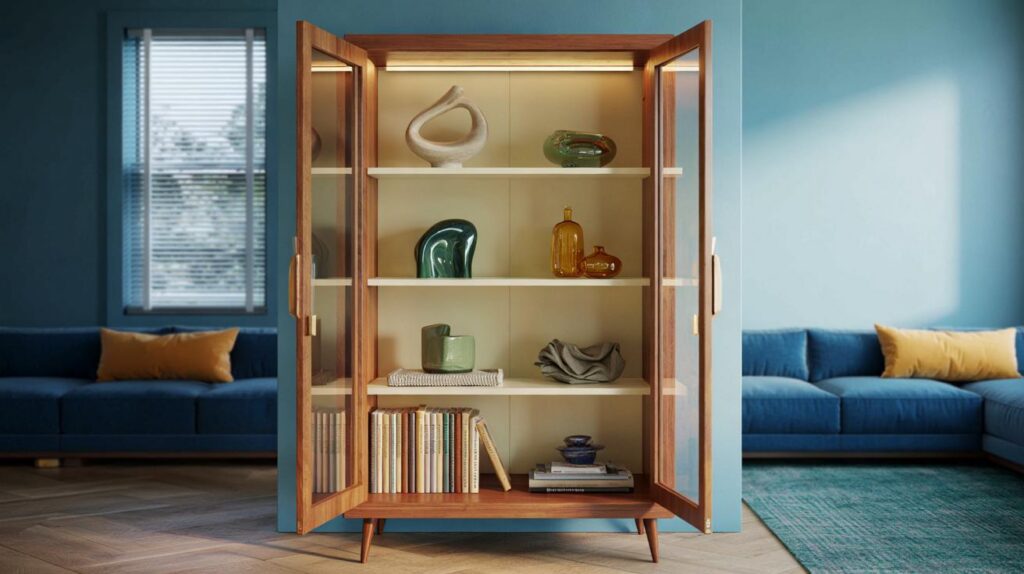
From lofts to living rooms, a once-overlooked cabinet is stealing attention as colour, character and confident displays come back.
After years of beige-and-bare minimalism, British homes are leaning into warmth, nostalgia and clever storage. That shift has pushed a familiar item to centre stage: the glass-fronted display cabinet your gran guarded like a crown jewel.
Why the 1970s cabinet suits 2025 homes
Today’s interiors mix bold colour with lived-in practicality. The 1970s and 1980s nailed that recipe. Slim profiles, glass doors and tall proportions give you generous storage without crowding the floor. The look pairs well with walnut, teak or faux-rosewood veneers, brass accents and glossy finishes.
The return of maximalism does not mean chaos. It means intention. You show what you love, edit what you do not and arrange pieces so the eye can rest.
Top-condition vintage display cabinets from the 70s and 80s now sell for more than £2,000, especially rarer models.
Colours that work in British light
British rooms run cool for much of the year. A cabinet with warm timber or caramel-toned veneer offsets grey skies. If you lean modern, paint the carcass in olive or mustard and leave the interior pale to bounce light. Deep blue frames with neutral backboards calm louder collections.
Maximalism with discipline
Think gallery, not jumble. Give each shelf a theme. Keep heights varied but align a few edges so the arrangement reads as deliberate. Add a single hero object per shelf and support it with quieter pieces.
One tall cabinet can make a small room feel larger: go vertical, keep the floor clear and use glass to carry light.
What exactly is a cabinet of curiosities
It’s a tall, mostly glass display case with shelves, often lit, designed to showcase objects while keeping dust at bay. Many vintage examples stand 160–200 cm high and 30–40 cm deep, so they slip along a wall where a sideboard would jut out. Sliding or hinged glass doors protect books, ceramics and textiles while keeping sightlines open.
Common period materials include veneered chipboard, solid teak trims, smoked or clear glass, and slim metal pulls. Some have mirrored backs that double the presence of your objects. Others feature cane or reed inserts that soften reflections.
Where people are finding them and what they cost
Demand has risen, but bargains still appear if you cast a wide net and move fast. Expect prices to reflect condition, size and provenance.
| Source | Typical price range | What to expect |
|---|---|---|
| Car boot sales | £50–£200 | Dusty, needs cleaning; check for chipped glass and loose shelves |
| Charity shops | £80–£300 | Honest condition, basic styles, swift turnover |
| Auction rooms | £150–£600 | Better quality; factor in buyer’s premium and transport |
| Design dealers | £450–£1,200 | Curated pieces, professionally cleaned or restored |
| Rare designer models | £1,200–£2,500+ | Notable makers, unusual finishes, original lighting |
How to style yours without clutter
- Group by colour or material: ceramics on one shelf, glass on another, books below.
- Use odd-number groupings (3–5–7) to keep arrangements lively.
- Layer heights with risers or stacked books so every piece is visible.
- Add a discreet LED strip at the top; choose warm white for timber veneers.
- Limit depth: leave two fingers of space at the front so the cabinet breathes.
- Rotate displays seasonally. Pack away what you replace; don’t double up.
Safety, maintenance and sustainability
Anchor tall cabinets to the wall, especially on carpet or if children visit. Use two brackets into solid studs or appropriate wall plugs. Fit soft-close pads so sliding doors do not rattle. Check for toughened glass; if in doubt, add a safety film to the inside.
Keep heat and humidity steady. Radiators nearby can warp veneers and dry out joints. Sunlight can fade dyed woods and book spines; sheer curtains or UV film help. Clean glass with a microfibre cloth and a tiny splash of vinegar in water. Nourish timber veneer with a light beeswax once or twice a year, buffed thin.
Buying vintage keeps materials in circulation and cuts the carbon footprint of new manufacture. Many 1970s boards are thicker than modern flat-pack, so they survive knocks. If shelves bow, add a mid-span support or replace with tempered glass cut to size.
Is it an investment or a fad
Interest in display cabinets has risen with the swing toward colourful, layered rooms. Dealers report faster sales and higher bids for clean, well-proportioned pieces. That said, condition drives value. A rare model with intact glass, original fittings and a known maker brings a premium. A common unit with swollen bases or cloudy panes sits longer.
How to check for quality
- Open and close doors: they should glide without scraping. Replace tired runners before the glass suffers.
- Inspect veneer edges and corners for lifting; small chips can be stabilised with PVA and a wax stick.
- Look for water staining at the base, a sign of past mopping or leaks.
- Examine shelves for sagging; glass inserts should bear a hallmark for toughening.
- Test lighting safely. Old halogen can run hot; upgrade to low-heat LED with proper insulation.
- Sniff for mustiness. Persistent smell may mean damp; walk away.
If you inherited one, you may already own £300–£600 of value. Rare examples push far beyond £2,000.
Smart ways to use one cabinet in different rooms
In the kitchen, line shelves with pressed glass, enamelware and cookbooks, with a tray for everyday mugs at hand level. In a hallway, use it as a landing zone: baskets for keys, hats and post behind glass so surfaces stay calm. In a child’s room, store models and badges at eye height and keep heavier items on the lowest shelf.
For a home office, treat it as a visual archive. Mix reference books with framed certificates and a single plant for softness. For a living room, pair the cabinet with a low, modern sofa to balance heights. A rug that picks up one colour from the cabinet ties the scheme.
If you want the look on a budget
- Hunt unloved units with cloudy glass and replace panes; glass is cheaper than a whole cabinet.
- Paint only the carcass and leave the doors timber; this saves time and keeps vintage character.
- Swap dated knobs for small brass mushrooms or leather pulls.
- Add a removable wallpaper panel to the back for instant depth.
- Raise a squat cabinet on tapered feet to lighten its stance.
Extra tips that help you decide
Measure before you buy: width, height and, crucially, depth. A 35 cm-deep cabinet usually clears skirting and sockets while staying slim enough for narrow rooms. Sketch your wall and mark the nearest plug; lighting looks better when you hide cables.
If you plan to resell, keep the finish sympathetic. Over-sanding can break through veneer, which sinks value. Gentle cleaning, minor repairs and reversible upgrades give you the best chance of recouping cost if tastes shift. And if you love the look but not the upkeep, consider a modern reproduction with soft-close hardware and warranty, then mix it with genuine vintage objects for charm without the maintenance load.



Just checked my loft and I think I’ve got the exact teak-and-glass cabinet from the late 70s, slim profile and smoked panes. If the shelves are bowing slightly, would tempered glass replacements be safest, or should I add a mid-span support first? Also, any tricks for clearing cloudy glass—vinegar and water, or is that a defintely-no on smoked glass? Lastly, beeswax on the veneer: light coat buffed thin, right? Trying to restore without ruining any resale value.