
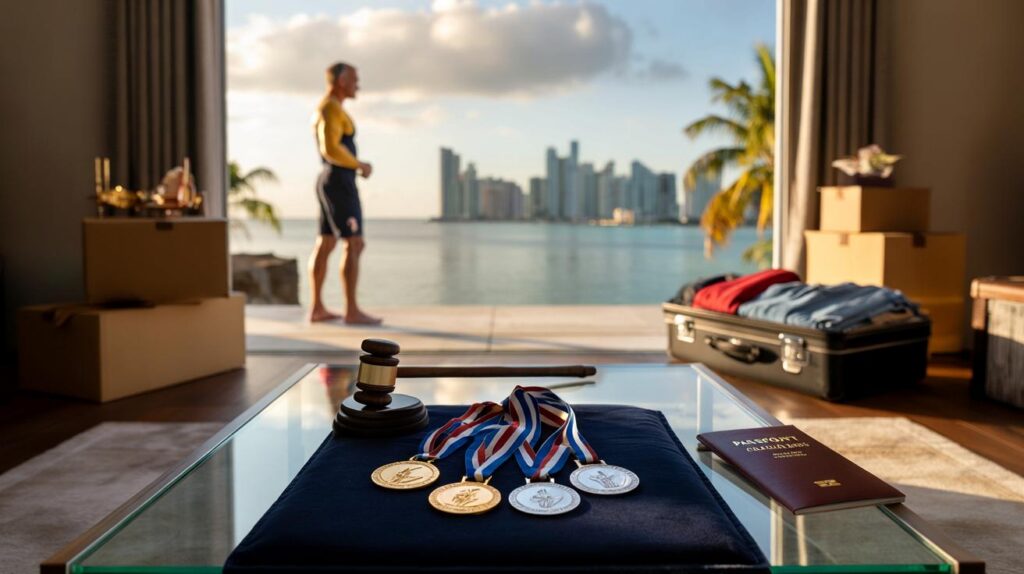
One of sport’s most decorated divers is stripping back his life, packing up memories, and pointing himself towards a quieter horizon.
At 65, Greg Louganis has chosen a reset abroad after a wholesale clear‑out that touched everything from his California home to the sacred symbols of his career. The decision folds together money, meaning and the search for calm in a way that many readers will recognise.
A decisive move at 65
Louganis, who won four Olympic golds and one silver between 1976 and 1988, announced he is relocating to Panama. He said he has donated items, sold what he could, and passed on belongings as gifts. He completed the sale of his house, and he expressed genuine contentment with the buyer who will now inhabit the space he once called home. He spoke of wishing the property joy, safety and peace, a ritual that marked the close of a chapter as much as a real‑estate transaction.
His rationale sounded honest and unvarnished. He acknowledged that better management earlier in his life might have left him in a different position today. Instead of hiding that truth, he spoke plainly about needs and choices. He also framed the move as an attempt to rediscover himself away from the noise that surrounded him during competition and afterwards.
At 65, the American diving great is selling down, moving out and carving space to work out who he wants to be next.
The auction that reset his legacy
Over the summer, Louganis parted with three Olympic medals at auction, a decision that startled some fans but drew fierce interest from collectors. RR Auction handled the sale. The lots went for more than $400,000 combined, a figure that reflects both sporting history and scarcity.
| Medal | Games | Hammer price (USD) |
|---|---|---|
| Gold | Los Angeles 1984 | $199,301 |
| Gold | Seoul 1988 | $201,314 |
| Silver | Montreal 1976 | $30,250 |
He did not hide his motivation. He said, in plain terms, that he needed the money. He contrasted his situation with people who build and sell companies. He had medals. He used them. Auctioneers said the outcome underlined the magnitude of his sporting story and the enduring appetite for tangible Olympic history.
Three medals fetched $430,865 in July — a market verdict on the value of a career seen from a display case.
Why sell now?
Timing helped. Olympic memorabilia often climbs when the Games are on the horizon and attention swings back to the feats that shaped the movement. Louganis also sized up his personal balance sheet and priorities. Converting symbolic wealth into liquid funds gave him the freedom to move country, reduce possessions and reset routines. He admitted that earlier guidance around finances left gaps. Rather than dwell, he acted and used the medals as the assets they are.
Why Panama beckons
Panama appeals to many retirees and remote workers for practical reasons. The climate is warm. Flights connect quickly to major US hubs. English is widely understood in business districts, while Spanish dominates daily life. The country runs several residency routes, including a long‑standing Pensionado programme for retirees and a Friendly Nations Visa for eligible nationals. Healthcare options range from private clinics in Panama City to regional hospitals, and premiums often undercut US rates, though coverage varies by age and provider. Living costs differ sharply between the capital, beach towns and rural highlands.
- Residency: check eligibility, paperwork and minimum income requirements before committing.
- Healthcare: compare private policies, hospital networks and age‑based exclusions.
- Tax: Panama taxes local income; speak to a cross‑border adviser about US obligations.
- Housing: short‑term rentals give time to test neighbourhoods and commute patterns.
- Language: Spanish lessons ease daily tasks and reduce reliance on expat bubbles.
- Pets: confirm vaccination rules and airline restrictions before booking flights.
For a public figure like Louganis, Panama also offers a degree of privacy. He framed the move as a personal experiment. He wants fewer distractions. He wants space to listen to his own instincts after decades in the pool, under lights and under pressure.
From champion to advocate
Beyond medals, Louganis has long used his platform. He publicly came out as gay in the mid‑1990s and disclosed that he is HIV‑positive. He has spoken about mental health, addiction, human rights and the environment. Those conversations gave other athletes permission to be candid. They also reframed his public life as something more than scorecards and podiums.
In Seoul in 1988, he became the first man to sweep Olympic diving at back‑to‑back Games — a standard still cited by Team USA.
That past will not vanish because medals changed hands. The footage endures. The influence lingers in younger divers who watched him, and in fans who understood that courage looks different outside a pool.
What it means for fans and collectors
For collectors, the sale offers a textbook case. Provenance matters. Buyers paid a premium for clear documentation and a name that travels beyond sport. For fans, the lesson is subtler. Objects carry stories, but they are not the story itself. Louganis can shed items and still keep the achievements that shaped him. The cash helps him fund a plan. The medals begin new lives with people who value them in another way.
Anyone weighing a late‑career move abroad can draw practical tips from his choice. Start with a trial stay. Tally ongoing costs rather than headline prices. Look at healthcare first, not last. Build a local network before formal relocation. Think about how to sustain purpose — through volunteering, mentoring or part‑time projects — once work routines fall away.
For athletes past their peak earning years, selling memorabilia sits alongside speaking, coaching, brand partnerships and writing as a legitimate income stream. The risks mirror any niche market: fluctuating demand, fees, and the challenge of letting go of objects that anchor identity. The upside is clarity. Assets become funds, and funds can unlock a move, pay debts or seed a new venture. That is the calculation Louganis has just made, in public and on his terms.



I respect the honesty here. Turning symbolic trophies into liquidity to fund a calmer life in Panama makes sense, especially at 65. Many of us would downsize if we could; he just had medals instead of stock options. Would I do the same? Probably, if it bought freedom, health care and peace.