
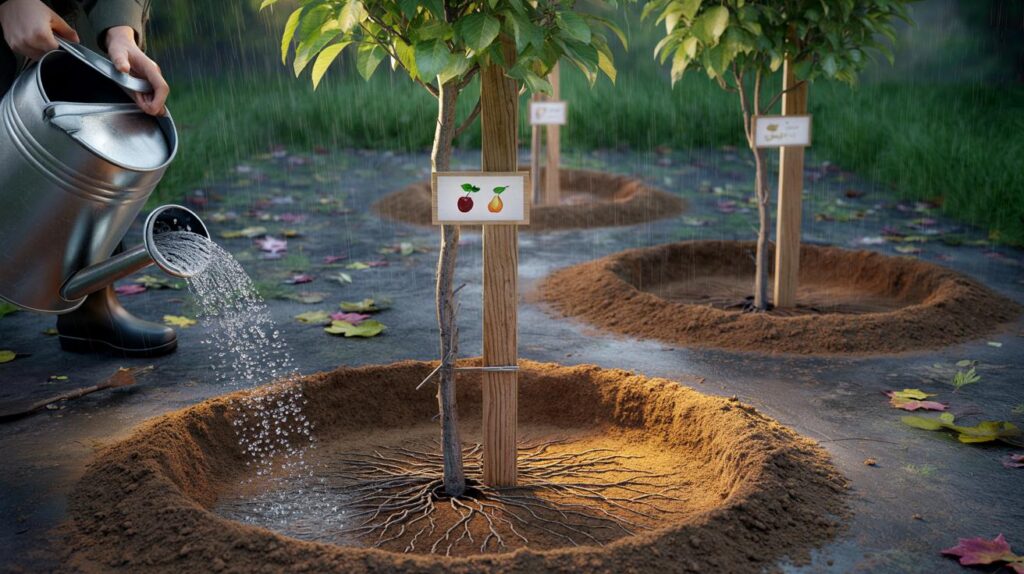
The quiet weeks before winter hide a decisive window for home orchards, when small actions can transform next year’s baskets.
Across the country, experienced growers are slipping young fruit trees into warm, damp soil before frosts bite. They are not racing the season. They are giving roots time to colonise, so spring growth erupts with less stress and fewer losses.
Why October changes everything for cherries, pears and peaches
Soil cools more slowly than the air. In October it often sits between 10°C and 14°C, a sweet spot for root growth. Roots keep expanding until the soil drops near 7°C. That gives six to ten weeks of silent progress before winter hardens the ground.
Warm soil, steady moisture and gentle handling at planting time combine to deliver faster rooting and stronger trees.
Autumn rain keeps moisture moving around the root zone. That reduces the need for hoses. It lowers transplant shock. It also helps soil settle around fine roots, removing air gaps that can desiccate tissues.
By spring, established roots support vigorous leaf and flower growth. Trees planted in October start the season hydrated. They face windy, bright April days with reserves already in place.
Soil warmth and root biology
Fruit trees build roots whenever temperatures are mild. Autumn’s stable readings favour root initiation and mycorrhizal partnerships. Those networks improve nutrient uptake. They also buffer drought spells the following summer.
Rain, not hoses
Regular showers drive oxygen and water into the profile. That balance matters. Waterlogged, compacted holes suffocate roots. A wide, loosened planting area prevents perched water tables after downpours.
A head start without summer heat
Spring-planted trees often meet early sunshine and cold winds. That combination dries leaves before roots can keep up. Autumn planting avoids that mismatch. It swaps emergency watering for patient rooting.
The seasonal gesture that pays: plant once, properly, then let roots work
Good planting is not complicated. It is neat, measured and light-handed. The goal is undamaged roots in friable soil at the right depth.
- Dig a hole two to three times wider than the root spread, and only as deep as the root system.
- Set the tree so the graft union sits 5–8 cm above finished soil level.
- Backfill with the original soil, broken up by hand, firmed in layers to remove voids.
- Stake before backfilling, on the windward side, with a soft tie at one-third of trunk height.
- Water in with 10–15 litres to settle soil. Add more if the soil is sandy.
Plant bare-root trees as soon as they arrive: hydrate roots for an hour, then dip in a thin clay-and-compost slurry to lock in moisture.
Container-grown trees go in the same way. Tease out circling roots so they do not strangle the trunk in later years. Avoid mixing rich compost in the hole. It can trap water and discourage roots from exploring the native soil.
Early care that pays back across five harvests
Attention in the first season prevents costly corrections later. Think soil life, stability and protection rather than fast top growth.
Feed the soil, not the tree
Spread 2–3 cm of mature compost on the surface out to the canopy line. Do not heap it against the trunk. Soil organisms will work it down. Aim for a pH near 6.5–7.0 for pears and cherries, and 6.0–6.5 for peaches.
Stake, mulch, monitor
Keep the stake for 18–24 months, checking ties after gales. Mulch 5–8 cm deep with wood chips or leafmould, leaving a clear collar around the stem. Mulch suppresses weeds and evens out moisture. Reapply when it looks thin.
Disease pressure starts in autumn
Remove fallen leaves to cut scab and leaf-curl spores. Fit grease bands in October to block winter moths. Use a winter wash on a calm, dry day if scale or aphids have been a problem. Site peaches against a sunny wall to reduce peach leaf curl, and prune cherries in summer to lower canker risk.
| Tree | Spacing | Ideal pH | Key risk | Common rootstock |
|---|---|---|---|---|
| Cherry | 3–4 m (dwarf), 5–6 m (vigorous) | 6.5–7.0 | Canker, birds | Gisela 5 (dwarf), Colt (vigorous) |
| Pear | 3–4 m (dwarf), 4–5 m (semi-vigorous) | 6.5–7.0 | Scab, fireblight | Quince C (dwarf), Quince A (semi-vigorous) |
| Peach | 3–4 m (fan/compact), 4–5 m (free-standing) | 6.0–6.5 | Peach leaf curl | St. Julien A |
Numbers that matter for your garden
- Soil target at planting: above 8°C at 10 cm depth for active rooting.
- Water-in rate: 10–15 litres per tree, then only when the top 5 cm dries.
- Mulch depth: 5–8 cm, kept 8–10 cm away from the trunk.
- Planting width: 60–90 cm, loosened beyond the hole to guide roots outward.
- Pruning: minimal in year one; remove only damaged or crossing shoots.
Many experienced growers report earlier flowering and larger fruit after autumn planting, with fewer summer water demands.
What gardeners get wrong in year one
- Planting too deep and burying the graft union, which invites disease and reduces vigour.
- Overwatering on heavy soils, which starves roots of oxygen.
- Feeding with high-nitrogen fertiliser, which forces soft growth and invites pests.
- Leaving grass to the trunk, which robs moisture; keep a 1 m weed-free circle.
- Skipping pollination planning for cherries and pears; many need partners.
Planning extras: pollination, rootstocks and microclimate
Cherries often need a compatible partner unless you choose a self-fertile type like ‘Stella’ or ‘Sunburst’. Pear ‘Conference’ sets fruit on its own but yields rise with a partner. Peaches are usually self-fertile, yet they prefer warmth and shelter for reliable set.
Match rootstock to your space. Gisela 5 holds cherries compact and productive. Quince A balances pear vigour with manageable size. St. Julien A supports peaches in most soils. Position matters as much as variety. South or south-west aspects speed ripening. Avoid frost pockets where cold air settles at dawn.
Choose the right variety and rootstock for your space, then let October’s conditions do the heavy lifting.
If you miss October
Bare-root trees can still go in from November to March on frost-free, workable days. Do not plant into frozen or waterlogged ground. Container-grown stock can be planted in spring. Expect to water more often through the first summer.
A quick calendar from autumn to summer
- October–November: plant on a still day, stake, water in, mulch, fit grease bands.
- December–February: check ties after gales, top up mulch, keep a weed-free circle.
- March–April: remove protective covers gradually, thin blossom on very young trees to prevent overbearing.
- May–June: water deeply but infrequently in dry spells; monitor for aphids and caterpillars.
- July–August: summer-prune cherries and peaches, net against birds, maintain mulch.
If space is tight, try fans or cordons against a sunny fence. Training flattens the canopy and increases light capture. It also simplifies bird netting for cherries. For a risk check, watch late frosts. Frosted blossom looks blackened within a day. A fleece on still nights can save a crop.
Curious about returns? A pair of young pears on Quince A can yield 6–10 kg by year three with good care. A compact cherry on Gisela 5 may give 4–6 kg once settled. Those numbers improve when trees root well in autumn-warmed soil. That is the quiet advantage October plants for you.



Loved the clear steps on staking and keeping the graft union above soil. I’ve always planted in spring and watched leaves crisp in April winds—makes sense now. Quick q: on sandy soil, would you water-in closer to 20L and mulch thicker than 8 cm? Thanks! 🙂