
Norway have sent Erling Haaland home from the national team camp, dropping an unexpected statement that landed like a thud in a quiet room. The message sounded calm, almost procedural, yet it crackled with consequence for a country that leans on its No 9 like a lighthouse in fog. Manchester City, watching from afar, will have read every syllable twice.
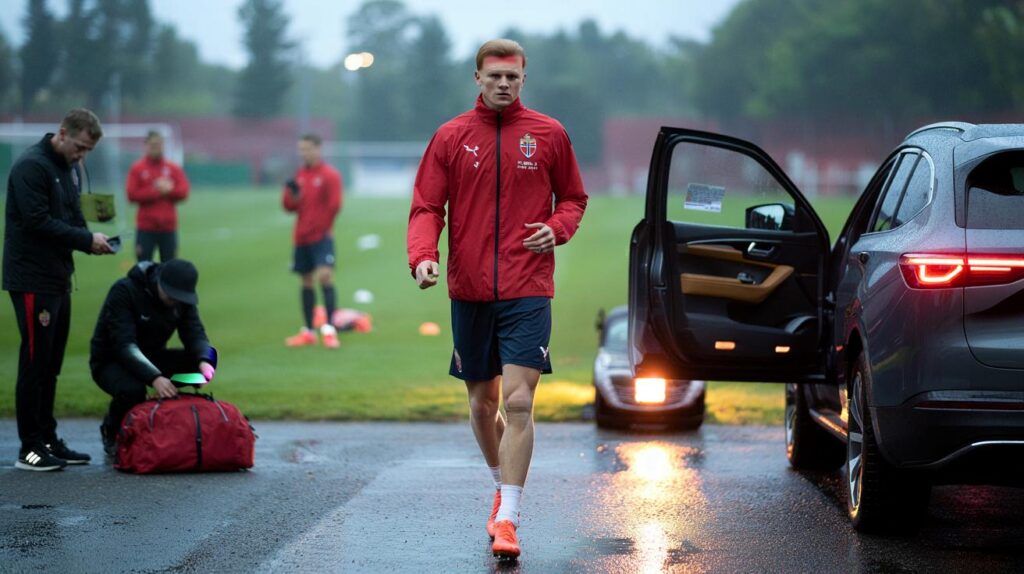
The training pitch was slick with drizzle, the kind that beads on jackets and makes studs whisper. Phones lit up along the touchline, a ripple first, then a buzz, as the federation’s note filtered through: Haaland had left camp, to be assessed, to be protected, to live to fight the next game. A kitman zipped a bag with the neat panic of someone who’s done this before, while a coach stared past the cones, mind already rearranging shape and duty. *It felt strangely quiet.* And then everything tilted.
Haaland sent home: what Norway actually said — and what it signals
The federation’s line was simple, almost clipped: the striker has been released from the squad and will return for checks, a precaution after discomfort. No theatre, no prediction, just a public note and a private calculation. Between those tidy sentences sits the human part of elite sport — risk, timing, the kind of judgement call you only get right by not playing roulette.
There’s a pattern here, and it’s not a scandal. Last autumn, Haaland took an ankle jolt in a low-stakes friendly and didn’t face Scotland days later. The message then, like now, was pragmatic: protect the long game. Norway missed his gravity in the final third, that invisible pull that frees Martin Ødegaard to paint rather than plough. The attack still moved, yet every cross felt a touch heavier without the No 9’s promise at the back post.
Read the tone and you hear cooperation rather than conflict. National team medics talk to club specialists, City share baselines, Norway share timing, and the player’s body gets the final vote. This is modern international football: not a tug-of-war, more a cautious waltz with a crowded calendar watching. City’s staff will parse the wording for clues, but the core is clear — pain management beats bravado.
What happens next — and how both camps will move
The next 72 hours are usually routine in shape, if not in temperature. Travel, scans, swelling checks, a short window of nothing but rest and compression, then a controlled ramp with a few test movements. Think short turns, light accelerations, a couple of finishing drills at half pace, and a long conversation that matters more than any metric: “How does it feel?”
Fans want fast answers, yet bodies don’t care about headlines. We’ve all had that moment where one wrong step makes you baby the ankle for a week, even when it looks fine. Let’s be honest: nobody really does that every day. Rush a superstar and you risk losing him for a month; pause him now and you might gain six weeks of clean minutes. The medical playbook is boring by design, and that’s the point.
For coaches, it’s template stuff with a twist: protect structure, simplify tasks, lean into patterns that don’t need a wrecking ball at centre-forward. Norway can slide a runner across the line, feed Ødegaard between lines, and punch set pieces harder. City will hold their breath, then calibrate the weekend.
“Protect the player, not the moment.”
- Early imaging, late decisions
- Load reduced in training games
- Travel minimised, recovery maximised
- Set-piece edge as insurance
- Communication every 12–24 hours
The wider stakes: a small nation’s star, a giant club’s clock
The cold truth is that Haaland changes rooms. With him, defenders backpedal five yards and midfielders dare to turn. Without him, Norway become a team that must craft their chances with more touches and more patience, which drains energy in late minutes. City know that swing better than anyone; his first two seasons put roughly ninety goals on the board and stretched back lines like cling film. This episode will fade, likely quickly, yet it hints at the season’s real puzzle — a superstar walking the tightrope of a schedule that never sleeps. Share that thought with a friend and you’ll end up debating what football asks of its best players now.
| Key points | Details | Interest for reader |
|---|---|---|
| Norway send Haaland home | Federation issues a short, unexpected statement citing precaution and assessment | Explains the shock and the immediate ripple on team plans |
| What the next days look like | Scans, swelling checks, light reintroduction, constant feedback from player | Demystifies the medical path fans rarely see |
| Club-country balance | Coordinated decisions to avoid long absences in a brutal calendar | Why a cautious call now can save weeks later |
FAQ :
- What exactly did Norway say?A brief note confirmed Haaland has left the squad and will be assessed as a precaution, without firm timelines.
- Is this a serious injury?There’s no definitive diagnosis in the statement. The language points to caution rather than crisis.
- Why send him home instead of keeping him with the team?Return trips allow club-level imaging, trusted specialists, and a calmer schedule away from match prep.
- Will he be fit for his next club match?That decision typically arrives 24–48 hours before kickoff, once pain, swelling, and movement patterns are reassessed.
- How does this change Norway’s approach?Expect more collective movement up front, extra weight on Ødegaard’s creation, and sharper set pieces to replace raw penalty-box gravity.



Is this truly just precaution or are Norway hiding something? Feels very… carefully worded.