
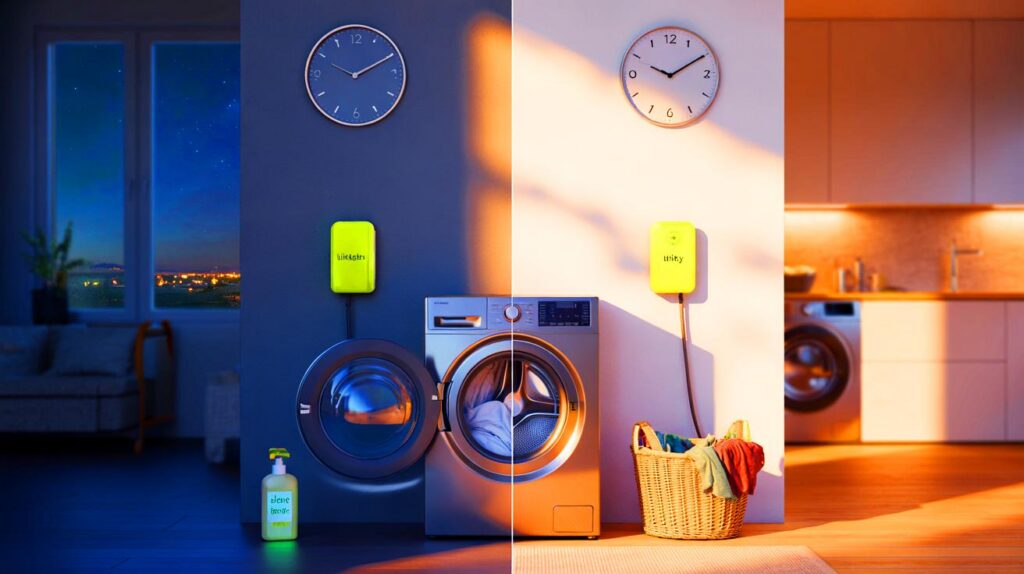
Your washing machine can cost less than you think this year, but the clock decides who wins and loses.
The rules of cheap electricity are shifting, and the new timetable could work for you or against you. If you adjust your habits now, you can nudge more consumption into cheaper hours without turning your home upside down.
The shake-up on 1 november: what changes and who it hits
From 1 November 2025, off‑peak windows move for around 11 million households. Nights stay discounted for at least five hours, while a short daytime slot appears between roughly 11:00 and 17:00 depending on your area. Early mornings (07:00–11:00) and the early evening rush (17:00–23:00) become peak for many contracts, ending the old routine of starting a cycle after dinner.
Some 3.5 million customers keep their current setup, but most must check their precise hours. You should receive a notice at least a month in advance. Where supported, your Linky meter will push the new schedule to connected appliances, yet it is still worth confirming your updated times on your bill or in your customer space and re‑programming timers.
From 1 November 2025, off‑peak shifts to late night plus a short mid‑day slot. Evenings become pricier for many homes.
Off‑peak versus peak: how much money is actually at stake
Prices vary by supplier and contracted power, but the gap remains meaningful. Recent examples show off‑peak from about €0.1635/kWh compared with €0.2081/kWh at peak, while some grids quote around €0.2068/kWh off‑peak versus €0.27/kWh peak. That spreads a difference of roughly €0.045 to €0.063 per kWh.
Turn those figures into something practical. A modern 40 °C eco wash often uses about 0.8 kWh. A hotter cotton cycle can hit 1.5–2.0 kWh. Here’s what that means.
| Example rate | Price (€/kWh) | 0.8 kWh wash (€/cycle) | 2.0 kWh hot wash (€/cycle) |
|---|---|---|---|
| Off‑peak (example A) | 0.1635 | 0.13 | 0.33 |
| Peak (example A) | 0.2081 | 0.17 | 0.42 |
| Off‑peak (example B) | 0.2068 | 0.17 | 0.41 |
| Peak (example B) | 0.27 | 0.22 | 0.54 |
Expect savings of roughly €0.04–€0.13 per wash, depending on your programme and tariff. Stack that across the dishwasher, water heating and tumble drying, and the monthly impact adds up.
When to press start without waking the building
Winter nights: aim just after the off‑peak switch or the small hours
If your off‑peak begins around 23:00, launch at 23:05 or in the deep night (around 02:00) to limit noise. Many flats have quiet‑hour rules; choose a gentler spin or use a vibration mat if your machine transmits sound.
Mid‑day windows: use the 11:00–17:00 gap if your contract offers it
Where a daytime slot exists, schedule a cycle squarely in the middle to avoid spilling into peak. The delay‑start feature is your best ally: load, set the programme, and delay so the entire run sits inside off‑peak. For a two‑hour cycle and an 11:00–13:00 window, start at 11:00 on the dot.
- Confirm your exact off‑peak hours on your bill or via your customer space before you automate anything.
- Use delay start rather than “delay end”, so the heating phase lands in off‑peak too.
- If noise is an issue, run at 30 °C or 40 °C with a lower spin speed and wash earlier in the off‑peak window.
- Avoid stacking multiple heavy appliances at the same time if your contracted power is limited; stagger them within off‑peak.
Make the peak/off‑peak option pay: target 30–35% off‑peak usage
For the peak/off‑peak (HPHC) option to beat a single‑rate plan, push at least 30–35% of your annual consumption into discounted hours. That means lining up more than the washing machine. Add the dishwasher, the immersion heater or cylinder, and—if you must—the tumble dryer during those windows. Smart plugs and basic timers help, but keep total draw within your subscribed power to avoid tripping.
If your off‑peak share sits below 30%, the single‑rate tariff may be simpler and cheaper despite careful scheduling.
Quick planner: suggested start times for common windows
These examples assume a two‑hour wash. Adjust to your machine’s duration.
| Your off‑peak window | Suggested start time | Why |
|---|---|---|
| 23:00–06:00 | 23:05 or 01:30 | Completes within off‑peak, limits late‑night noise |
| 00:30–07:30 | 00:35 or 02:00 | Heating and spin both discounted |
| 11:00–13:00 | 11:00 | Entire cycle stays inside the mid‑day slot |
| 12:00–15:00 | 12:00 or 13:00 | Avoids slipping into the peak shoulder |
| 13:00–17:00 | 13:00 or 14:30 | Leaves margin if the cycle overruns |
Practical ways to cut the energy per wash
- Wash at 30 °C or 40 °C. Compared with 90 °C, 30 °C can use around three times less energy, depending on the machine.
- Fill the drum. Half loads multiply the number of cycles and waste heat.
- Pick the eco programme for regular clothing; it runs longer but heats less.
- Maintain the door seal, filter and detergent drawer to keep efficiency high.
- Use modern detergents designed for cold water to keep results consistent at 30 °C.
- Spin well to shorten tumble‑dryer time, or air‑dry during the day.
- Automate with a simple plug‑in timer if your washer lacks delay‑start.
- Place an anti‑vibration mat under the machine to dampen noise at night.
Check your new hours before you fall back into old habits
Many customers previously enjoyed broad off‑peak blocks between 20:00 and 08:00. With 17:00–23:00 now peak for a large share of contracts, an early‑evening wash may cost more than you expect. Verify your revised schedule via your bill, your customer portal or your Linky display, then re‑set any appliance timers.
A quick household simulation to size your savings
Take a family running four washing cycles and four dishwasher cycles per week, a tumble‑dryer cycle once a week, and a 200‑litre hot‑water cylinder reheated daily. Rough energy: washing 12.8 kWh/month (0.8 kWh × 16), dishwasher 16 kWh/month, tumble dryer 8 kWh/month, hot water 90 kWh/month. Total that you can push into off‑peak: about 127 kWh.
With a €0.045/kWh gap, that’s roughly €5.70 per month. With a €0.063/kWh gap, near €8.00 per month. Add cooking shifts, electric vehicle charging or storage heating and the gains scale further. If you struggle to reach a 30–35% off‑peak share, consider whether a single‑rate plan or a different time‑of‑use offer fits your routine better.
Beyond the washing machine: extra angles to consider
Households with rooftop solar can schedule washing to overlap with mid‑day generation, which may beat off‑peak pricing outright. Those with dynamic tariffs should check day‑ahead prices and reserve the overnight slot only when it undercuts their mid‑day rate. If your building has strict quiet hours, use mid‑day windows for spinning and run quieter phases at night. Finally, keep an eye on programme length: a “quick 30” wash may push part of the heating into peak if you cut timings too fine.



OK, mais en copro avec heures de silence, démarrer à 02:00 c’est no‑go. Le créneau 11:00–17:00 m’arrange, sauf que je suis au bureau. Un programmateur sur prise suffit ou faut‑il un timer intégré ? Et le Linky pousse vraiment les nouveaux horaires aux appareils connectés, ça fonctionne t-il partout ?