
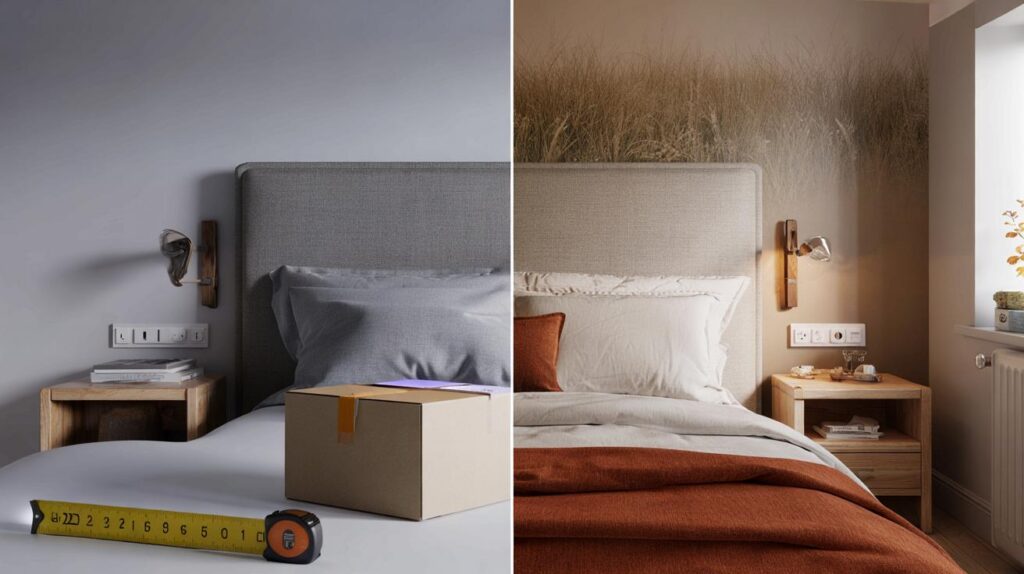
Autumn nudges bedrooms towards warmth, texture and calm. Tight budgets and tight spaces steer choices. Old habits face fresh scrutiny.
Across the UK and Europe, interior designers now question the classic padded or timber headboard. Many are switching to a vertical “feature backdrop” behind the bed, usually a made‑to‑measure wallpaper panel that frames the sleeping zone, saves floor space and costs far less than furniture.
Why the classic headboard is losing favour
Designers cite cost, bulk and sameness. A conventional headboard can swallow 8–12 cm of depth, crowding small rooms and blocking sockets. Large frames look dated when storage needs rise. Delivery times stretch. Fabrics mark easily. Timber needs dusting and care.
Households report paying £250–£600 for a headboard, plus delivery. Most feature wallpaper projects sit under €200.
Renter life also plays a role. Landlords often dislike wall fixings. People move more, and they want scheme flexibility. A replaceable wall finish helps refresh a space without committing to heavy furniture.
What replaces it: a tailored wallpaper “headboard”
The modern alternative uses wallpaper, mural or printed vinyl to zone the bed. The design spans the width of the mattress and a chosen height, sometimes up to the ceiling to draw the eye. The effect acts like a headboard without the bulk.
Suppliers offer pre‑pasted or peel‑and‑stick materials that cut cleanly and install fast. Many print to order, so the pattern scales to your wall. You pick colours and textures that support the mood you want: restful, cosy, crisp or bold.
Typical price points start around €39 per m² (about £34 per m²). A 3–5 m² panel often totals €120–€195.
What it does for the room
- Creates instant focus behind the bed and anchors side tables and lamps.
- Helps hide minor wall flaws when a textured print diffuses light.
- Visually widens a narrow room with horizontal motifs or a light timber effect.
- Raises perceived ceiling height with vertical stripes or a tall panel that meets the cornice.
- Supports seasonal changes: swap patterns without moving furniture.
How to choose colours and patterns
Soft neutrals in sand, stone and mushroom calm busy minds. Deep greens and blues add cocooning depth for darker months. Gentle geometrics give order without fuss. Natural fibres elsewhere in the room—washed cotton, linen, bouclé—add touchable comfort.
Children’s rooms benefit from playful, graphic or celestial prints that grow with them. For principal suites, tonal panoramas or low‑contrast geometrics reduce visual noise and aid rest. Always test two or three samples in night and morning light.
Installation: clean, quick and renter‑friendly
Pre‑pasted and adhesive wallpapers remove messy paste buckets from the process. Panels arrive numbered. You trim the top and bottom, butt the seams, and smooth with a felt tool. Two hours usually covers a standard wall behind a double bed.
Many modern coverings lift off in one piece and leave paint intact when prepped correctly—use primer and wait the manufacturer’s cure time.
Maintenance stays simple. Wipeable surfaces shrug off fingerprints and stray cocoa splashes. UV‑resistant inks keep colours stable when morning sun hits the wall. Moisture‑tolerant options work near en‑suite doors where humidity fluctuates.
Safety, durability and service features to look for
| Feature | Traditional headboard | Feature wallpaper panel |
|---|---|---|
| Typical outlay | £250–£600 plus delivery | From €39/m²; many projects under €200 |
| Footprint | 8–12 cm depth lost | Zero floor space |
| Installation time | 30–60 minutes plus fixings | Under 2 hours, tools light |
| Cleaning | Vacuum, spot clean fabric | Wipeable surface, stain‑resistant options |
| Changeability | Bulky to store or replace | Peel off and reprint a new design |
| Compliance notes | Materials vary | Fire‑rated and low‑VOC options available |
Seven reasons designers say the switch makes sense
Some suppliers even offer a 15‑day “swap before you stick” scheme: if the motif feels wrong on arrival, exchange it unused.
Style playbook: schemes that work
Warm minimalism for autumn
Choose a chalky mushroom ground with a faint basket‑weave. Pair with off‑white bedding, a rust throw and a reading light in aged brass. Keep the panel slightly wider than the bed for balance.
Quiet luxury on a budget
Pick a faux grasscloth or light oak grain. Run the panel to the ceiling and align bedside lights within its width. Add tonal artwork with slim frames for depth.
Calm kids’ rooms that grow up well
Opt for soft star maps or low‑contrast stripes. Use washable materials. When tastes change, replace the panel and keep the furniture.
Practical pitfalls and how to avoid them
- Measure twice: include skirting to cornice height if you plan a full‑height panel.
- Order a sample: colours shift under warm lamps and cool morning light.
- Prep the wall: fill, sand and prime to help clean removal later.
- Mind sockets and switches: mark cut‑outs before you start.
- Check tenancy rules: get written approval if you rent.
- Scale matters: large motifs need space; small repeats suit narrow walls.
Real‑world outcomes
A 35 m² city flat replaced a 10 cm‑deep velvet headboard with a 2.2 m‑wide mural. The room gained enough space to shift a bedside by 6 cm, freeing a socket and improving lamp placement. The panel cost £156 and went up in 90 minutes.
In a semi‑detached family home, a child’s bold jungle wall became a calming navy starfield before exams. The change took one afternoon with no furniture moves. Old panels lifted cleanly after a gentle heat from a hairdryer.
What to budget and how to plan
Work on 3–5 m² for a queen‑width focal area. At €39 per m², you land between €120 and €195, plus a small install kit. Add £15–£30 for primer and filler if the wall needs care. If you want a ceiling‑height run, increase the area and allow for pattern repeat.
Sketch the design within a 160–180 cm wide box for doubles, 140–160 cm for small doubles, and 200 cm for super kings. Mark lamp centres at 60–65 cm above the mattress. This keeps symmetry and ensures the print frames the scene.
Extra detail to help your decision
Acoustic benefit stays modest with wallpaper, but textured non‑wovens can reduce flutter echo slightly when paired with heavy curtains and a rug. If you need stronger sound control, consider a thin acoustic panel hidden behind the wallpaper within a timber frame.
For renters, test a removable adhesive on a low area first. Fresh paint needs to cure fully—often 14 days—before application. If you plan seasonal changes, store the next design rolled in a tube, upright, to avoid creasing.



We ditched our 10 cm velvet headboard for a tall wallpaper panel last month—game changer. It opened the room and finally uncovered that blocked socket. Cost us about £150 and took under two hours.
Isn’t wallpaper behind a pillow just asking for scuffs and oils? How does it hold up after a year of nightley use. And are the low-VOC inks actually certfied, or is that just marketing?