
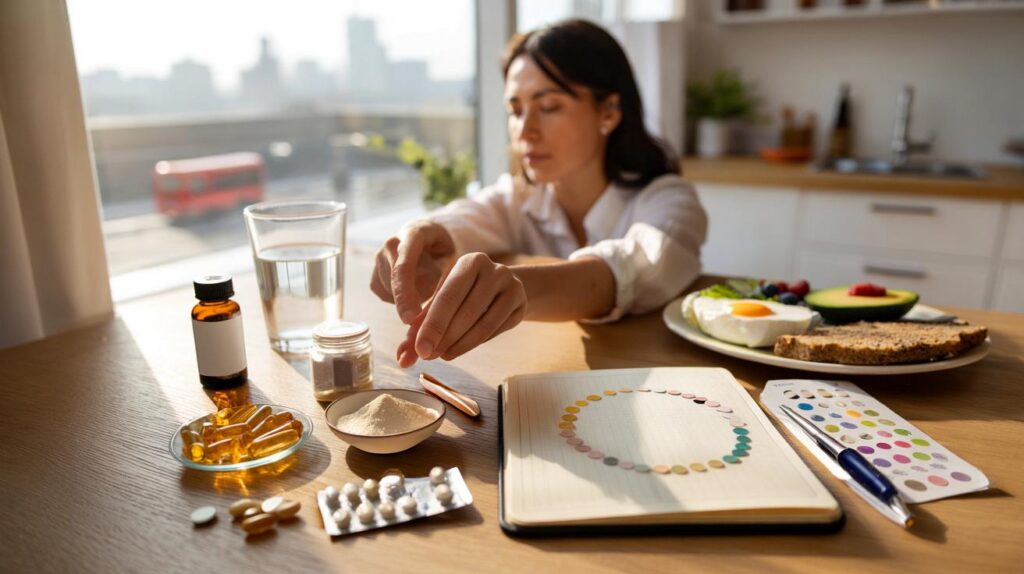
You open a cupboard and 11 half-empty bottles stare back. Mood swings that arrive like weather. Periods that act like they forgot your postcode. This is the quiet, messy reality for so many: trying to steady hormones with pills and powders, not entirely sure what’s signal and what’s noise. Between TikTok tips and a rushed chat at the chemist, it’s easy to feel stuck between hope and guesswork.
I’m in a London pharmacy watching two friends whisper in front of the “women’s health” shelf. One holds a pot of magnesium like it might answer a personal question; the other scrolls reviews as if the algorithm knows her luteal phase. We’ve all had that moment when you swear your mood has a mind of its own, then your period shows up a day late carrying snacks and apologies. The pharmacist glides past, mentions vitamin B6, and disappears again. So, which bottles are more than hope?
Reading the body’s signals before reaching for a bottle
Hormones are storytellers, and mood is often their loudest line. A sudden Monday fog, a tearful Thursday, then that jolt of relief when bleeding begins — it isn’t random drama. It’s chemistry nudged by sleep, stress, blood sugar, and the slow tide of oestrogen and progesterone. Some days, balance feels like a rumour. Before stacking supplements, it helps to map what your body’s already saying: when the dip hits, how long it lasts, and what else is happening around it.
A simple cycle diary changes everything. Two weeks of notes — sleep, stress, cravings, energy — and patterns start to surface like tramlines. One reader messaged me a graph where day 22 to 26 meant tears and toast; day 1 to 3 meant relief and naps. Small studies echo this: PMS mood symptoms often cluster in the late luteal phase, when progesterone drops and some people become more sensitive to stress. Even a basic phone note can turn “I feel off” into “I’m on day 24, this fits.”
Once the pattern is visible, logic enters the room. Oestrogen’s rise mid-cycle can lift mood and sharpen focus; its fall later can make the brain more reactive to poor sleep and low magnesium. Blood sugar swings add fuel, masking as “moodiness” when it’s really a breakfast built on caffeine and vibes. Iron dips from heavy periods can flatten energy, which the brain reads as sadness. This is why supplements sometimes help and sometimes do nothing — they work best when they match the root of your story.
Supplements that show promise (and how to use them)
Start with the basics most people skimp on. Many find magnesium glycinate in the evening (200–300 mg) eases premenstrual tension and sleep, while vitamin B6 (25–50 mg, often as P-5-P) supports neurotransmitter pathways that shape mood. Pairing both during the luteal phase can feel like softening the edges of a storm. Add quality omega‑3 DHA/EPA (1–2 g combined daily) for emotional steadiness; the evidence for PMS mood is decent, and it’s friendly to the brain in general.
For cycle regularity, inositol shines in specific cases. Myo-inositol (2–4 g daily) is well-studied for PCOS, helping ovulation and smoothing insulin sensitivity. Vitex (aka chasteberry) is a different story: low-dose extracts (about 20–40 mg) may help PMS and cycles that point to high prolactin or a short luteal phase, yet it’s not a match for everyone. Let’s be honest: nobody does that every day. Consistency still matters, and most hormone-friendly supplements earn their stripes over 8–12 weeks, not a weekend.
There’s also the “don’t harm” list. St John’s Wort can tangle with medications and hormonal contraception. High-dose B6 taken for months can backfire on nerves. Ashwagandha may not play nicely with thyroid issues. Vitex isn’t ideal if you’re on the pill. And 5-HTP plus SSRIs is a no. A GP or pharmacist can help you dodge the landmines — especially if you’re pregnant, breastfeeding, or managing mental health care.
“Supplements can be useful, but they’re tools, not magic,” says a London GP who spends half her week separating TikTok myths from decent evidence. “Match the tool to the job, and give it time.”
- Quick checks before you buy: medication interactions
- Baseline bloods if you can: ferritin, vitamin D, B12
- Start low, change one thing at a time
- Track symptoms for at least two cycles
- Reassess if nothing shifts after three months
Beyond bottles: small experiments, steadier rhythms
Supplements aren’t the whole story; they’re one instrument in an orchestra. Eat a breakfast with protein and fibre and your 3 p.m. spiral quietens. Walk 15 minutes at lunch and sleep arrives on time. Light earlier, screens later, and the luteal irritability loses its megaphone. None of this is glamorous. It is gloriously boring, like turning a dial from 7 to 5 and noticing you don’t cry at the advert anymore. For some, adding iron after heavy bleeds changes the week. For others, vitamin D in winter returns a sense of brightness you forgot you deserved. Fit the tools to your life, not the other way around.
| Point clé | Détail | Intérêt pour le lecteur |
|---|---|---|
| Start with foundations | Magnesium, B6, omega‑3, protein-forward meals, sleep windows | Reduces overwhelm; early wins without complexity |
| Match tool to pattern | Inositol for PCOS patterns; vitex for specific luteal issues; iron if ferritin is low | Higher chance of results, fewer dead ends |
| Safety first | Check interactions (SSRIs, contraceptives, thyroid meds), track for 2–3 cycles | Protects health and money; keeps progress measurable |
FAQ :
- Can supplements regulate my period on their own?Sometimes, if the issue matches the tool — inositol with PCOS, iron with deficiency, vitamin D with low levels. If cycles are very irregular or absent, speak to your GP to rule out thyroid, prolactin, or hypothalamic causes.
- How long until I feel a difference in mood?Expect 2–4 weeks for magnesium or omega‑3, 1–3 cycles for B6 or vitex. Track symptoms so you notice subtle shifts rather than guessing.
- Is chasteberry safe with the pill or hormonal coil?It’s not recommended with hormonal contraception because it may alter the intended balance. If you use it, do so under medical guidance.
- What if I get worse before I get better?Stop, take stock, and review interactions or dosing. Some people are sensitive to B6 or vitex; switching forms or focusing on sleep, protein, and magnesium can stabilise things.
- Are there mood-friendly options without interactions?Often yes: magnesium glycinate, omega‑3, and L-theanine are generally well tolerated. Always check if you’re pregnant, breastfeeding, or on medication.



This is the first piece that actually clarifed why my “Thursday tears” line up with day 24. Thank you for connecting sleep, blood sugar, and mood instead of just yelling “take x.” I feel less like guesswork, more like a plan.