
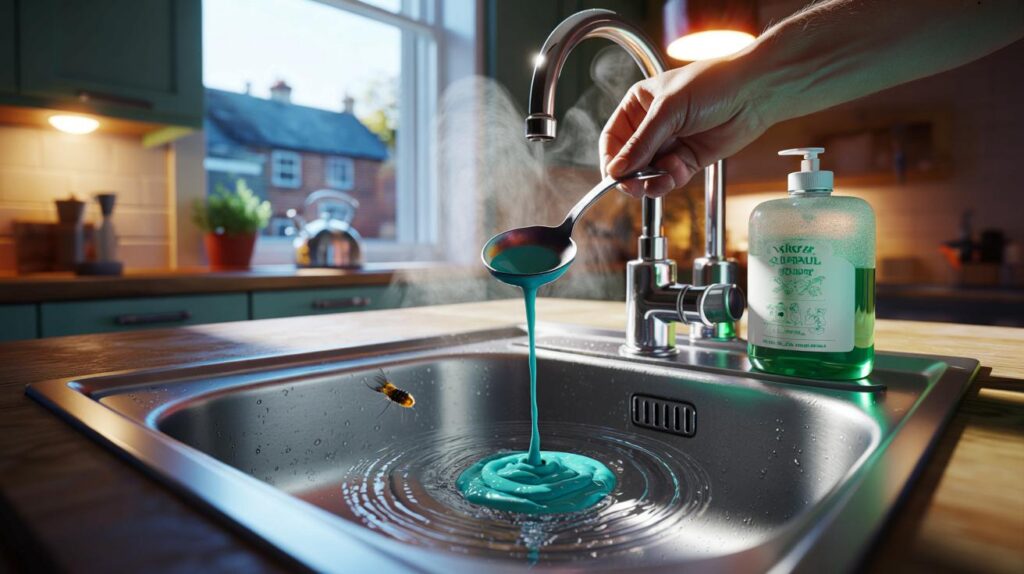
Households across Britain are being urged to pour a small squeeze of washing liquid down their drains. Not for sparkle or scent, but for a reason that feels oddly modern and very human.
The scene starts in a quiet kitchen before work: kettle on, window cracked, a faint sweet stink rising from the plughole. The gurgle sounds like a bad mood. A neighbour messages a link from the council Facebook page, the kind that usually gets three likes and a yawning emoji: “Drop of washing-up liquid down your drains tonight.” You try it almost ironically—teal swirls, a soft hiss, then a hush. The smell steps back. The drain fly that’s been doing laps on the tiles disappears by morning. You don’t expect an ordinary bottle by the sink to double as a tiny piece of civic hygiene. Yet here we are, suds as strategy. There’s a twist here.
The counterintuitive fix: soap, not bleach
Across terraces and tower blocks, the advice is the same: a teaspoon of washing liquid in slow or smelly drains, especially as temperatures climb. Summer supercharges biofilm and brings drain flies out to party. The fix isn’t flashy. It’s not about scrubbing—it’s about physics and a tiny insect.
Think of a ground-floor flat where the bathroom gurgles for weeks. The caretaker tries the old routine—boiling water, a brush, a squirt of bleach—only for the gnats to return by Friday. Then they switch to a weekly squeeze of washing-up liquid into each floor drain, followed by warm water. By the third week, the swarm is gone. Google searches for “drain flies” more than doubled last July; people were clearly hunting for something that works without a hazmat suit.
Washing liquid is a surfactant. It drops surface tension, collapsing the tiny water “trampoline” that adult drain flies and larvae rely on, while loosening the slimy biofilm that feeds them. A brief soapy film also re-primes U-bends that have dried out, stopping sewer gas sneaking back. You’re not nuking your pipes. You’re nudging a small ecosystem so it stops blooming in your bathroom.
How to do it safely at home
Pick a quiet time—late evening is ideal—then run the hot tap for 20 seconds. Add roughly a teaspoon of washing-up liquid to each sink, shower and floor drain, followed by a litre of warm water. For loos, a short squirt into the bowl, brush if needed, then flush. For outdoor gullies, a squeeze at the grate and a kettle of warm (not boiling) water. Think of it as tucking your drains in with a light duvet of suds.
Less is smarter than more. Choose a biodegradable formula and skip antibacterial mixes if you can, especially if you’re on a septic tank. Don’t mix soap with bleach or other chemicals; keep it simple. If you can smell rotten eggs or see backing-up waste, that’s a job for a professional. Let’s be honest: nobody really does this every day. Once a week in summer, or after a fortnight away, is a sweet spot.
When people hear “pour soap down the drain,” they imagine waste or guesswork. The reality is small, regular, and targeted. You’re not fighting a monster; you’re keeping a trap moist and a biofilm honest.
“A teaspoon of washing-up liquid is like a nudge to your plumbing,” says a London plumber who services big blocks. “It breaks the slime, re-primes the trap, and suffocates the flies. Most call-outs I see in July start with a dry U-bend.”
- Use: a teaspoon per drain, followed by warm water.
- Timing: evenings, weekly in warm months, after time away.
- Avoid: mixing with bleach, boiling water on PVC, big splashes outdoors.
- Choose: eco-friendly, non-antibacterial formulas where possible.
- Call a pro: if you have persistent blockages, sewage smells, or slow drains that don’t improve.
What this says about modern homes
There’s something telling about a nation turning to a humble bottle by the sink to keep buildings livable. Modern flats are sealed tight, warm, and stretched thin by hot summers; unused guest showers dry out, floor drains become tiny ecosystems, and odours hitch a ride into your hallway. A small ritual—soap, warm water, done—keeps those edges under control. It’s unglamorous, but weirdly communal; if everyone on your floor treats their drains, your stairwell smells different too. Tiny habits change what we smell, what we breathe, how we live together. On nights when the heat doesn’t budge and the city hums, the quiet relief of a sweeter kitchen and a silent bathroom feels larger than it should. And, shared from neighbour to neighbour, it travels faster than a noticeboard ever could.
| Key points | Details | Interest for reader |
|---|---|---|
| Why soap, not bleach | Surfactants lower surface tension, disrupt biofilm, re-prime traps | A fast fix that’s gentler on pipes and lungs |
| How to do it | Teaspoon of washing liquid + warm water, weekly in summer | Simple routine you can try tonight |
| When to call a pro | Persistent smells, slow drains, sewage backing up | Saves time and avoids bigger repair bills |
FAQ :
- Is pouring washing liquid down drains safe?Yes, in small amounts. A teaspoon followed by warm water is gentle on pipes and helps re-prime U-bends without harsh fumes.
- Will this clear a serious blockage?No. It can ease minor gunk, but heavy clogs, tree roots, or backed-up sewage need a plumber.
- How often should I do it?Weekly in warm months, and after time away when traps may have dried out. Monthly is fine in cooler seasons.
- What kind of washing liquid works best?Standard, biodegradable washing-up liquid. Avoid antibacterial types in large amounts, especially with septic systems.
- Can I use boiling water?Stick to warm or hot, not boiling, especially on plastic pipes. Boiling water can warp PVC and damage seals.



Just did the teaspoon + warm water on our bathroom and kitchen sinks — the gurgle stopped and the teeny gnats vanished overnight. Wild that surface tension is the trick, not bleach. Filing this under boring-but-brilliant home hacks.
Isn’t pouring soap down drains bad for rivers though? Even “biodegradble” stuff can foam up. Any sources on the impact at such small amounts, esp. for septic tanks?