
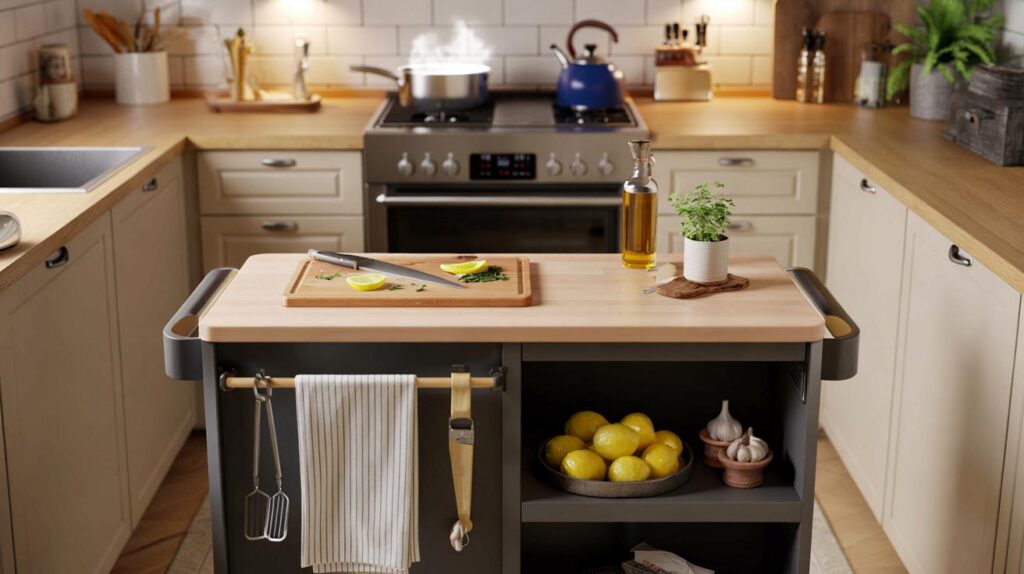
The first time I watched a rolling kitchen cart earn its keep was in a narrow London galley at 7pm, when dinner collides with life. Two pans steaming, the kettle coughing, a chopping board teetering on the edge. My friend nudged a slim cart out from a corner, locked the wheels, and suddenly there was a new slice of counter where there had been air. Utensils within a wrist-flick. Lemons in a shallow tray. Garlic in a little pot that looked like it had stories. Ten minutes later the cart slid away again, parking by the window with a plant and a bottle of olive oil like a mini still life. The room breathed out. Something tiny changed everything. Remember that feeling.
Why wheels beat walls in small kitchens
Walls are static; wheels are permission. A rolling cart gives you inches that act like metres, because it turns space into time. When you need prep, it’s a worktop. When you need to plate, it’s a landing pad. When you’re done, it’s a tidy trolley against the radiator, pretending to be furniture. *The cart is the room you don’t have.*
I saw it again in a one-bed flat in Leeds, where the fridge door blocked half the room if you opened it the wrong way. They kept a narrow beech trolley tucked beside the cooker. Friday nights it became a bar—tonic on top, lime wedges in a ramekin, bottles on the lower shelf. Sundays it rolled into the hallway for batch-cooking trays to cool. Midweek it moonlighted as a laptop perch for a quick Teams call. **Small wheels can unlock big rooms.**
What makes it work is simple geometry. A 40–60 cm-wide cart can slip through most doorways and sit parallel to standard 60 cm-deep cabinets without snagging knees. Locking castors stop creep. Open shelves mean everything is visible, which cuts down rummaging. The magic is movement: you pull work surface to the job, rather than dragging the job to the fixed work surface. That flips the script in tiny spaces, where walking two extra steps is half the battle.
How to set up a rolling cart that actually works
Start with a purpose. Give the cart a job title: prep station, coffee zone, baking caddy, bar, or mini-pantry. Match the top to the task—wood for chopping, stainless for messy prep, laminate for quick wipe-downs. If you cook often, pick a model with a lip so nothing slides off when you roll. Aim for 85–95 cm height so it meets your worktop without catching your wrist.
Then zone it. Top for active tools, middle for ingredients or kit, bottom for weighty or infrequent items. Use shallow trays as “drawers” you can lift out. Add S-hooks on the side rail for tongs and a tea towel. A magnetic strip for knives if you trust your bumps and knocks. One clever move: a lidded box for the ugly stuff—bin liners, rubber bands, that mystery cork. It keeps the look calm.
Soyons honnêtes : nobody wipes down their cart after every single coffee. That’s fine. What matters is flow. Keep weight low so it rolls smoothly. Keep handles flush so pockets don’t snag. If your floor is uneven, choose larger rubber castors; they iron out thresholds. We’ve all had that moment when you need one more square foot and it simply isn’t there. A cart creates that square foot on demand.
The flexible life: beyond the kitchen
There’s a reason restaurants love speed racks and service trolleys: mobility is efficiency. At home the principle is softer, more domestic, but it’s the same trick. A cart becomes a herb garden by the light, a breakfast console in the bay window, a homework bench beside the plug. On Friday it’s a bar. Saturday it’s a baking island. Monday it’s back to calm, herbs and cookbooks lined up like well-behaved guests.
Get real about mistakes. Overloading a tall cart with bottles on top makes it tippy. Too many tiny containers turns it into a travelling junk drawer. Metal-on-metal can rattle across old floorboards, so add a thin mat or switch to softer wheels. Don’t buy a cart that looks perfect but is 5 cm too wide to pass the bin—those 5 cm are your life.
One designer told me something I still scribble in notebooks.
“In a small home, anything that moves is worth twice what it costs.”
- Pick castors that lock both wheel and swivel for steady chopping.
- Keep the top 25% for today’s task, not storage.
- Use a tray to carry eight small items at once.
- Label shelf edges on the underside—visible to you, not to guests.
- Park it where it looks intentional, not apologetic.
The flexible life: beyond the kitchen
Think of the cart as a little promise: room on demand. It lets renters change a layout without a single screw in a wall. It helps sharers split stations—coffee up top, protein bars in a bowl, mugs hung like cheerful punctuation. It even softens the look of tech in a studio, because you can wheel the laptop away and reclaim a meal table. **A cart turns dead corners into working square metres.**
| Key points | Details | Interest for reader |
|---|---|---|
| Choose purpose first | Prep, coffee, baking, bar, or pantry dictates surface and height | Fewer bad buys, faster setup |
| Design for movement | Locking castors, rubber wheels, weight low, handles flush | Smoother rolling, safer chopping |
| Make it look intentional | Trays, side hooks, one closed box for “ugly” items | Calmer feel, easier to keep tidy |
FAQ :
- What size cart works best in a small kitchen?Look for 40–60 cm wide, 70–90 cm long, and around 90 cm high so it aligns with standard worktops and passes doorways.
- Can a cart really replace an island?Not fully, but it mimics the function: extra prep area, storage, and a place to gather. The gain is mobility.
- Will it scratch wooden floors?Choose soft rubber castors and keep grit off the floor. If you’re cautious, add felt rings or a thin runner under the parking spot.
- How much weight can they handle?Many hold 50–100 kg across shelves, yet check the maker’s figure. Keep the heaviest bits low for stability.
- What materials are easiest to clean?Stainless and laminate wipe fast. Oiled wood feels warm but needs an occasional refresh. Let’s be honest: no one actually does that every day.



This made my tiny galley breathe—the “cart is the room you don’t have” line is stuck in my head 🙂 Any recs for a model with soft rubber castors that won’t scuff old floorboards?