
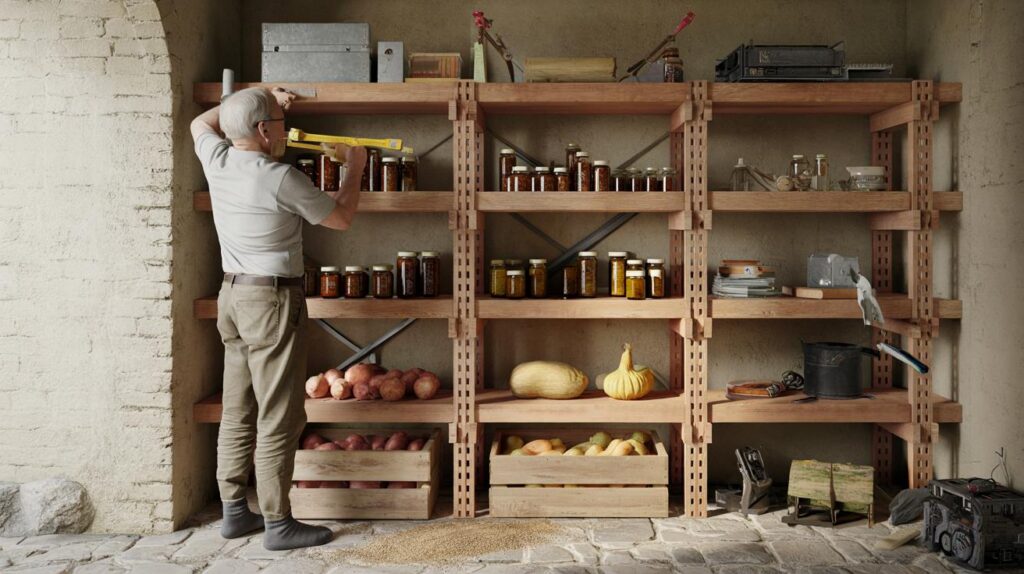
What if organising a cellar could quietly change how you shop, store, and waste less? One retiree decided to build his own wooden shelves, not for show, but for sanity—and a smaller footprint. The result looks simple. The impact isn’t.
The air down there was cool and a little sweet, like apples kept too long. Martin, 68, stood in his socks on the stone floor, pencil behind his ear, measuring the wall that had been swallowing boxes for years. He ran a hand along a stack of old timber he’d collected from a neighbour’s renovation, muttered something about “proper span”, and smiled at the thought of jars in tidy rows. Somewhere, a spider retreated behind a jar of chutney from 2019. He squeezed the tape, made a mark, and the pencil snapped. He laughed, picked another, kept going. He was building more than shelves. He was building a way to live with less fuss and less waste. Then he stopped.
The cellar that swallowed Saturdays
At some point, a cluttered cellar stops being a room and becomes a fog. You go in for tea lights and come out twenty minutes later with a mystery cable and the feeling you’ve lost the plot. Martin had reached that stage. Saturdays disappeared into the hunt for the potato sack, the vinegar, the camping stove. He wasn’t chasing perfection. He was chasing reachability. A place where onions breathe and labels face forward. Nothing fancy. Just wood, order, and the quiet thud of a loaf tin finding its place.
Martin’s first move was to banish the leaning towers of mixed boxes. He sketched a wall of shelves to fit the cellar’s wonky brick, using reclaimed scaffold boards for the spans and 63×38mm timber for uprights. He’d read that WRAP estimates UK households throw away roughly 4.5 million tonnes of edible food a year, much of it lost to forgetfulness. He wanted every jar visible, every crate slide-out simple. “If I can see it, I’ll use it,” he said, and started with one bay: four shelves, 1.8m tall, 400mm deep, spaced so a crate of apples didn’t bruise against the shelf above. Simple worked.
Why does a wall of shelves change behaviour? Visibility trims waste. Depth and spacing protect produce. Timber breathes, unlike plastic tubs that sweat and trap moisture. Martin positioned onions and squash at shoulder height, where they’d be seen first. Heavy gear sat low, pickles and jams lined the middle, and the top took seasonal kit. When the storage matches the way you move in a room, you stop stashing and start rotating. It’s not storage for storage’s sake. It’s a layout that nudges better habits without nagging you.
How he built it: simple, sturdy, repeatable
He worked in pairs: uprights at 600mm centres, shelves from reclaimed boards planed where needed. Each shelf sat on 38×38mm ledgers screwed into the uprights, with the ledger ends notched for a snug fit. He added a diagonal strap at the back of each bay to stop racking, then fixed the uprights to the wall with masonry screws and nylon plugs. The boards were wiped with vinegar and water, then sanded by hand. He left a finger of space at the rear to keep air moving. The rhythm was gentle: measure, cut, test, cup of tea. Repeat. **Reclaimed timber** never looked so dignified.
Common mistakes kept trying to sneak in. Shelves too deep swallow jars. Gaps too tight trap damp. Forgetting wall fixings turns a lovely idea into a wobble risk. Martin caught himself reaching for quick wins, then slowed. We’ve all had that moment when you stack just one more thing and hope for the best. He set a top load limit per shelf and kept heavy items below knee height. He labelled the front of each span with masking tape for now, plates later. Let’s be honest: nobody does that every day. Still, most days is enough.
He swore by a pencil, a square, and patience. The joy came from the click of a true 90-degree corner and the small pride of an evening tidy. It felt like building a second pantry.
“I wanted it to be **anchored, not wobbly**. And I wanted to breathe in there. It’s a cellar, not a submarine,” Martin laughed. “Now I can find the vinegar before I buy another bottle.”
- Core materials: 63×38mm softwood for uprights, 38×38mm for ledgers, reclaimed boards for shelves
- Fixings: 5×70mm wood screws, masonry screws and plugs for wall ties
- Extras: vapour-open paint, brackets for crates, chalk labels, silica sachets for tool drawers
- Smart positioning: roots low, preserves mid, kit high; keep a **breathable storage** path behind jars
- Safety: tie to wall, glove up, lift with legs, test loads before stacking
From timber to habit: what changed
Here’s what shifted after the shelves went up. The cellar turned from stash spot into a working larder. Martin began keeping a small inventory on the back of the cellar door, ticking off as he used things and making notes when a shelf felt sparse. He found he cooked more from stores and shopped with a list. The shelves didn’t make him virtuous. They made it easy to see what he already had, so those impulse “just in case” tins didn’t pile up. Friends started bringing empty jars. The cellar became a quiet part of his week rather than a wrestling match.
| Key points | Details | Interest for reader |
|---|---|---|
| Build for visibility, not volume | Shallow shelves, clear labels, air gap at the back | Reduces waste, speeds up everyday cooking |
| Use reclaimed, tie to wall | Scaffold boards, softwood uprights, solid fixings | Sustainable, sturdy, budget-friendly |
| Design nudges habits | Heavy low, often-used mid, seasonal high | Makes “being organised” almost automatic |
FAQ :
- What wood works best in a cellar?Softwood uprights and reclaimed boards are fine if the room is reasonably dry. Choose straight timbers and avoid painted boards of unknown finish.
- Do I need a damp barrier?If walls weep or smell musty, improve ventilation first. A breathable paint or limewash helps more than plastic liners that trap moisture.
- How much weight can a shelf take?With 38×38mm ledgers and boards spanning 600mm, a well-fixed shelf comfortably holds crates and jars. Test with water jugs before loading preserves.
- How do I keep mould off jars and tools?Air gaps, clean boards, and spacing between items. Keep cardboard off the floor. Use silica gel in drawers and rotate stock.
- Can renters build this without drilling?Free-standing bays with cross-bracing work, but they must be stable. Consider tension poles to add light bracing, or ask permission for discreet wall ties.



Love the focus on visibility over volume. Since you used 63×38 uprights and 38×38 ledgers at 600mm centres, could you share a rough cut list per bay? I’m realy curious how many boards you needed and the typical shelf spacing for jars vs apple crates. Also, did the vinegar-and-water wipe leave any odour on the timber, or does it flash off quick? Thanks for the pragmatic, no-fuss approach.
Interesting, but I’m not sold on “timber breathes” as a big win. In a damp cellar, wood can soak up moisture and go wavy—mabye worse than a ventilated plastic crate. Any long-term data or tips beyond limewash and airflow? I’d hate to build this only to fight mould in a year.