
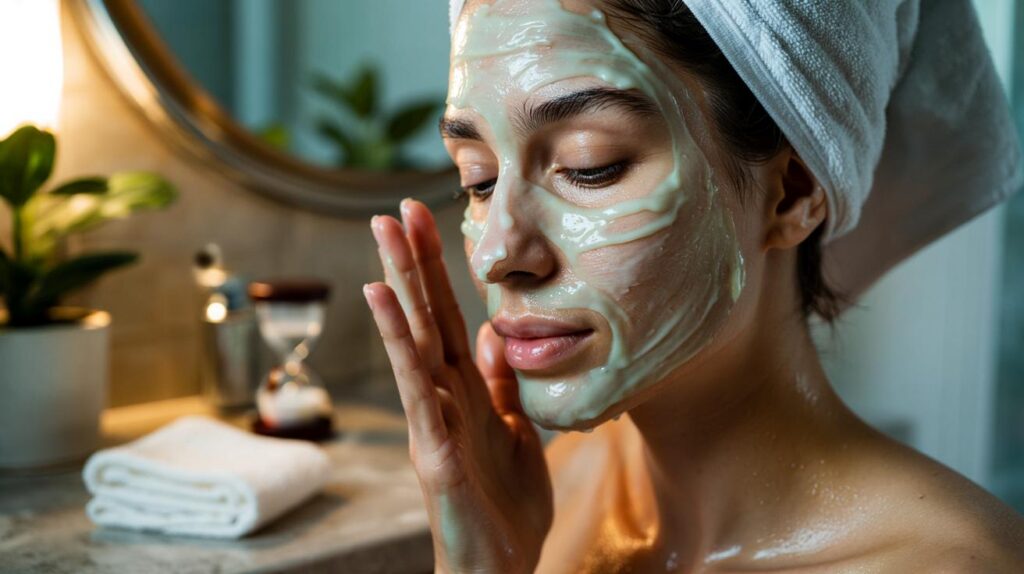
You smooth on a mask and wait for glow, but it just sits there, slick and shy, like it’s afraid of your face. We’ve all had that moment when the timer goes off, the kettle whistles, and your mask has done little more than menace your pores.
The bathroom was fogged from a shower that had run a touch too long. My friend Meg anchored a sheet mask along her cheekbones, pushing out creases with the pad of her thumb. It looked glossy, theatrical, almost right. Then gravity won. The edges peeled away as she scrolled, eyes half on a group chat and half on her reflection. Across town, a teenager in a pharmacy aisle posted a video of clay cracking like a dry riverbed. The myth remains: more mask, more glow. People chase that cool, tight feeling like it’s proof. It isn’t. The trick is timing.
Why masks seem to sit on top
Skin isn’t a sponge. It’s a barrier—bricks and mortar, cells and lipids—designed to keep the world out and your water in. When that barrier is parched or rough, product pools on the surface and feels performative. You see sheen, not change. Hot water, central heating, stress, even fast cleansing can tighten the outer layer so it refuses to budge. Watch a clay mask blanch from grey to chalk and you’ll see the story: evaporation outpaces absorption. The product dries; your face doesn’t drink.
Now picture the opposite: you step out of the shower, pat to damp, and use a gel mask with glycerin and a touch of urea. It glides, then grips. Hyaluronic acid pulls in water it’s given—no magic there, just chemistry. A small tweak in routine can double how soft your skin feels by morning, not because the mask “went deeper”, but because your outer layer stayed flexible. When I asked Meg to apply her sheet mask on a barely damp face, she texted me at midnight: “It didn’t slide. It hugged.” The mirror agreed.
Absorption, in beauty-speak, is mostly diffusion. Water swells the top cells so actives can move along a gradient, and occlusion slows evaporation to buy them time. Texture matters: gels and creams linger; clays pull and then need removing before they overstay. pH matters a little too—vitamin C likes it low, peptides prefer gentle. None of this is about bulldozing the barrier. It’s coaxing. A soft canvas, an even layer, and the patience to let the surface do what it’s built to do.
The method that actually works
Start clean, not squeaky. Use a mild, low-foam cleanser for 60 seconds, rinse tepid, and leave the face lightly damp. If you exfoliate, keep it to once or twice a week with something gentle, then wait a minute. For a cream or gel mask, warm a blueberry-sized amount between fingertips and smooth from centre to ear, feathering at the hairline and under the jaw. Press along the nose. Thin enough to see skin through it. **Thin layers win.** For a sheet mask, pour a teaspoon of excess essence into your palms, pat that in first, then fit the sheet and smooth bubbles outwards with slow, rolling presses.
Time is a setting, not a dare. Clay should never reach the crackle stage—remove when it lightens at the edges, while the centre is still a little damp. Don’t talk on the phone with a sheet mask on; it lifts with every word. Rinse masks with cool-to-lukewarm water, no scrubbing, then pat—not rub—your face dry. Follow with a serum if you like, then a mid-weight moisturiser to lock things in. **Moisturiser is the seal.** Let’s be honest: nobody really does that every day. Aim for once or twice a week and you’ll still notice the difference.
Pair like with like. Hydrating masks love a misted canvas; clay masks like a clean slate; retinoid nights prefer something bland and soothing. Avoid piling acids under strong actives—you want comfort, not fireworks. Seal the session by giving your skin thirty quiet minutes before bed, screens away if you can manage it. **Press, don’t rub.**
“The mask is the show. The prep and the pause are the plot.” — an aesthetician who has seen every shortcut and every glow
- Before: cleanse, leave skin damp, skip harsh scrubs that day.
- During: thin, even layer; watch the clock, not your notifications.
- After: rinse gently (if needed), pat dry, moisturise, sleep.
Make space for results
A mask that truly lands isn’t louder—it’s calmer. Give your skin a quiet runway and ordinary products start to feel like they’re punching above their weight. The ritual is small: water on the face, product on damp, a few patient minutes, then a soft finish. This is skincare, not a sprint. Pause long enough to notice how your face feels under your fingers. That’s your feedback loop. Maybe you’ll find clay works best at lunch on Saturdays, or that your gel mask sings after a run when cheeks are warm. Share it with a friend who keeps asking why hers won’t sink in. The magic isn’t in a jar; it’s in the choreography you set around it.
| Point clé | Détail | Intérêt pour le lecteur |
|---|---|---|
| Apply on damp skin | Pat-dry post cleanse, leave a light film of water | Boosts diffusion and comfort without dilution |
| Layer thin and even | Blueberry-sized amount, see-through finish | Reduces pilling, sliding, and waste |
| Remove at the right time | Clay off before cracking; rinse cool; then moisturise | Prevents rebound dryness and preserves glow |
FAQ :
- Should I rinse after a sheet mask?If the essence is comfortable, you can leave it on and follow with moisturiser. If it feels sticky or you used actives underneath, lightly rinse and then moisturise.
- How thick should a clay mask be?A thin, even veil. You should still see some skin tone through it. Thick layers dry patchy and pull moisture out.
- Can I use a mask after retinoid or acid nights?Yes, but choose soothing, fragrance-free hydrators. Skip extra acids to keep the barrier happy.
- What’s the best time of day?Evening lets you seal with moisturiser and sleep. Morning works for short hydrating masks if you finish with SPF.
- Why does my mask pill?Too much product or silicone-heavy layers underneath. Use less, apply to damp skin, and let each layer settle for a minute.



Testé ce soir sur peau à peine humide + couche fine: le masque gel a enfin “accroché”. Franchement, le conseil de ne pas laisser l’argile craqueler m’a sauvé la peau. Merci !
Question: sur peau grasse/à tendance acnéique, appliquer sur peau humide ne fait-il pas glisser d’avantage et boucher les pores? Je flippe un peu des gels collants. Des astuces pour éviter le film poisseu?