
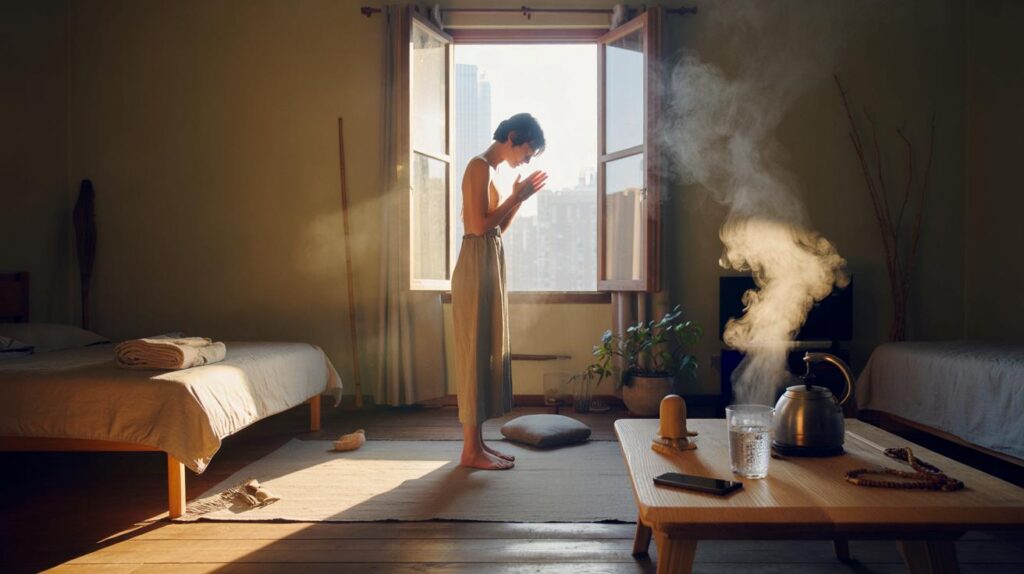
Your alarm screams, your thumb finds the screen, and the day starts in a sprint you didn’t choose. Coffee becomes a crutch, the inbox a flood, your shoulders inching up before 9 a.m. Meanwhile, somewhere in a quiet courtyard, a bell sounds, robes rustle, and a floor is swept with the patience of rain. Two mornings. Two brains. One choice to make tomorrow feel different.
The kitchen clock read 5:37 and the kettle hummed like a polite bee. I stood barefoot on cold tiles in the half-light, the city still yawning. A memory surfaced: dawn at a hillside monastery in northern Thailand, the wooden gong rolling over the valley, monks padding into the mist, breath clouding like prayer. No rush. No buzz. Just a sequence that held them, move by measured move. Back home, my phone glowed like a small black sun. The contrast felt loud. We’ve all had that moment when the day decides you before you decide it. What if five minutes changed the whole day?
What dawn looks like when your life is ritual
Monks don’t “win the morning.” They inhabit it. The wake-up is plain and early, the actions simple enough to do on tired feet: water over the face, a bow to the light, a clean sweep of the floor, a few quiet chants that feel more like deep breaths with edges. No drama. No hacks. The routine is a small boat that ferries the mind from sleep to clarity. You can see it in the pacing, in the way a kettle is set down, in the way silence is shared. The point isn’t holiness. It’s rhythm.
On my second day at the monastery, a novice showed me how he starts. He folded his blanket once, then again, hands smooth and slow, then sat and counted ten breaths with the steadiness of a lighthouse. Later, he swept fallen leaves into a tidy arc outside the hall, one quiet stroke at a time. Back in London, my friend Mia borrowed just the breath count. She does it on the edge of her bed. No cushion, no app, three minutes. She swears her commute feels less like battle, more like weather she can walk through.
The logic isn’t mystical. Strip the first minutes of choice and noise and your nervous system settles. Fewer decisions mean less early willpower wasted on tiny things. A repeated sequence tells your brain, “We’re safe, we’re steady,” so stress hormones don’t spike at the first email. Small physical cues—cool water on skin, a window opened for fresh air, a few slow exhales—downshift the body and prime attention. Habit science calls it an anchor. Monks call it practice. The effect is the same: you create a groove the day can ride in, rather than skidding all over it.
Build your monk‑inspired morning, step by humble step
Start with twenty minutes you can defend. Think of it as four short stations. First, wake without reaching for glowing rectangles. **Phone stays out of reach.** Sip water. Open a window and meet the light, even grey light. Second, sit for three to five minutes and count breaths up to ten, then back to one. If you drift, you start again, no sighing. Third, move gently: neck circles, shoulder rolls, a slow fold forward, hips waking. Fourth, one mindful act—kettle, shower, bed-making—done so you could narrate it frame by frame. Close by naming an intention in seven words or less.
Common traps? Turning it into a performance. Buying a new journal, a robe, three apps, then feeling guilty by Friday. Keep it domestic and doable. Start tiny, not heroic. If twenty minutes feels like a fantasy, do five and protect them like you would a good secret. If you miss a day, it’s a day, not a verdict. Let’s be honest: nobody does this every single day. Parents, shift workers, students—it flexes. A monk isn’t waiting with a clipboard. The routine serves you, not the other way around.
Ritual also needs kindness in the rough patches. Build friction against old habits and ease for new ones: charge the phone outside the bedroom, leave water and a mug where you’ll see them, put a cushion by the chair. **Three breaths, then move.** Distraction will still flirt with you. That’s fine.
“When you sweep the floor, you sweep the mind.” — temple saying passed from elder to novice
- Bow to the day: a single nod at the window, palms together, one slow inhale.
- Three-breath rule at thresholds: pause before you exit the bedroom or enter the kitchen.
- Drink your first glass of water as if tasting rain.
- Make the bed with one smooth pull, then one smoothing hand.
- Sweep ten strokes—literal broom or a quick tidy—just enough to say “this space matters.”
Let the morning ripple, not explode
Keep the tone gentle and the gains sneak up on you. The monk trick is less about length, more about repeatability. *This is not about perfection, it’s about direction.* When the first minutes are quiet and owned, your afternoon meetings feel less jagged, your evening less like a crash. You start noticing the tiny pauses you’ve built, like hidden lay-bys on a busy road. Over a week, you’ll find yourself craving that first glass of water, that small bow to the light. Over a month, people will ask why you seem a bit less hurried. **Ritual beats motivation.** The day stops bullying you. You meet it on your feet.
| Point clé | Détail | Intérêt pour le lecteur |
|---|---|---|
| Start phone‑free | Keep the device outside the bedroom or on aeroplane mode until after your first ritual | Protects attention and mood before work or news intrude |
| One anchor practice | Three to five minutes of breath counting or quiet sitting, same spot, same time | Stabilises the nervous system and reduces early decision fatigue |
| Close with intention | Seven words or less: “Write page one,” “Be patient with James,” “Walk at lunch” | Gives the morning a forward thread you can actually follow |
FAQ :
- How early do I need to wake?You don’t need 4 a.m. mystique. Wake at a time that allows 10–20 quiet minutes before obligations. Consistency matters more than the hour.
- What if I have kids or a flatmate schedule?Go smaller and sneakier. Two minutes on the edge of the bed, three slow breaths at the door, a mindful kettle—done before anyone notices.
- Can I drink coffee?Yes. Pair it with a ritual: first sip in silence, one full inhale before you reach for the mug, notice warmth and aroma. Coffee can be part of the practice.
- Do I have to meditate?No. You can sweep, stretch, chant softly, journal a few lines, or sit with breath. The point is a repeatable, calming anchor.
- How long before it feels natural?Give it two weeks of “good enough.” By week three, the body starts asking for it. By week six, it’s weird not to do it.



Testé ce matin: eau froide, fenêtre ouverte, 10 respirations comptées, deux minutes d’étirements, puis une intention en 7 mots (“Être doux avec moi et les autres”). Résultat: trajet moins agressif, boite mail moins menaçante. Franchemant, la partie “pas de téléphone” pique, mais l’ancre respiratoire change vraiment la donne. Merci!
Honnêtement, belle écriture mais je reste sceptique. Les moines ont un cadre, nous on a enfants, coloc, horaires éclatés. Je crains que ça devienne une injonction de plus à “optimiser” nos vies. Comment garder la douceur sans culpabiliser quand on loupe trois matins d’affilée?