
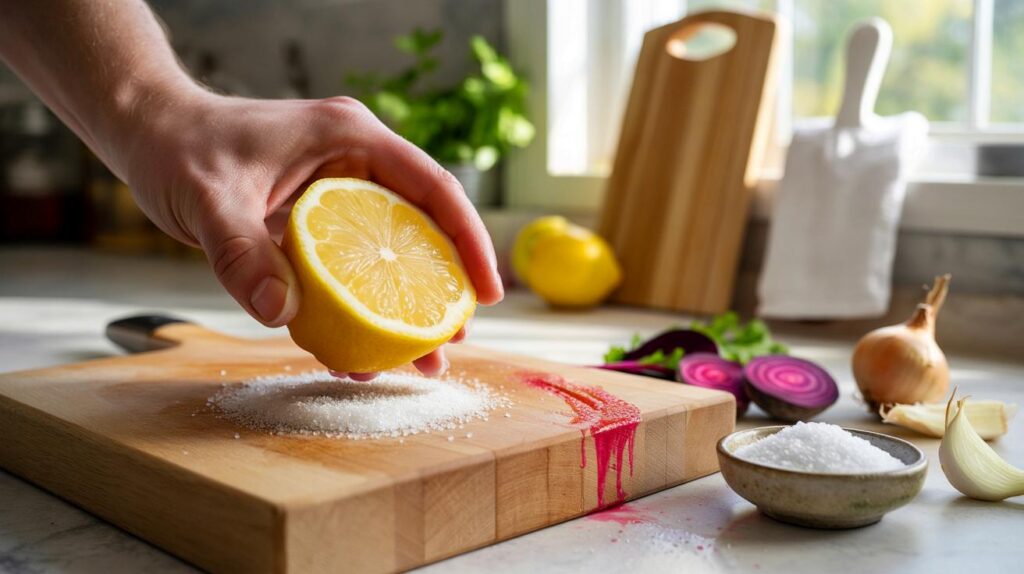
Your chopping board looks clean after a quick rinse. Then the onion smell hits. Little scratches hold garlic, beetroot stains bloom in the grain, and you start eyeing the bleach. You don’t want your salad tasting like a swimming pool, though. There’s a calmer way. It’s in the cupboard, it’s cheap, and it won’t strip your board or your hands.
I watched a neighbour rub half a lemon across a heavy beech board, salt crystals popping under the pressure like tiny stones under a tyre. The citrus misted the air, sharp and clean, and the board darkened where the juice met the grain. He worked in small circles as if polishing a shoe. A minute later, he tilted the board to the window. No harsh spray. No rubber gloves. Just a kitchen that smelled like late summer and a board that looked less tired. No spray bottle in sight.
Why salt and lemon work on chopping boards
Granular salt is a gentle abrasive, the sort that scrubs without gouging. Lemon juice is acid, bright and slightly sticky, so it clings to stains and cuts through surface grease. Together they lift odours that cling to wood and plastic in a way soap alone doesn’t. Think of it as a tiny beach for your board: grit, tide, then sun.
We tried the trick on three boards in a shared flat: one plastic, one bamboo, one old oak. The plastic had a mustard ring, the oak reeked of garlic, the bamboo looked dull. After two minutes of salt and lemon on each, the mustard mark faded by half, garlic vanished, and the bamboo grain woke up. No lab coats. Just a kettle, a lemon and a small bowl of salt.
There’s a simple science to the magic. Salt draws out moisture by osmosis, which helps pull odours and pigments from shallow cuts. Citric acid (pH around 2) loosens fats and tannins, so they release with a light scrub. You get mechanical action from the crystals, chemical action from the acid, and the lemon’s oils leave a fresh, food-friendly scent behind.
Step-by-step: the salt-and-lemon method
Sprinkle a thin, even drift of coarse salt over the board. Halve a lemon and use the cut side as your scrubber, squeezing lightly as you go. Work in circles for 60–90 seconds, push juice into the grain, then leave the briny citrus to sit for 3–5 minutes. Rinse with hot water, stand the board upright, and dry with a clean tea towel. It takes two minutes and a lemon.
Use coarse sea salt or kosher salt. Table salt is too fine and melts before it can scour. Don’t soak a wooden board; moisture in the joints is how warping starts. If fibres lift slightly, let the board dry fully, then smooth with a quick pass of fine sandpaper and rub in a lick of food-grade oil. Let’s be honest: nobody really does that every day.
For tougher jobs, add a pinch more salt and a touch more pressure. If a turmeric halo or beetroot bruise refuses to budge, repeat once and give it longer to rest in the juice. Then rinse hot and dry well.
“Salt is your scrub, lemon is your lift. Together they reset the board without fighting the wood,” said a London café cook who cleans five boards a day.
- Use the lemon rind as a last pass: the zest’s oils add a clean finish.
- Sunlight helps fade stains naturally; give the board a short window perch.
- Wipe edges and handle cut-outs; odours love hiding in corners.
- Finish wood with a thin coat of neutral oil to seal the fresh grain.
Care, safety, and when to replace a board
Keep one board for raw meat and another for veg and bread. Heat is your ally: plastic boards can go in a hot dishwasher cycle, while wood prefers hot water, a quick scrub, and air. For everyday veg and fruit, **salt and lemon** are a clean, friendly reset.
On a day when the kitchen smells busy, a salt-and-lemon pass calms the space fast. We’ve all had that moment when last night’s garlic barges into this morning’s peaches. Use the method as a reset before you cut anything sweet. For deeper odours, leave the salted lemon juice on the board a bit longer, then rinse hot and dry standing up, not flat.
Replace a board when deep grooves won’t sand out or the wood starts to split. Those trenches trap moisture where cleaning can’t reach. If a board stays damp in the centre after a night upright, the fibres may be tired. Retire it to craft duty or the barbecue pile, and treat yourself to one that will last. Your knives will thank you.
The quiet power of a simple clean
This little ritual isn’t about perfection. It’s about a board that smells like nothing, so your strawberries taste like strawberries and your parsley doesn’t borrow yesterday’s fish. You’ll feel it in the way the knife tracks, the way the surface squeaks when it’s truly clean. **No chemicals needed**, just kitchen things doing kitchen things.
It’s not performative sustainability either. It’s a small, handy habit that keeps wood happy and plastic from getting a weird gloss. Try it once, then try it on the board you thought was past saving. The lemon wakes the grain, the salt does the grunt work, and suddenly your counter looks fresher. A humble, **everyday reset** that quietly changes how your kitchen feels.
| Key points | Details | Interest for reader |
|---|---|---|
| Why it works | Salt abrades and draws moisture; lemon’s citric acid loosens stains and odours | Confidence in a natural method that actually cleans |
| How to do it | Coarse salt + lemon half, scrub 1–2 minutes, rest 3–5, rinse hot, dry upright | Clear, fast steps you can try today |
| Care and safety | Separate boards, avoid soaking wood, use heat for meat boards, replace when grooved | Clean boards without fuss or harsh products |
FAQ :
- How often should I clean a board with salt and lemon?For everyday use, once or twice a week is great. After strong-smelling foods, give it a quick pass straight away.
- Does this method disinfect after raw chicken?Salt and lemon reduce odours and surface grime, but they’re not a medical-grade sanitiser. Use a separate meat board and clean it with hot soapy water followed by heat (dishwasher for plastic, boiling rinse for wood’s surface).
- Will lemon damage wooden boards?Used briefly, no. Don’t soak; rinse with hot water, dry upright, and oil the board now and then to keep the grain sealed.
- What type of salt works best?Coarse sea salt or kosher salt. The larger crystals give you gentle scrubbing power without chewing the surface.
- Can this remove turmeric or beetroot stains?Often, yes. Scrub, rest 5 minutes, rinse hot. Stubborn patches may need a second round and a short spell in sunlight to fade.



Tried this on my beat-up oak board after a curry night. Coarse sea salt + half a lemon, 90 seconds of scrubbing, quick rest, hot rinse. The garlic funk vanished and the turmeric halo faded a ton. The surface even feels “squeaky clean” like you said. I skipped bleach for once and didn’t miss it. Pro tip from the piece about drying upright was key—no damp smell next morning. Definately adding a light oil rub after; the grain woke right up.
Looks neat, but is this actuallly safe enough after raw chicken? The FAQ says it’s not a sanitizer—so would a boiling-water rinse be enough for wood, or am I risking cross-contam? Also, does the acid eventually dry out the board if used too oft?