
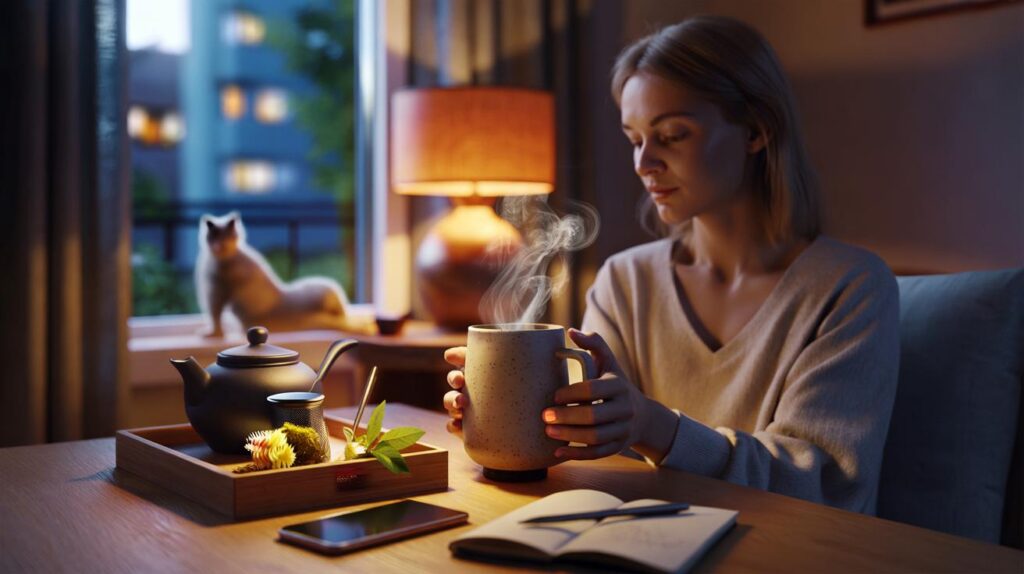
There’s a world of difference between sipping a random herbal brew while doomscrolling and having a small, repeatable ceremony that whispers to your nervous system: lights out. The first is a drink. The second is a signal. If your nights feel jittery, a bedtime tea ritual can become the hinge between a noisy day and a softer night, a cue your body recognises without debate. Not magic. Just pattern, place, and pace.
It starts with a kettle’s sigh and a quiet room. Late evening, the city outside still buzzing, you catch your reflection in the window and dim the lamp to amber. Steam blooms around a heavy mug, the kind that warms your palms. Your phone lights up; you turn it face down without a glance. The chamomile smells like a meadow after rain. You stir the spoon three times, the tiniest chime against ceramic, then sit and breathe while the leaves unfurl. A neighbour’s cat pads along the fence; the kettle clicks as it cools. You pour. You pause. You sip, slow enough that the moment widens. The tiny ritual feels oddly serious, like tying a ribbon on the day and tucking it away. The tea is the message.
Why a ritual works better than a random mug
Your body loves rhythm more than willpower. Across a day, hormones rise and fall in waves, core temperature dips and climbs, and the brain searches for patterns to follow. A bedtime tea ritual bundles gentle cues—warmth, scent, light, touch—into one consistent moment. That consistency builds a pathway. Do the same things, in the same order, at roughly the same time, and your system starts to anticipate what comes next. **Signals beat intentions.** Think of it less as “drinking tea” and more as “marking the edge” between being on and switching off.
A friend of mine, Maya, commutes across London and used to collapse into bed with Netflix chatter still in her head. She set up a tiny ritual for 21 nights: kettle on at 9:30pm, lights to warm, lemon balm and chamomile, three deep breaths, one page of a paper journal, screens away. By week two, she noticed she yawned as she filled the mug. By week three, she felt drowsy halfway through. One in three UK adults struggles with poor sleep quality; a cue-based wind-down won’t fix everything, but it gives your body a reliable path to follow. Tiny cue, outsized effect.
The logic is simple conditioning. Your nervous system links repeated sensations with outcomes. Warm ceramic in your hands, the earthy-sweet scent of herbs, the visual of steam in low light—over time, these become shorthand for “safe to power down.” There’s physiology underneath, too. Warm drinks can nudge peripheral blood vessels to dilate, helping your core temperature drift downward afterwards, which aligns with natural sleep onset. Dim light cues melatonin release. Quiet, rhythmic breathing nudges the vagus nerve and lowers arousal. Put together, the ritual does what a lone tea bag can’t: it speaks your body’s language.
Build a bedtime tea ritual that sends a clear signal
Start with time and order. Choose a 20-minute window you can hit most nights—say, 60–90 minutes before lights out—and keep the sequence identical. Kettle on. Lights to warm. Phone face down, Do Not Disturb. Choose a herbal tea with a scent you love: chamomile, lemon balm, rooibos, or a lavender blend. While it steeps, breathe through your nose for four seconds, hold for four, out for six. Count three rounds. Stir three times in the same direction. Sit in the same chair. Sip slowly, focusing on the first and fifth sips. **Your body learns best from repeatable anchors.**
Pick a mug you associate only with evenings. Sounds fussy, but tactile cues matter. Opt for a heavier ceramic and a neutral colour. Keep sweetness low or skip it to avoid a glucose bump. If you tend to wake to use the loo, pour a smaller cup earlier in the window and finish no later than 45 minutes before bed. Set your lamp at a warm hue, and let one soft sound—quiet jazz, rain on a loop—play at the same volume each night. We’ve all lived that moment where you’re “just checking one message” and end up spiralling. So place the charger in another room. Let your ritual own this corner of time.
Let mistakes be part of the design. If you miss a step, carry on anyway. The signal is the sequence, not perfection. Let’s be honest: nobody actually does this every day. If caffeine sneaks in, shrug and switch to rooibos tomorrow. If you feel restless, lengthen the breathing by one round and shorten the cup size by a third. Permission to keep it small beats pressure to make it perfect.
“Rituals are just consistent stories we tell the body. Keep the story simple, repeat it often, and the body remembers.”
- Time anchor: same 20-minute window, 60–90 minutes before sleep.
- Sensory anchors: warm mug, distinct scent, dim amber light.
- Sequence: kettle, lights, phone face down, breathing, stir, sip, journal line.
- Boundaries: no screens, no heavy snacks, no last-minute work.
- Recovery rule: if you skip, restart the next night without guilt.
Make it yours, then let it do the work
A ritual sticks when it feels like you, not like homework. Maybe you swap music for the hum of a fan, or trade a journal line for brushing your hair slowly. Maybe you add a tiny “closing tab” sentence you say out loud—“enough for today”—before the first sip. If a partner or housemate shares the space, invite them in or set a visual boundary with a throw and a chair angle. Tea isn’t a sleeping pill; it’s a cue. When you give your body the same cue, in the same shape, night after night, it will start to meet you halfway. Share your version. Tweak it. Keep the bones, change the clothes.
| Point clé | Détail | Intérêt pour le lecteur |
|---|---|---|
| Create consistent cues | Repeat the same sensory steps in the same order each night. | Builds a predictable path to drowsiness. |
| Mind the timing | Begin 60–90 minutes before bed; finish tea 45 minutes before lights out. | Aligns with natural temperature and melatonin rhythms. |
| Keep it small and human | Short, enjoyable, easy to recover if you miss a night. | Makes the habit stick without pressure. |
FAQ :
- What herbs actually help at night?Chamomile, lemon balm, lavender, rooibos, and passionflower blends are popular. The key is a scent you genuinely like so your brain tags it as “evening”.
- When should I drink the tea?Start your ritual 60–90 minutes before sleep and finish the cup about 45 minutes before lights out to avoid unwanted wake-ups.
- Does it really work or is it placebo?Rituals create conditioning. Over time, repeated cues lower arousal and set expectations, which is exactly what you want before bed.
- What if I can’t drink much before bed?Use a smaller mug, sip slowly, and lean on scent and warmth. You can also hold the mug for a minute, breathe in the steam, then take just a few sips.
- Is decaf black tea okay?Decaf still contains a little caffeine. If you’re sensitive, choose naturally caffeine-free herbs like rooibos or chamomile.



Loved the idea that “the tea is the message.” I tried the three-stir thing tonight and weirdly started yawning by sip five. The heavier mug + dim light combo felt like a mini off-switch. Simple, human, repeatable—thank you for this.