
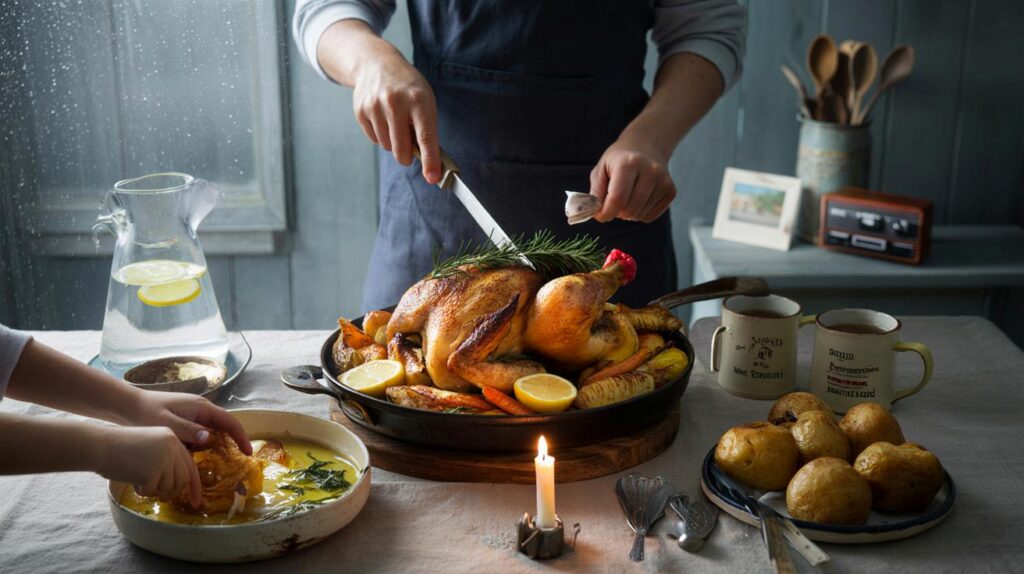
Sunday roasts can be a study in contradictions: calm in theory, chaos in practice. The clock runs faster, the tray is too small, someone forgot the carrots, and the gravy threatens mutiny. We crave the warmth and ritual, not the performance. A mindful Sunday roast tradition isn’t about perfect beef or glossy potatoes. It’s about a weekly pause where the room breathes with you.
The rain started just as the oven light blinked on, that faint hum that makes the kitchen feel like a small theatre. A chicken, patted dry and salted, waited under a quiet crown of rosemary. On the counter, Yorkshire batter rested beside mugs with damp teabags, a postcard propped against a jar of wooden spoons. Outside, the street was sleepy and grey; inside, time seemed to stretch like dough under the heel of a hand. When the radio cut to a song your mother used to hum, you reached for the pan with a kind of respect rare in daily life. The room softened. You caught yourself whispering thanks to no one in particular. What happens if we make this feeling a weekly thing?
Why a mindful roast feels different
A Sunday roast isn’t just meat and potatoes, it’s a tempo. The chopping, the seasoning, the steady heat — it gives your brain a pattern to rest in. When you treat the roast as a ritual, not a race, you notice small joys: the sound of oil whispering in a tin, the sudden lift of rosemary, the shine on a parsnip as it turns caramel. It’s a way to mark the week’s edge with intention and warmth, to make time visible.
Think of Nora, a nurse who lives down my road. She used to dread Sundays because the roast felt like a performance. She scaled it back: one good joint, two sides, a walk to the greengrocer, and a phones-in-a-bowl rule by the door. She added one tiny ritual — each person shares a small gratitude while the gravy rests. No speeches, no pressure. The change was immediate. Her kids now linger at the table, picking at crispy bits and telling stories that wouldn’t fit into the weekday rush.
Rituals work because they reduce decision fatigue and create a safe boundary around the moment. You’re not asking, “What shall we cook?” You’re saying, “This is what we do.” Predictability isn’t boring when it’s seasoned with care; it’s grounding. The senses do the heavy lifting: the smell of roast garlic reminds the body that it’s off duty, the warmth from the oven coaxes shoulders down from ears. The oven becomes a metronome for the mind. Slowly, the roast becomes more than food. It becomes a weekly reset you can actually feel.
How to build the ritual, step by step
Start small and precise. Plan backwards from the moment you sit down. If you want to eat at 2pm: take the meat out of the fridge at noon, preheat the oven at 12:10, meat in by 12:20, veg in at 1, Yorkshire batter poured at 1:40, gravy made while everything rests at 1:50. Use a single sheet of paper as your “roast map” and tape it to a cupboard. Touch it when you pass, as if clocking in. Between steps, take one breath with both feet planted and the kettle’s gentle hiss as your cue.
Keep the menu honest. One centrepiece, two sides, something green. Roast carrots with honey and mustard, or cabbage with butter and nutmeg, and call it done. Don’t juggle five pans, three sauces and a dessert you saw on a showreel. Let the oven do the work and let the table carry the mood — a cloth, a candle, and a jug of tap water with a slice of lemon is already generous. We’ve all had that moment where the Yorkshire puddings slump and your patience tilts with them. Let them slump. Let conversation rise instead.
Let people help, but give them named, small jobs: “You’re on the music. Two songs you love, two songs your gran would love.” “You’re the gravy taster.” “You’re the green veg captain.” Make a phones basket by the door, not a rule book. Let’s be honest: no one really does this every day. That’s the charm. Give it weight by keeping it light, and claim your five quiet minutes while the meat rests to step outside and feel the air on your face.
“The roast is a long exhale if you let it be,” my grandfather used to say, carving more slowly than seemed possible.
- Set a start time, not a finish time.
- Cook one thing perfectly; accept the rest.
- Create a phones basket, not a phones argument.
- Choose music that starts soft, ends brighter.
- One gratitude while the gravy rests.
Keeping it going without turning it into a chore
Traditions survive when they bend. Some weeks you’ll roast a chicken with lemon and thyme and lay potatoes like tiles in the tin. Other weeks you’ll do a tray of sausages with onions and apples and call it a roast by spirit, not statute. If Sunday shifts clash, move the ritual to 6pm, or to Monday night with leftover meat and a pan gravy. The logic is to protect the state of mind, not the exact menu. Swap the showpiece for a quiet centre and watch the habit stick.
Rotate seasonal veg to keep it interesting and thrifty. Spring loves a roast of carrots and radishes with dill yoghurt. Early summer hums with tomatoes and courgettes under garlic crumbs. Autumn adores parsnips and swede glazed with cider. Winter warms beautifully with leeks, sprouts and chestnuts. Save all the trimmings for stock; freeze in a bag you keep adding to, and simmer it next Sunday for the gravy. A mindful roast respects food by using it fully, and that frugality feels strangely luxurious at the table.
If you want to share the ritual, share the work. Invite a neighbour to bring the greens, or trade Yorkshires for a crumble from the friend down the road. Name your roast playlist and add one song each week. Keep a notepad in the kitchen drawer with simple notes: “Less salt on carrots,” “Loved the dill,” “Yorkshire batter rested 40 min — keeper.” Your future self will thank you. The roast becomes a living document, written in steam, crumbs and small kindnesses.
| Point clé | Détail | Intérêt pour le lecteur |
|---|---|---|
| Set a gentle timeline | Back-plan from mealtime with 10–20 minute blocks | Removes rush, creates calm focus |
| Keep the menu small | One centrepiece, two sides, something green | Easier to execute, more time at the table |
| Build simple rituals | Phones basket, gratitude while gravy rests, soft-start playlist | Turns cooking into a mindful weekly anchor |
FAQ :
- How do I make a mindful roast if I’m vegetarian?Roast a whole cauliflower with cumin and lemon, or a mushroom and walnut loaf. Layer flavours with stock, garlic and herbs, and give gravy the same attention.
- What if my kitchen is tiny?Cook in stages. Do veg first, keep warm wrapped in foil, then roast the centrepiece. Choose two trays max and collapse washing-up with lined tins.
- How do I involve kids without chaos?Give them one named job each: peeling carrots, placing rosemary, choosing songs. Small hands love clear roles, and it keeps the room calm.
- What if I work Sundays?
Shift the ritual to Sunday night or Monday evening. Try a “quick roast” tray bake and keep the same playlist, phones basket, and gratitude moment.
- How do I avoid waste?
Plan leftovers into tomorrow: sandwiches with herby mayo, bubble and squeak, broth from bones and trimmings, veg fritters. Label and freeze portions while the kettle boils.



This is the first roast guide that talks to my nervous system, not my ego. The “set a start time, not a finish time” and one-gratitude-while-the-gravy-rests ideas are gold. I’m defintely stealing the phones basket and the roast map on the cupboard door. Also loved the seasonal veg rotation—generous without the faff. Thank you!