
The kettle clicks, a flat beep that cuts through the quiet, and you’re already thinking about spreadsheets while hunting for a clean mug. The laptop opens on the dining table, a chair scrapes, Slack pings, and the room that held last night’s life — laundry, crumbs, the news still paused on your TV — becomes your world of deadlines and adults-only focus. A sunbeam shifts across your face like a spotlight you didn’t ask for, and your shoulders rise without permission.
The day hasn’t really started yet, but the room is already negotiating with your brain. It bargains with glare, with background noise, with the half-finished craft project on the sideboard. What if your space, quietly and steadily, made this easier?
What if the room could do the heavy lifting?
Build a space that protects your focus
Your environment steers your habits faster than motivation does. When your home office reduces friction — the right chair height, tools within reach, cables tidy, visual clutter off-camera and off-mind — your focus stops leaking. **Clear boundaries** beat willpower on a Wednesday afternoon, and they feel kinder than rules.
Think of a friend who swore they were “fine” at the kitchen table until their neck wasn’t. Mine was Maya, a project manager who carved a workspace from a spare wardrobe. She fitted a shallow desk, a light on a motion sensor, and a curtain she could slide shut. The act of pulling that curtain became her on/off switch, and her evenings stopped feeling like overtime.
There’s a reason that worked. Your brain stores tasks with their context, so changing the container changes the recall. A defined zone reduces attentional residue — the sticky leftovers from task-switching — and frees up working memory. Out of sight really does shrink the mental load, and a doorway, curtain or screen becomes more than furniture. It becomes a boundary your focus trusts.
Ergonomics, light and micro-rituals
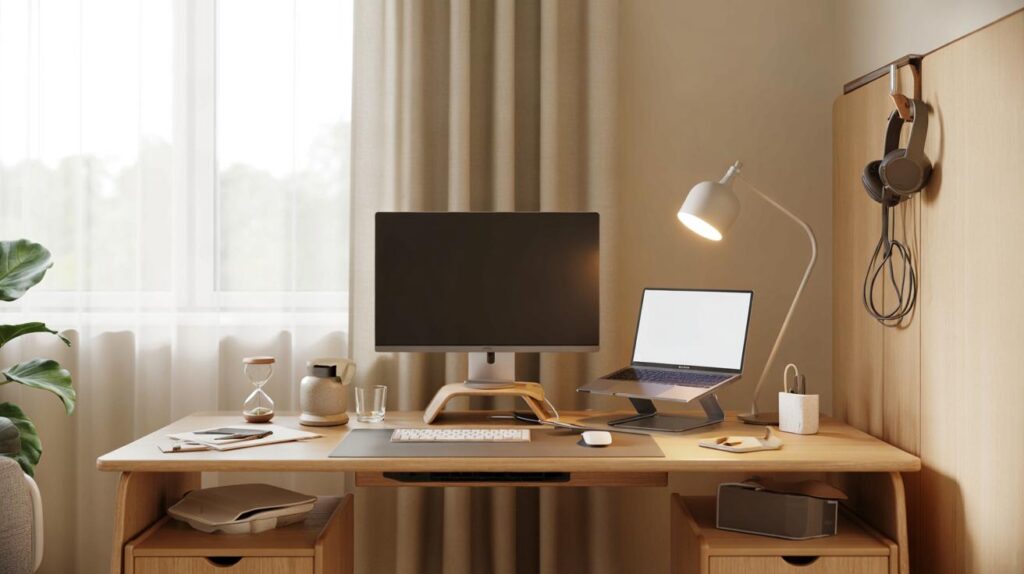
Start with posture you don’t have to think about. Chair at a height where knees and hips sit level, feet flat or on a small footrest, elbows tucked at 90 degrees, wrists relaxed on the desk. Screen about an arm’s length away; top edge near eye level. Add an external keyboard and mouse if you use a laptop, and angle a desk lamp to wash the surface from the side. *This is your daily cockpit.*
Face daylight, don’t sit with it blasting your eyes or bouncing off the screen. A neutral-white lamp (around 4000–5000K) keeps colour true and your mind alert. People who work by windows report fewer headaches and less eye strain, and Cornell research recorded big drops in eye fatigue when teams moved closer to daylight. **Light your brain, not just the room** — and your mood follows.
We’ve all had that moment when you realise you’ve been hunched like a prawn for two hours. Sofas seduce, kitchen stools punish, and laptop-only setups drag your head forward. Let’s be honest: nobody really does that every day. Build tiny checks into the day instead — a sip of water, a stretch you can do in a chair, a quick reframe of the screen height. Little nudges that keep you honest without nagging.
Your tools are half the story. The rest is the rhythm you wrap around them.
“Your setup should invite micro-movements and micro-breaks. If it doesn’t, you’ll feel great for twenty minutes and rubbish by lunchtime.” — a London-based ergonomist told me in a café, then straightened my laptop by instinct.
- Try a 50-minute focus, 10-minute reset cycle: stand, sip, blink, breathe.
- Keep a soft timer that nudges, not alarms.
- Switch between sitting and standing twice a day, not ten times.
- Park a resistance band under the desk for two sets of pulls between calls.
- End the day with a two-minute “wind-down” checklist and a literal close of the lid.
Design for calm, not just output
The best home office feels like a quiet ally. Colour and texture soften edges — a plant in your peripheral vision, a warm wood surface, a picture that’s there for you, not the meeting. Noise matters too: if neighbours drill, layer sound with a fan, brown-noise app or a simple “door open means chat, door shut means not now” agreement with the people you live with. A calmer room gives you back the bandwidth you’ve been spending on vigilance.
Clutter isn’t just visual; it’s cognitive. If papers linger on the desk, your brain keeps asking whether they’re urgent. Use trays with names that mean something — “Doing”, “Waiting”, “Parking Bay” — and have one small box for cables and chargers. Create a tiny prop table for video calls: lamp, notepad, glass of water, lip balm, done. **Small rituals beat big resolutions** because they get repeated without drama.
Make your shutdown routine oddly specific. Close tabs you won’t need tomorrow, jot three bullet points you’ll hit first thing, put the chair back in, and turn off the desk lamp last. That sequence becomes a cue for your nervous system: it’s over, you can let go now. The room returns to being a room, not your boss. And tomorrow has a runway instead of a scramble.
The perfect home office isn’t a showroom; it’s a relationship you keep tweaking. Start with one boundary, one ergonomic fix, one ritual. Give it a week. Then notice what felt lighter and nudge the next piece. Your space won’t solve every stress, and it doesn’t need to. It just needs to stop stealing energy you could use on the work — or on a walk outside when the meeting ends.
| Point clé | Détail | Intérêt pour le lecteur |
|---|---|---|
| Dedicated zone | Doorway, curtain, room divider, or a visual boundary on a desk | Fewer interruptions, easier “on/off” for the brain |
| Ergonomic basics | Chair and screen at neutral heights, external keyboard and mouse | Less pain, more energy left for thinking |
| Light and rituals | Daylight-facing setup, neutral lamp, short reset cycles | Sharper focus and steadier mood across the day |
FAQ :
- What’s the best home office setup on a small budget?Prioritise posture and light. Raise your laptop with books, add a cheap external keyboard/mouse, sit on a firm chair with a cushion for lumbar support, and angle a basic desk lamp from the side.
- I don’t have a spare room. How can I create boundaries?Use a foldable screen, a curtain on a tension rod, or a specific table runner that only appears during work. Pack tools into a crate that lives out of sight after hours.
- How bright should my workspace be?Face a window if possible, with light coming from in front or from the side. Pair it with a neutral-white lamp (around 4000–5000K) and reduce screen glare with a matte filter if needed.
- What’s a realistic break schedule?Try 50 minutes on, 10 minutes off, twice, then a longer 20-minute step-away. Stand up, blink deliberately, sip water, and reset your posture. No heroic marathons.
- How do I handle noise from neighbours or family?Layer solutions: soft in-ear plugs, over-ear headphones with brown noise, and a visible “do not disturb” cue. Set “quiet blocks” with housemates and offer a swap later to keep the peace.



Loved the idea of a curtain as an on/off switch — genius 🙂 The 50/10 reset cycle sounds humane, and the neutral-white lamp tip (4000–5000K) is super actionable. Printing that shutdown ritual to test this week.
Is there actualy solid evidence that facing daylight reduces eye strain, or is that mostly anecdote? You cite Cornell, but no link—pls add. Also wondering about evening work: won’t 5000K mess with melatonin? Any peer-reviewed refs would be great.