
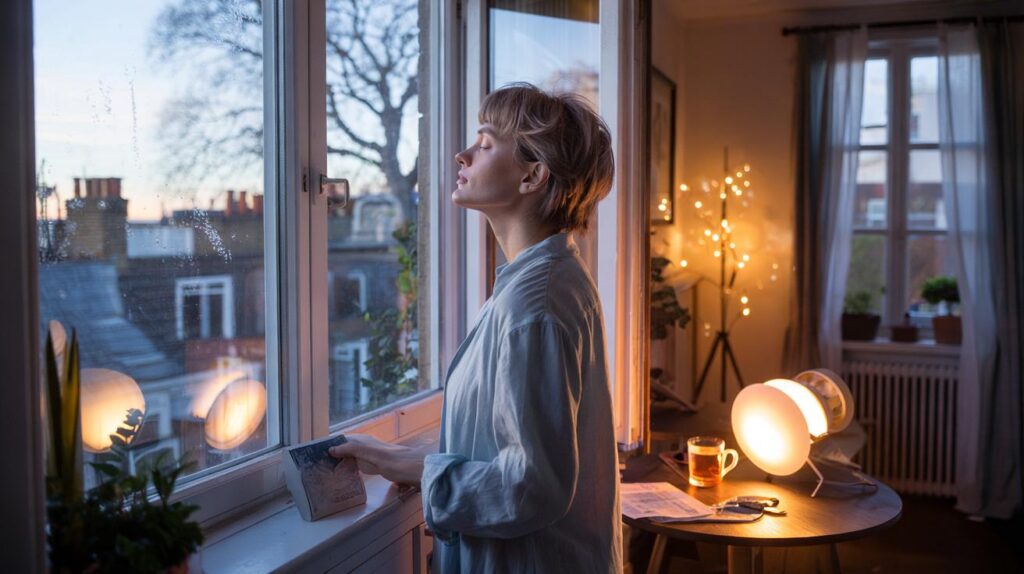
The evening creeps in earlier, the streets turn to silhouettes, and the clock says 4pm while your body swears it’s bedtime. Light shrinks. Mood follows. The trick is not to surrender to the dark, but to learn where the light still lives.
I watched a London bus wheeze to a halt as the sky tinted plum, faces inside caught in a wash of cold phone glow. A woman zipped her coat, then shuffled to the sliver of brightness under a cafe awning as if it were a heat lamp at the seaside. The city felt dimmer, and I felt it too. A cyclist rolled past with fairy lights on his rucksack, a small rebellion against the slate afternoon. A man with a takeaway tea stepped behind a lit billboard and exhaled, like a plant leaning to a window. Then a child pressed a hand to the glass, following the path of a pale sun that wouldn’t last another hour. The light slipped away. There’s more light than meets the eye.
What short days do to your body and mind
Light is not just scenery; it’s a signal that sets the pace inside you. As days shorten, your body clock can drift late, nudging sleep, appetite and mood off their old tracks. **Light is not a luxury; it’s biology.** Less morning brightness means melatonin sticks around longer and alertness arrives on a delay. You feel foggier at nine, hungrier at eleven, flatter at three. It’s not laziness. It’s the season tugging at your rhythms.
We’ve all had that moment when the sun dips behind the houses before tea and you swear your bones just aged a decade. In Britain, December sunsets can land before 4pm, and in northern towns it’s earlier still. Office windows hold the day like shoebox dioramas while pavements turn ink-black. A friend in Edinburgh swears by standing on her doorstep at nine for a hit of pale light, breath fogging into clouds, because that is when the sky gives her something.
The pattern is simple: bright light early nudges your clock earlier, bright light late pushes it later. Morning brightness lifts cortisol to get you going and trims melatonin so you’re less drowsy. Night-time glare keeps melatonin suppressed, leaving you wired when you hoped to wind down. That’s why a grey morning plus a glowing laptop at 11pm feels like the worst trade. Your brain takes its cues from photons, not intentions, and it keeps score.
Ways to catch and create light when the day shrinks
Start with a morning ritual that tilts the day towards alertness. Step outside within an hour of waking, even if it’s drizzly and unromantic. Twenty minutes on a brisk loop, face uncovered, is a simple reset for your inner clock. If you can’t get out, sit by the brightest window you have, curtains fully open, and angle your face to the sky. **Morning light is your strongest lever.** A 10,000‑lux light box can help in winter: place it slightly off to the side at arm’s length while you read or eat, for 20–30 minutes.
Make light your companion, not your enemy. Keep evenings gentle with warm lamps lower than eye level, and save the bright stuff for morning and midday. People often stare straight into light boxes or use them at night, then complain they can’t sleep; don’t do that to yourself. The goal is to cue your clock, not overwhelm it. Let’s be honest: no one really does this every day. Think of it as a bias rather than a rule—aim for most mornings, and forgive the rest.
Layer your lighting at home so rooms feel like places you want to be, not caves. One overhead bulb won’t carry you through a December week. Mix a bright task lamp on the desk, a floor lamp near your reading chair, and a string of warm LEDs to soften the edges. Mirrors opposite a window double the daylight you get, and pale walls reflect more glow than you think.
“Light isn’t just about seeing; it changes how you feel,” a lighting designer told me. “Think of it as nutrients you can spread through your day.”
- Put a light box on a timer for weekday mornings, so it glows as you brew your tea.
- Move your desk within a metre of a window; the difference is visible on your face.
- Swap one bulb to a brighter, high-CRI LED for tasks, and keep another lamp cosy for evenings.
- Take calls while walking outside when it’s brighter; you’ll hear the lift in your voice.
- Keep screens dim and warmer after 8pm to help melatonin do its quiet work.
Leave room for a little glow
Light hides in small rituals. A lunchtime detour to the sunniest side of the street, five minutes leaning by the window as the kettle works, a weekend train to the coast just to watch silver water catch the sky. You’re not chasing summer in a bottle. You’re letting your eyes find brightness where the season allows, and giving your brain a reason to trust morning again. In the gaps between showers, it’s there.
| Point clé | Détail | Intérêt pour le lecteur |
|---|---|---|
| Morning exposure | 20–30 minutes outdoors or with a 10,000‑lux lamp soon after waking | Resets body clock, boosts alertness, eases low mood |
| Smart evenings | Warm, lower lighting; limit bright screens after 8pm | Protects sleep pressure and smoother nights |
| Home lighting layers | Task lamp + floor lamp + reflective surfaces | Makes rooms usable and pleasant in dark months |
FAQ :
- How much light do I need on a winter morning?Enough to make you squint a touch. Outdoors is best—20–30 minutes within an hour of waking. With a light box, aim for 10,000 lux at about arm’s length for a similar window.
- Do light therapy lamps actually work?Many people with winter low mood and sluggishness find them helpful, especially when used early in the day. Use them while you read or eat, not at night, and angle them slightly to the side rather than staring straight in.
- Is vitamin D a substitute for light?Different jobs. Daylight sets your body clock and affects alertness right away. Vitamin D relates to bone and immune health over time. You might need both in winter, but they’re not interchangeable.
- Will evening light ruin my sleep?Bright, cool light late can delay melatonin and keep you wired. Keep evenings warmer and dimmer, and push the bright, cool light to mornings and work hours instead.
- What if I live in a basement flat?Get creative: work near the brightest window, add a mirror to bounce light deeper into the room, and use a high-quality light box in the morning. Take phone calls outdoors when you can, even for ten minutes.



Loved this piece—“light is biology” really landed. I’m moving my desk within a metre of the window and putting the light box on a timer. Simple, actionable, and it defintely feels doable.
Is there solid evidence that 10,000‑lux boxes help beyond placebo? Any RCTs comparing morning vs. midday timing, and typical effect sizes on mood/sleep? Links would be great.