
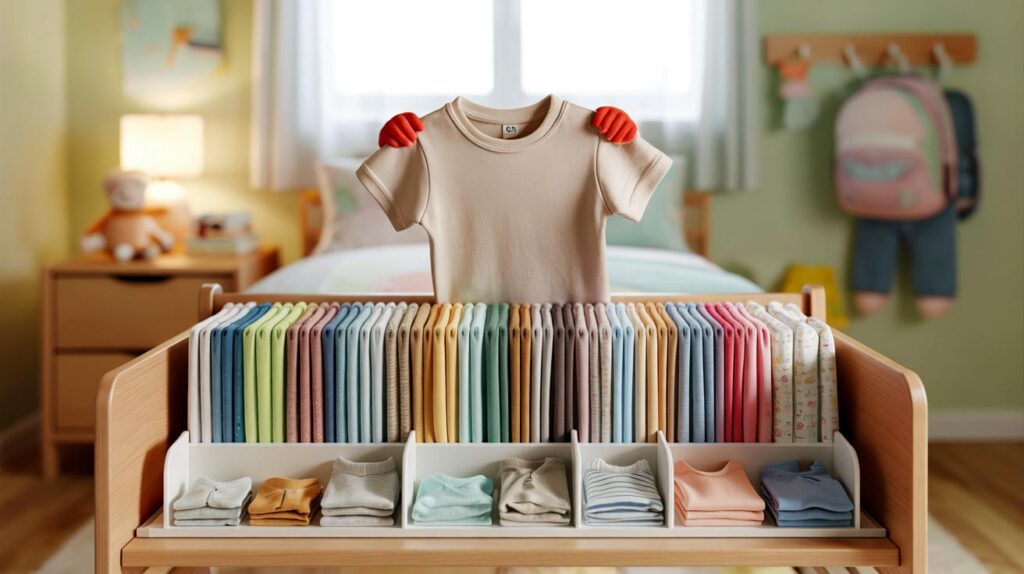
Your child’s drawers don’t need to look like a laundry avalanche — a few precise folds can turn chaos into calm, and keep it that way.
On a Monday morning in a South London hallway, I watched a little boy kick a drawer shut with the soft fury of a late toddler. T-shirts lay in drifts, socks hid inside pyjama legs, and the school jumper had vanished to a place beyond reason. We’ve all had that moment when the clock is ticking and the clothes seem to multiply out of sight, just to taunt you. I sat on the floor, took one tiny T-shirt, and folded it into a neat, patient rectangle that stood upright on its own. Then another. Then another. By the time the kettle clicked off, the drawer looked like a tiny bookshop — spines out, colours in order, choices obvious. The tantrum dissolved like steam.
Here’s the thing I didn’t expect: three weeks later, it still looked good. Watch what happens next.
Why vertical folds tame the chaos of kids’ drawers
Children aren’t messy by malice; they’re kinetic, curious, fast. Drawers set up like piles are made for toppling because the only way to see what’s there is to dig. The Marie Kondo, or KonMari, fold flips the logic: clothes stand upright like files, so little hands can pull one out without sinking the stack. **You don’t need a walk-in wardrobe — just a shift from stacks to spines.** Once every item has a visible “face,” the decision-making load drops, and the morning rush stops feeling like a scavenger hunt.
At a family home in Walthamstow, I tried the KonMari fold on a single drawer: ten T-shirts, five leggings, three pairs of shorts. The six-year-old slid it open and froze, eyes wide, then picked a top without disturbing the rest. On day four, her dad sent a photo: still tidy. On day ten, a crumpled leggings incident, corrected in eighty seconds by the child herself. That’s the quiet magic — not just order, but ownership.
The logic is almost embarrassingly simple. Drawers fail when the system demands adult-level precision every day. The vertical fold creates mini-containers of fabric that hold their shape, so the drawer becomes a grid instead of a heap. Each “file” stands by friction and habit, not by balancing acts. It’s a small structural change that meets the way kids behave: quick movements, quick choices, quick fixes. A drawer that forgives human hands will last longer than one that scolds them.
The KonMari fold for kids: the method that actually sticks
Start with tops. Lay the T-shirt flat, smooth the air out, then fold the left side in by a third, sleeve back over itself; repeat on the right. Fold the bottom up to the middle, then again to create a compact rectangle. Test if it stands; if it flops, make one more fold. Leggings are similar: fold in half lengthways, tuck the crotch curve, then fold into thirds until it stands. Socks? Lay one on the other, fold toe to ankle, then in thirds — no tight rolling bands that stretch and sag. Pyjamas can nest: fold top and bottoms separately into rectangles, then place one on the other and fold once more so they become a single “book.”
Label drawers by category and height, not age or season. T-shirts left, bottoms right, pyjamas front; tallest items at the back so the short ones don’t disappear. Use boxes or cardboard shoe lids as dividers inside the drawer to corral tiny pants and vests. Soyons honnêtes: no one really does this every day. That’s the point; set up a shape that stands after imperfect refills. When laundry comes in, fold one or two things “to standard,” and the rest will conform around them like bricks in a wall.
Parents trip on two things: folding too tightly and overfilling. Tight folds crush fabric so it slumps; airy folds keep bounce. Leave breathing room — one finger’s width — at the end of each row. *It feels indulgent, but it’s discipline hiding in softness.*
“The day my four-year-old could put away her own clothes without me hovering, I felt like I’d hacked parenting,” said Emma, a London mum who adopted the fold last winter.
- Pick one drawer only. Finish it. Celebrate the tiny win.
- Keep a “rehab zone” at the front: items that need a quick refold tonight.
- Use colour as a cue: light to dark helps kids choose silently.
- Refresh the rows while the kettle boils. Two minutes, big payoff.
A tiny ritual that keeps paying rent in your drawers
This isn’t about perfection; it’s a reset that unlocks easier mornings. Teach kids to slide a hand down the spine of a T-shirt and lift from the bottom, like picking a book without collapsing the shelf. Make it a five-minute ritual after bath time: two folds together, a silly name for the “standing shirts,” a high-five for every row that stays upright. **The real win isn’t neatness, it’s the small sense of control that steadies a day.** When a child can open a drawer and see their choices, they don’t tug at you for answers you can’t give at 7:58am. You’re not hunting for a clean sock under a duvet of jumpers; you’re choosing and moving on. That calm stacks up, one quiet rectangle at a time, and the drawer holds the story of a household that learned to breathe between the folds.
| Point clé | Détail | Intérêt pour le lecteur |
|---|---|---|
| Vertical, not stacked | Fold into rectangles that stand like files | Faster choices, less mess after every grab |
| Right-size the drawer | Use dividers and leave breathing room | System survives real-life, kid-speed use |
| Ritual beats overhaul | Two-minute daily refresh, one drawer at a time | Sustainable habit, not a weekend marathon |
FAQ :
- What’s the simplest KonMari fold for a tiny baby onesie?Lay it flat, fold the sides in to create a neat rectangle, bring the bottom up to the middle, then fold into thirds until it stands. Tiny clothes need one extra gentle fold to hold their shape.
- How do I teach a toddler to put clothes away without wrecking the rows?Model the “book pick” with your hand sliding under a shirt’s edge, then let them try one item each night. Praise the action, not the outcome — the row will recover, the habit needs the applause.
- My drawers are shallow. Will vertical folding still work?Yes. Fold to the height of the drawer. If items still topple, store heavier pieces at the back and use slim boxes to support the front row so items don’t slide flat.
- How long does a full drawer take to fold the first time?One child’s T-shirt drawer usually takes 12–18 minutes, slower on day one, faster with rhythm. The second drawer is always quicker, because your hands remember the shape.
- What about hoodies and bulky jumpers?Fold sleeves in, create a long rectangle, then fold in thirds; tuck the hood inside the last fold so it makes a flat top. If it won’t stand, store it on its side at the back as an anchor.



Just tried the T-shirt “spines out” method and wow — my six-year-old actually put her own clothes away without chaos. The “rehab zone” tip is gold. Thank you!