
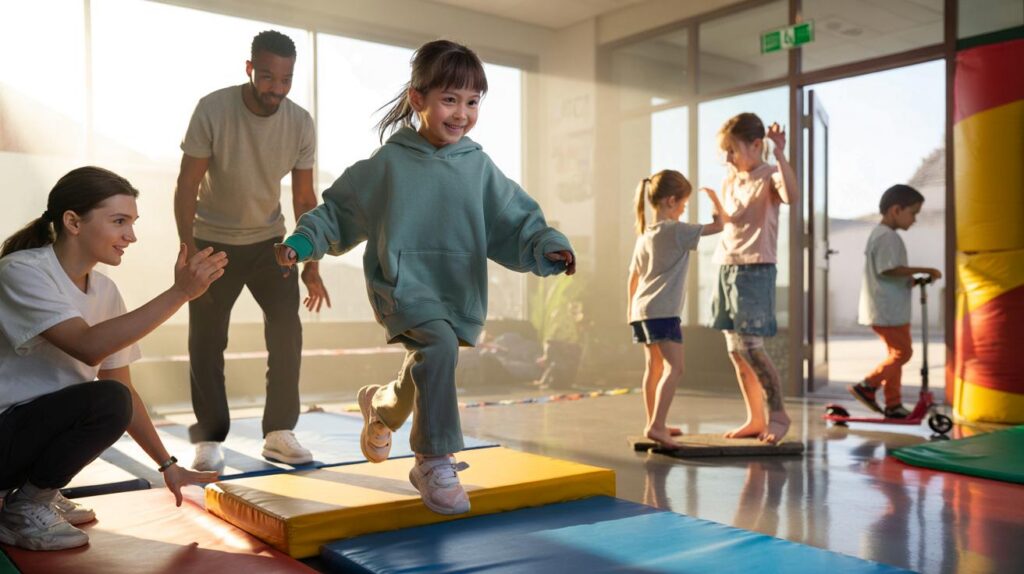
How to get kids who hate sport moving: and find an activity they’ll genuinely love long term
Some children freeze at the idea of PE, team shirts and cold sidelines. The tug-of-war at home isn’t about laziness, it’s about not seeing themselves in the word “sport”. What if movement could look different, feel different, and quietly stick?
Saturday morning, leisure centre corridor, that hum of whistles and squeaky soles. A girl in an oversized hoodie is dragging her laces along the lino while her dad hovers, half-cheerleader, half-traffic warden. They peek into the sports hall, clock the netball bibs, and she steps back like the ball might bite. Then they stumble on a parkour taster in the dance studio next door: mats, soft blocks, a coach saying, “Try it your way.” Her shoulders drop. She pads over, touches a vault, tries a tiny jump, grins at nobody in particular. What if “sport” wasn’t the point at all?
Why some kids turn away from sport
For plenty of kids, the clash isn’t with movement itself; it’s with the culture wrapped around it. Scoreboards, whistles, the pecking order of who gets picked first. We’ve all had that moment where a childhood memory of being benched swims back and sours the air. Change the wrapping, and the same body often moves with ease.
Think of Jay, 10, who rolls his eyes at PE and fake-coughs on football days. His mum tries a climbing centre on a rainy Sunday and he ends up spidering up a beginner wall, harness squeaking, face set in that serious-concentrated way. He doesn’t call it exercise; he calls it a puzzle he can feel with his feet. In England, Sport England’s latest survey shows roughly 47% of children reach an average of 60 minutes’ activity per day across the week, which means many don’t. The gap isn’t willpower. It’s a menu problem.
Looking closer, three dials tend to matter: autonomy (Do I choose it?), competence (Do I feel I can succeed?), and belonging (Do I feel welcome?). That’s straight from decades of motivation research, but you can see it on a playground. Turn the dials up, motivation rises. Throw in sensory overload, public scorekeeping, or uniforms that don’t fit their body, and the dials plummet. Joy before drills isn’t fluffy; it’s a doorway. This is not about making mini athletes; it’s about playful bodies.
How to spark movement in a sport-averse child
Start with a “taster fortnight” and a promise: no sign-ups, no matches, no spectators. Offer a simple menu—three short options a day, 15 minutes each: scooter loop, backyard obstacle, dance video, chalk hopscotch, geocache, balance beam on a curb. Call it a “try-5 rule”: five minutes to sample, stop if it’s “meh”, swap fast if it’s a no. Build an “A-B-C” check: did they choose it (A), feel capable (C), feel seen (B)? If two are a yes, you’ve got something. Start with zero sport, then let sport re-enter by stealth if it wants to.
A few pitfalls tend to trip us. Big promises (“three sessions a week!”), long contracts, or bribes that turn movement into a chore with a price tag. Comparison sours it fast—especially between siblings. Keep it light, keep it local, keep it quiet. Let’s be honest: nobody does that every single day. Aim for most days across a week, with wiggle room for weather, moods and homework crunch. And on flat days, make the “smallest win” ridiculously easy: two songs of kitchen dancing while the pasta boils counts.
When something clicks, name what works out loud—“I love how you found your own route on that log”—not how it looks or who was fastest. That feeds the competence dial without turning it into a stage. Progress, not performance, is the tone.
“If they laugh, come back, and ask to show you a move, that’s the win. Skill stacks from there,” a youth coach told me after a trial session where three kids ended up teaching each other a goofy skip.
- For the shy or “watch-first” child: solo-cycle loops, bouldering, archery, Yo-Yo tricks, backyard slackline.
- For the sensory seeker: trampolining, parkour, swimming with quiet hours, scooters, paddleboarding on calm water.
- For the story-lover: dance routines, circus skills, role-play adventures with “quest” walks, yoga with animal poses.
- For the collector brain: geocaching, orienteering, Pokémon GO walks, step-count treasure hunts.
- For the tinkerer: skateboarding, BMX pump tracks, frisbee tricks, techy wearables that light up with movement.
Make it stick for the long term
Think less “new hobby”, more “movement identity”. That’s the bit that sounds grand until you notice it lives in tiny rituals: a Sunday loop along the canal; a midweek “song-and-stretch” while the bath runs; a Saturday “dad-and-daughter climb” that’s never about grades. The long-term love tends to appear when kids feel they own it and can tweak it as they grow. You can layer seasons like flavours—winter bouldering, spring bikes, summer paddle, autumn dance—without drama if the core is choice. Share photos of moments, not medals, and let them teach you their favourite warm-up. If grandparents are in the mix, ask them for the stories: skipping ropes, old-school rounders on the green, wartime cycle-to-school tales. Movement becomes family culture, not homework you set. That’s when it lasts.
| Key points | Details | Interest for reader |
|---|---|---|
| Reframe sport as “movement” | Offer playful tasters, short and pressure-free, across two weeks | Reduces battles, reveals genuine preferences fast |
| Use the A-B-C motivation dials | Autonomy, Belonging, Competence as your quick check after each session | Gives a simple tool to spot what sticks and why |
| Build tiny rituals, not big plans | Movement “snacks”, weekly loops, seasonal swaps | Makes consistency feel light, adaptable and child-led |
FAQ :
- My child refuses everything—what now?Go stealth. Movement can be music-led tidying, a dog walk with photo challenges, or a sunset scooter to the corner shop. Offer two-minute tasters and let them pick the soundtrack.
- How much activity do they need?The UK guideline is an average of 60 minutes a day across the week, mixing moderate and vigorous, with activities that strengthen muscles and bones on three days. Aim for the weekly average, not a perfect streak.
- Do active video games count?Yes. Just Dance, Ring Fit, Beat Saber and similar can spark breathy, real movement. Use them as a bridge to outdoor play or a rainy-day go-to, ideally as a family.
- What about kids with sensory or attention differences?Think quieter slots, predictable routines, clear exits and coaching that allows stimming and breaks. Noise-reducing headphones, softer kit and visual schedules can turn “no way” into “maybe”.
- How do we handle competition nerves?Pick formats where the “team” plays the clock or a course, not other kids. Celebrate effort, ask them to set one tiny personal target, and let opt-outs be clean and shame-free.



Love the idea of a taster fortnight and the try-5 rule—took the pressure right off my 9yo. We tried geocaching and ‘kitchen dance while pasta boils’ and both stuck 🙂 Any tips for keeping grandparents from turning every walk into a race?