
Energy bills are still stubbornly high, the nights draw in earlier, and the garden feels like it’s slipping into shadow. You want safety along the path, a little glow by the shed, maybe something lovely around the patio without running a cable or adding to the meter. Solar garden lights promise all of that for pennies once they’re in. The trick is getting them right before the frost arrives.
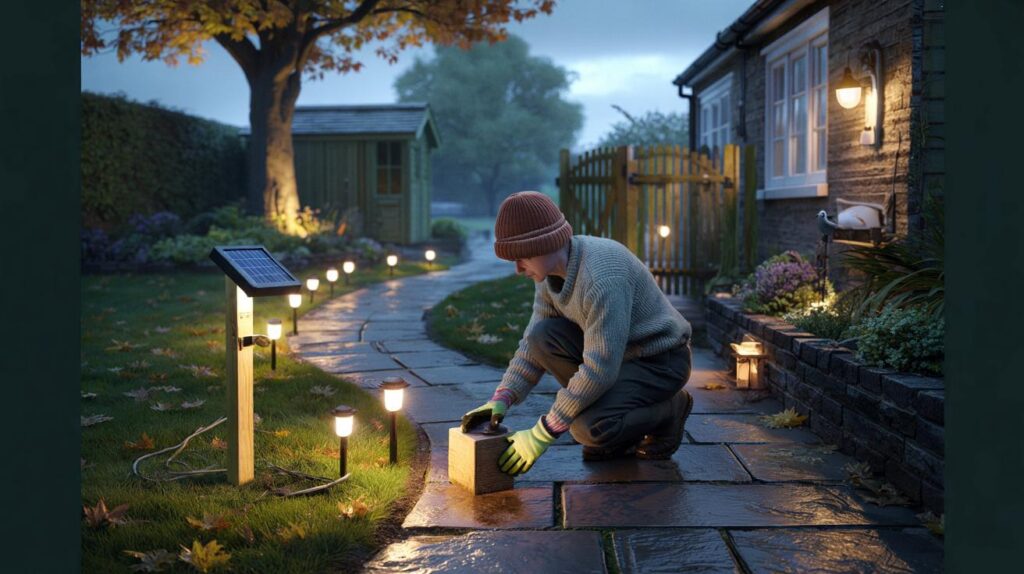
I watch a neighbour tug a wool hat down as he pads across damp grass, arms full of little solar stakes. A robin bobs along behind him like a nosy supervisor. He pauses by the path, presses one into the soil, steps back, and smiles at nothing in particular. Later, after tea, those quiet dots of light show him the way to the bins, and his mood lifts in the cold air.
We’ve all had that moment when a small upgrade changes how a place feels. A soft glow can do that. It’s ordinary and slightly magical at once.
He told me he didn’t even read the leaflet. He just poked them in, went inside, and hoped. The next morning, he asked if there was a smarter way. There is.
Why solar garden lights shine in autumn
Autumn light is precious. The sun dips low, shadows stretch, and the garden’s risky bits reappear at tea time. That’s exactly when small, low-voltage solar lights pull their weight. They guide feet, mark edges, and make corners feel cared for.
They also run off the day you’ve already had. No trenching cables. No fiddling with outdoor sockets. The panel drinks in sun, the battery holds it, and a tiny sensor flips them on just as the sky turns to pewter. That low-key cleverness suits the season.
Cost-wise, solar still wins. The upfront price of a few path lights is less than a single month of mains lighting left on by mistake. Over a year, there’s no bill, no guilt, and a quiet feeling that you’re using what’s freely there. That matters when the boiler kicks in and you’re counting minutes with the thermostat.
Real-world proof and a nudge of numbers
Picture a typical British back garden: a path from the kitchen to the gate, a shed under a sycamore, maybe a raised bed. South-facing sections get the lion’s share of light from late morning till mid-afternoon. Those are your money spots for panels, because the UK sun sits lower now and trees throw longer shade.
In October, many parts of the UK see roughly nine to eleven hours of daylight, but not all of it is direct. That’s fine. Most decent solar garden lights only need a few good hours to charge for four to eight hours of glow. Go for warm white LEDs if you like cosy; cool white is brighter but a touch clinical on autumn leaves.
Watch the sun’s path for a day. It takes ten minutes and saves a season of disappointment. If a spot gets full sun from 11am to 2pm, it’s golden. If it’s dappled under a tree, use a separate panel-on-a-stake light and run the cable to a shaded lantern. Simple tweak, bigger payoff.
How it actually works (and why yours might be dim)
A tiny panel charges a rechargeable battery, usually Ni-MH. A dusk sensor tells the light when to switch on. If the panel is dirty, the angle is wrong, or the battery is old, the light fades early or never really gets going. Maintenance is boring but it’s the secret sauce.
Set expectations. Solar path lights aren’t floodlights. They’re markers and mood-setters. For tasks like finding keys or sorting the recycling, pair them with one brighter motion-sensor solar lamp by the door. Layers beat brute force every time.
Let’s be honest: no one does that every day. A light wipe of the panel on Sundays, a battery swap once a year, a glance after storms. That rhythm keeps them crisp. And there’s a quiet satisfaction to it.
Step-by-step: install solar garden lights like a pro
Start with placement. **Pick the sunniest spot** you can find along the intended line, ideally south or south-west facing. Keep at least a metre away from heavy shade at mid-day. If your path winds, plot a gentle zig-zag so each panel has a clear sky view.
Unpack and assemble. Most stakes come in three parts: spike, stem, head. Push the spike in by hand first using a spare piece of wood, then add the stem so you don’t crack it. Before planting the head, remove any battery tab and give the top a full day of charge with the switch set to off.
Now set levels and spacing. Aim for 1.5 to 2 metres between path lights for a continuous ribbon. Keep heads roughly 30–45 cm above ground to spread light without glare. **Charge before use** is the golden rule: one clear day, then switch on at dusk and watch them wake up.
“Autumn isn’t a reason to give up on solar,” says garden designer Priya Mehta. “It’s a test. If they still shine in November, you’ve placed them well.”
- Wipe panels with a soft cloth to remove pollen and dust.
- Tilt panel caps 10–20° if adjustable to catch low sun.
- Use warm white (2700–3000K) for cosy paths, cool white (4000–5000K) for tasks.
- Choose Ni-MH batteries over Ni-Cd; swap yearly for best life.
- Anchor stakes firmly in soft ground after rain for stability.
Common mistakes, kind fixes
Shading kills performance. A fence post, a shrub, even a hanging basket can rob an hour of charge. Move the light half a metre and it can double its glow time. Tiny changes do a lot in autumn.
Don’t bury them in borders. Soil splashes, slugs, and stray mulch will fog the panel. Keep heads clear, and give them a quick spruce when you water pots. *Your future self will thank you at 5pm on a gloomy Tuesday.*
Modes can confuse. Some sets cycle through colours or dim early to stretch battery life. If yours feel too faint, check for a low-power mode and switch to steady warm white. **Clean the panels** now and then so the sensor isn’t tricked by grime.
Care through the colder months
November brings long nights, wet mornings, and the first frosts. That’s not the end of the show. Lights with separate panels do best now, because you can angle the collector up a touch and keep the lantern exactly where you want the glow.
If a week of heavy rain or snow arrives, pop the heads off and bring them into the shed. Dry them gently and let them charge by a bright window for a day. **Winter care** is mostly about kindness to batteries.
Batteries wear down. When you notice lights fading after an hour, swap the cell for the same type and capacity. It’s a small, cheap refresh that gives them another year. Don’t bin a good light for want of a £3 battery.
What it adds to your life, quietly
There’s a soft drama to autumn evenings when a path lights up as you step outside. The dog knows where to go. The bins aren’t a stumble. That edge of the patio becomes a place again, not a blur of cold slate.
Friends will ask where the cable runs. There isn’t one. You’ll point at the little panel and shrug, and the conversation drifts to the rising cost of everything, and how small wins stack up. It feels sensible without being joyless.
Solar garden lights won’t change the world. They will change your 6pm. Take an hour this weekend, walk the garden with a mug in hand, and place light where you actually live. The first night they flicker on, you’ll see what you’ve done.
| Key points | Details | Interest for reader |
|---|---|---|
| Placement is everything | South or south-west aspect, clear sky view, 1.5–2 m spacing | Maximises brightness and run-time in shorter days |
| Charge and maintain | One full-day pre-charge, wipe panels, annual battery swap | Reliable dusk-to-bedtime lighting with minimal faff |
| Mix light types | Path markers plus one motion-sensor task light | Cosy atmosphere and practical visibility where you need it |
FAQ :
- How many hours will solar garden lights last in autumn?Quality lights typically run 4–8 hours after a bright day. In grey spells, expect shorter and use brighter units sparingly.
- Do I need to turn solar lights off to charge?Switch them off for the first day to bank a full charge. After that, leave them on auto so the sensor handles dusk and dawn.
- Can solar lights work in shade?They struggle in deep shade. Use a remote panel on a stake in a sunnier spot and cable the lantern back to where you want light.
- What batteries should I buy as replacements?Match the original type and capacity, usually Ni-MH AA or AAA. Avoid mixing brands or capacities within a set.
- Are warm white or cool white LEDs better?Warm white feels inviting for paths and patios. Cool white is punchier for tasks like the side gate or the bin area.



Loved the bit about watching the sun path for a day—never thought ten minutes could save a season. I’ve been guilty of ‘poke-and-hope’ installs. The pre-charge with switch off is a great reminder. Going warm white this time; cool white made my patio feel like a dentist’s office.
Not convinced. In Manchester’s murk my current set barely lasts 2 hours after a ‘bright’ day. Is this just marketing or do higher mAh batteries and larger panels actually fix it? Any lumen or panel-size minimums you’d reccomend? Also, does tilting 10–20° really matter at our latitude?