
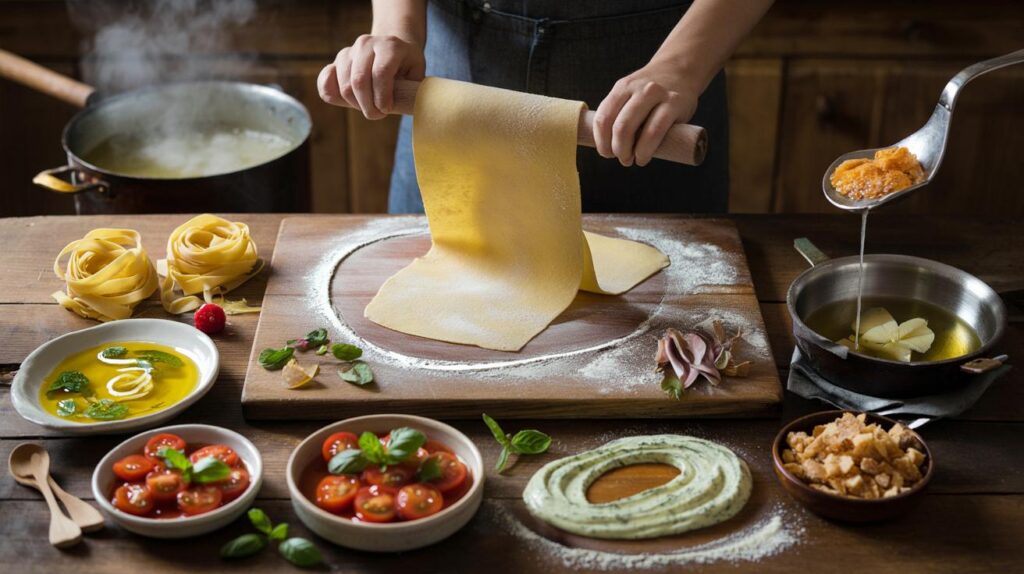
Your pasta machine is a myth you don’t need. The secret to springy ribbons and silken shapes lives in your hands, a rolling pin, and a bowl of flour — then a few light sauces that taste like fresh air after rain.
The first time I rolled pasta by hand, it was a Tuesday with laundry draped over the chairs and the radio mumbling the football. The dough looked stubborn, like wet sand that didn’t want to know me. I pressed, folded, pressed again, wondering why anyone would do this on a weeknight.
Then something shifted. The dough warmed, smoothed, and pushed back under my palms with a soft resilience. I could feel the gluten waking up, like a shy person finding their voice. One minute I was wrestling it, the next I was guiding it.
I cut thin ribbons and tossed them with lemon, oil, and a fist of parsley. The bowl steamed like a message. Three ingredients, five minutes, and this light, bright lift. The room went quiet. The pasta had a point to make.
It was telling me there’s another way.
Why hand-rolled pasta still wins
Flour and eggs behave differently when you do it yourself. The friction of your hands, the steady rhythm of a rolling pin — they give the dough a structure that feels alive. You end up with pasta that bites back gently instead of collapsing on the fork.
I remember a neighbour in Leeds, flatmates in and out, kettle always on. He didn’t own a machine, but on Friday nights he made tagliatelle on a chopping board the size of a magazine. Two eggs, a mug of flour, a glass bottle instead of a pin. The queue for his kitchen started at 7.
Texture is the quiet star. When you hand-roll, you leave tiny variations in thickness that sauce loves to cling to. Sauces show up differently, too. Bright olive oil picks up on the uneven edges; tomato juices soak into the softer parts. That mix of chew and silk is what makes it feel human.
The no-machine method: dough, rolling, and cutting
Start with 300 g “00” flour or plain flour and 3 large eggs. Tip the flour onto the counter, make a well, crack the eggs in, and fork them into a shaggy mass. Bring it together and knead for 8 to 10 minutes until smooth and springy, resting your wrists now and then. Your hands will tell you when it’s right.
Wrap the dough and rest it for 30 minutes at room temp. Cut into quarters. Take one piece, keep the rest covered. Roll from centre outwards with a pin, turning the sheet a quarter turn between rolls. Dust lightly with flour. Aim for “you can read a recipe card through it” thinness for ribbons, a touch thicker for shapes.
For tagliatelle, fold the sheet like a letter, then slice 6–8 mm strips and unfurl. For pappardelle, go wider. For pici, roll little ropes by hand. For orecchiette, cut pea-sized nuggets and drag with a butter knife, then flip onto your thumb. Cook in salted water: ribbons take 1–2 minutes, shapes 3–5. Taste, not the clock.
Let pasta water be your sauce’s secret muscle.
Use light sauces that lift, not smother. Warm 4 tbsp olive oil with a crushed garlic clove until fragrant, then toss with lemon zest and parsley. Or burst cherry tomatoes in a pan with chilli, finish with basil, and loosen with a ladle of that starchy water. A pea-and-mint swoosh is lovely: blitz hot peas with a splash of water, a spoon of ricotta, and salt.
We’ve all had that moment when dinner feels like a puzzle with missing pieces. The path out usually starts in the simplest place: one good dough, one bright sauce, one small win. Let’s be honest: nobody really does this every day.
Flour, eggs, patience — that’s the trinity. The sauce should whisper, not shout.
- Lemon, olive oil, parsley: 1 lemon zest + 4 tbsp oil + chopped parsley, tossed off the heat.
- Cherry tomato, garlic, basil: 250 g tomatoes + 1 garlic clove + basil, simmered 8 minutes.
- Pea, mint, ricotta: 200 g peas + 3 tbsp ricotta + mint + pasta water to loosen.
- Anchovy, chilli, pangrattato: melt 3 anchovies in oil, add chilli; finish with toasted crumbs.
- Brown butter and sage, light: 40 g butter, brown lightly with sage, cut with lemon juice.
Light sauces that lift, not mask
Think of sauce as seasoning for the grain, not a costume. Olive oil wants partners: acidity, heat, herbs. A tiny squeeze of lemon wakes everything, pasta included. You can build an entire dinner around that triangle and never repeat yourself.
Pairing is about mood and texture. Thin, silky sheets love slippery sauces: oil, citrus, thin tomato juices. Thicker cuts like pappardelle appreciate a soft emulsion: butter split with pasta water, scattered herbs, a curl of Parmesan. If you want creaminess without heaviness, whisk a spoon of ricotta or yoghurt into warm oil off the heat.
Pasta is a canvas that prefers pencil to paint.
From a cook’s eye view, the trick is balance. Salt your water until it tastes like the sea. Save a mug of it before draining. Toss pasta and sauce together in the pan for 60 seconds, adding splashes of that water until it clings and shines. A final thread of oil, a squeeze of lemon, done.
There’s a quiet joy in making food this direct. It asks you to pay attention, then rewards you fast. Pass a bowl around and watch people lean in without talking much. That’s the kind of dinner that changes a week.
What this practice gives back
The ritual is tiny and generous. Five minutes of kneading, a pause, then a small act of rolling that empties your head in the best way. You learn something about texture, patience, and how far simple things can go when you get out of their way.
It also travels well. Keep flour in the cupboard and eggs in the fridge, and you’re always one rest away from a soft stack of noodles. If the shop is out of 00, use plain flour and a spoon of semolina for grip. Light sauces make it feel bright even on rainy nights.
Some kitchens are loud with gear. This is quieter. Fewer tools, more touch. The dough remembers your hands, the way bread does. And when you eat, you taste the week lifting a little. **That’s the kind of small win that carries through to tomorrow.**
| Key points | Details | Interest for reader |
|---|---|---|
| Hand-rolled dough | 300 g flour + 3 eggs; knead 8–10 minutes; rest 30 minutes | Reliable, repeatable method without equipment |
| Rolling and cutting | Roll thin from centre; cut ribbons or shape pici/orecchiette | Versatility with only a board and pin |
| Light sauces | Oil, lemon, herbs; quick tomato; pea-mint; anchovy-chilli | Fresh flavour that flatters handmade texture |
FAQ :
- Do I need “00” flour for hand-rolled pasta?Plain flour works well. “00” gives extra silk. Mix in 1–2 tbsp fine semolina if you like a little grip.
- My dough is sticky. What should I do?Dust lightly and keep kneading. If it still clings after 3 minutes, add 1 tsp flour at a time. Resting usually fixes stickiness.
- How thin should I roll without a machine?For ribbons, almost see-through. For shapes, a touch thicker so they hold form. When you can read faint print through it, you’re close.
- Can I skip eggs for a lighter feel?Yes. Mix 200 g fine semolina with 100–110 ml warm water and 1 tsp olive oil for a sunny, springy dough. Rest longer, 40 minutes.
- Best quick light sauce?Warm olive oil with a crushed garlic clove, toss with lemon zest, parsley, and pasta water. It tastes like a window opened.



Loved the idea that the pasta machine is a myth—rolling by hand really does make noodles that bite back. I tried the lemon–oil–parsley and it was bright without being greasy. Pasta water as the “secret muscle” is defintely the missing piece I kept ignoring. One Q: for tagliatelle, do you prefer 6 mm or closer to 8 mm when serving with tomato–chilli? Thanks for the calm, practical tone.