
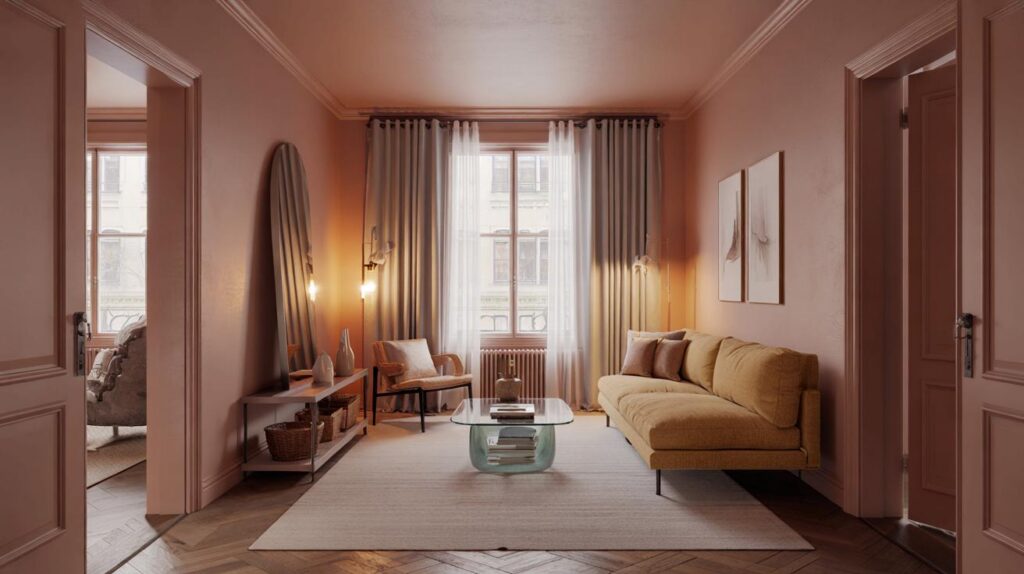
You want your tiny living room to feel generous, light and calm. Not like a shoebox where the coffee table bumps your shins and the TV glowers from two feet away. The trick isn’t knocking down walls. It’s learning to cheat the eye, the light, and the layout.
I’m standing in a one-bed in Brixton, holding a tape measure while a tabby cat sits on the skirting as if supervising. The room is narrow, the ceiling isn’t high, and the afternoon sun lands in a sulky square on the rug. Yet ten minutes later, after a few tweaks, the space starts to breathe. The air looks taller. The floor feels longer. *For a second, I thought the sofa had grown.* We’ve all had that moment when a room suddenly “snaps” into place and your shoulders drop. It’s less magic than method. The mind notices what’s missing and what’s in the way. The fix isn’t obvious.
Why small rooms feel cramped (and how to un-cramp them)
Biggest culprit? Visual clutter. Not just stuff on shelves, but too many breaks: short curtains, choppy colours, furniture that bites the room into pieces. Your eye keeps stopping and starting, like traffic on the North Circular. Continuity stretches space. Fewer lines, longer lines, calmer lines. That’s why designers obsess over sightlines, skirtings, and the way a rug frames the floor. They’re not being precious. They’re editing where the gaze comes to rest.
Take Mia’s flat in Manchester. She had a low, dark TV unit, a too-small rug, and curtains hung just above the window. We lifted the pole nearly to the ceiling, swapped the rug for one that ran under front legs of sofa and chairs, and leaned a tall mirror opposite the window. The same furniture suddenly felt intentional. The cat stopped trying to sleep on the remote and began sunbathing at the edge of the new rug. No walls moved. The room simply stopped shouting and started flowing.
There’s a little physics at play. Light bounces off pale, matte surfaces; mirrors double the sense of depth; long verticals lift the gaze away from the floor. Your brain stitches those cues into a story: bigger, brighter, taller. Contrast can be stunning, but in a small living room, too many contrasts chop it up. A tight palette and a few bold lines read as spacious. In other words, give the eye a runway, not a maze.
The 7 designer tricks that make a small living room look twice as big
Start with the windows. **Raise the curtain rod** to just below the ceiling and run full-length drapes to the floor. If you can, match the fabric to the wall colour so the whole wall reads as one. Sheers behind the drape soften daylight and blur the sash. Suddenly the wall feels taller, the window looks grander, and the corners fade. If blinds suit your style, choose a recessed or low-profile fit that doesn’t protrude into the room.
Now anchor the floor. A large rug under front legs of every seat unifies the seating zone like a stage. Go too small and the room shrinks; go generous and everything “belongs”. Pair that with leggy furniture that reveals more floor, plus a glass or open-frame coffee table to keep sightlines open. Let’s be honest: no one actually does that every day. A lift-up top with hidden storage helps keep life doable, not Instagram-only.
Lighting is your secret weapon. **Layer your lighting**: a reading lamp near the sofa, a soft-glow lamp on a console, a sconce or two to pull the walls outward, and a discreet uplight in a dark corner.
“Small rooms don’t need fewer lights,” a London designer told me. “They need gentler pools of light that overlap.”
- Hang curtain rods high and drape to the floor to stretch the walls.
- Use a large rug to unify the zone and visually widen the floor.
- Lean an oversized mirror opposite a light source to deepen the room.
- Pick low-profile, leggy pieces; show more floor and skip bulky arms.
- Colour-drench walls, trim and doors in one shade for seamless edges.
- Layer lamps, sconces and an uplight to soften shadows and push boundaries.
- Float furniture off the walls; create clear pathways and diagonal sightlines.
Make space feel generous, then make it yours
Give your walls and woodwork a hug: **Colour-drench the walls and trim** in a single mid-to-light tone with a high LRV (light reflectance value). Skirting, doors, even radiators in the same shade erase jagged edges. Then add a single deeper accent on a built-in or frame to anchor the view. Keep shelves 60% full at most; leave place for air as much as objects. The room will breathe, and you will too.
| Point clé | Détail | Intérêt pour le lecteur |
|---|---|---|
| Raise lines | High curtain rods, tall bookcases, vertical art stacks | Makes walls feel taller and ceilings higher |
| Unify the floor | Oversized rug under front legs of seating | Stretches width and calms the layout |
| Soften the edges | Colour-drench, layered lighting, big mirror | Blurs boundaries so the room reads larger |
FAQ :
- What colours make a small living room look bigger?Paler, warm neutrals with a high LRV bounce light and smooth edges. Matching walls, trim and doors in the same shade removes visual breaks.
- Should I push furniture against the walls?No. Floating the sofa by 10–15 cm and creating a clear walkway makes the room feel intentional and wider. It also improves conversation flow.
- Do big mirrors really help?Yes. Place an oversized mirror opposite a window or lamp to deepen the view and double perceived space. Leaning it adds relaxed scale.
- What size rug for a small living room?Large enough that front legs of all seating touch it. A bigger rug unifies the zone and stops the floor from looking bitty.
- How can I hide clutter without bulky storage?Choose dual-duty pieces: ottomans with lift-up lids, a slim console with baskets, a coffee table with a shelf. Keep surfaces 40% empty to let the eye rest.



Finally a guide that explains why my room felt “choppy”! I raised the curtain rod and swapped to a bigger rug and—boom—the space stopped shouting. The layered lighting tip is gold; the uplight in the dark corner made the ceilng look higher. Bookmarked. Thank you!