
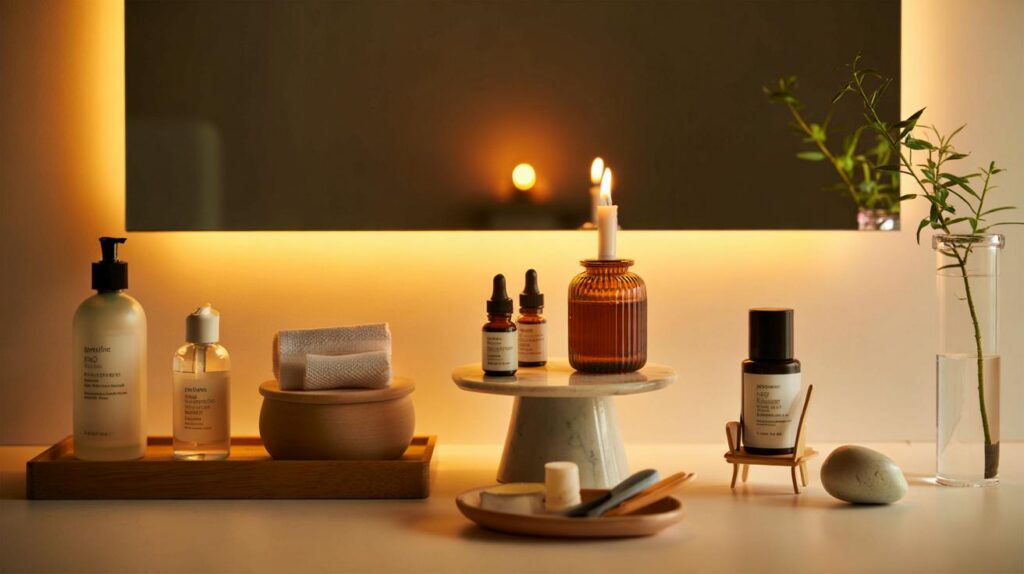
Your bathroom shelf could be a spa in disguise — or a stress shelf. The difference isn’t your budget. It’s how you build the ritual into the wood, glass and light you see every single day.
The first time I cleared my cluttered shelf, it felt like tipping a handbag onto the floor after a long week. Bottles skittered, lids rolled, a half-forgotten cleanser winked guiltily from the back. I wiped the cold surface, lined up a few favourites, and suddenly the whole room exhaled. A candle caught, the mirror softened, and my shoulders dropped as if someone had turned down the volume on my brain. The routine didn’t change — the scene did. Then the shelf does the work.
Design your shelf for flow, not storage
Your skincare shelf isn’t a cupboard; it’s a runway. **Clarity on the shelf creates calm in the mind.** When objects are placed in the sequence you’ll use them, your hands move without second-guessing, and your breath finds a steadier rhythm. Think of heights and textures like set design: a low tray to corral cleansers, a mid-height stand for serums, a slim riser for SPF. The shapes guide you. Your eyes rest. The routine you promise yourself suddenly feels doable.
Hannah in Brighton told me she used to do her routine only twice a week because the shelf felt “like a shop clearance bin”. She swapped random baskets for a narrow oak tray, put her daily trio front-left, and stashed the experimental bits in a drawer. We’ve all had that moment when a tiny change flips the whole mood of a room. Three weeks later, she’d added six minutes of quiet each night without touching the products themselves. The shelf made the invitation, so she kept showing up.
There’s a psychology to it. Decision fatigue makes us avoid even small tasks when our environment looks busy, so a clean visual line lowers the cognitive tax. Left-to-right placement mirrors how most of us scan, which makes the routine feel like a simple story: cleanse, treat, seal, protect. It’s not storage; it’s stagecraft for your senses. When the cast stands where you expect, your brain stops negotiating, and your hands begin to trust the ritual. That’s when the spa feeling slips in quietly.
The method: zone, sequence, signal
Start with zones. Left: clean and prep. Middle: treat and target. Right: seal and protect. Place the things you use every day in the front row, eye-level if you can, with evening formulas slightly to the right of their daytime twins. A shallow tray keeps textures contained and makes wiping down easy. A small dish holds spatulas and lip balm. A folded flannel sits ready like a napkin in a good restaurant. Your shelf becomes the script, and you just follow the cues.
Common trip-ups are visual noise and orphan products. You don’t need to decant everything into matching bottles unless that brings you joy. Rotate seasonal actives to a labelled box under the sink and keep only one of each step up top. **Stop hiding what you actually need behind what looks pretty.** Let’s be honest: no one does that every day. Wipe the tray every Sunday night, retire empties immediately, and keep a small “audition” corner for new arrivals so they don’t gatecrash the front row.
When in doubt, think sensorial signals: touch, sight, scent. A wooden tray feels warm under your fingertips; a ribbed glass jar catches candlelight; a linen towel tells your brain, “slow now”.
“You’re not just arranging bottles,” says spa director Lila Grant. “You’re choreographing how your nervous system lands at the end of a day.”
- Put cotton pads in a lidded pot to remove the pharmacy vibe.
- Use a small clip-on light set to warm white to soften reflections.
- Keep fragrance away from active serums to avoid crowding scents.
- Stand one plant cutting in water to add a living pause.
- Choose one signature object — a pebble, a shell — as your anchor.
This is how a shelf becomes a signal, not just storage. The moment you switch on that light, your shoulders know what to do.
Make it yours and let it breathe
Personal touches turn habit into hospitality. Maybe it’s a ceramic cup from a seaside market, maybe it’s that hotel flannel fold you nail every time, or the mini sand timer that keeps your mask honest. **What you see is how you begin.** Keep the cast small, let the negative space speak, and treat the edge of the shelf like a horizon — nothing spills past it. If a week gets messy, reset in five quiet minutes and forgive the rest. Your shelf is a tiny room within a room, a place where you’re the guest and the host. Share a photo with a friend, steal an idea from theirs, swap a tray for a plate, and notice how ritual spreads when it looks good. The spa feeling isn’t out there. It’s on the shelf you touch every night.
| Point clé | Détail | Intérêt pour le lecteur |
|---|---|---|
| Zone your shelf | Left for cleanse, middle for treat, right for seal/SPF | Smoother flow, fewer choices, less faff |
| Front-row only | Keep daily products visible; store extras elsewhere | Faster routine, less clutter stress |
| Sensorial cues | Warm light, tactile trays, one anchor object | Switches your brain to “spa” mode on sight |
FAQ :
- How many products should sit on the shelf?Keep the front row to one of each step you do daily — usually four to six. Extras can live in a drawer.
- Should I decant into matching bottles?Only if it delights you. Labels matter more than looks; clear names beat uniform pumps in the dark.
- Where do tools like gua sha or rollers go?Give them a small stand or dish to the right of serums. Cold tools can live in the fridge if you like that wake-up snap.
- What about shared bathrooms?Use two slim trays side by side, one per person. Colour-code flannels and mark lids with tiny dots.
- Small space, no shelf?Mount a narrow picture ledge above the sink or use a tiered spice rack. The principle is the same: zone, sequence, signal.



Tried the left-to-right flow last night and my routine finally felt like a ritual. Candle + warm light = instant spa vibes 🙂
This feels a bit like stagecraft for bottles—do we realy need a “signature object” just to wash our face? Looks nice, but maybe form over function?