
The sky turns ink by half four and the city exhales. You watch commuters fold into padded coats, buses blink orange, the pavement glisten like slate, and your good intentions sit in a tote by the door next to the dog lead and a pair of damp trainers. The kettle wins, the sofa smiles, and your phone shuffles a reel of astonishingly upbeat HIIT clips that feel like they belong to another planet, another body, another season entirely. You tell yourself you’ll go after dinner, then after the emails, then after that long text, until the window closes and the gym’s neon sign becomes a taunt. What if the dark is not the villain but the script you can rewrite. Start smaller.
When dusk edits your brain
There’s a reason your energy droops as the streetlights blink on and the shop shutters slide down with a soft clatter, and it’s not a character flaw. As daylight fades, your body leans towards melatonin, core temperature dips a notch, and every cue around you whispers that the day is winding down. The world slows its pace, and your brain simply follows the room tone.
Ask Sarah, 32, who cycles the Embankment in July and swears by gloveless mornings, yet clocks thirty per cent fewer rides once the clocks go back and the air bites. She isn’t lazy; she’s responding to a season that rearranges light, time and safety in one swoop. Fitness apps often show activity dipping through late autumn, and office chat swings from parkrun splits to slow-cooker recipes the moment the rain turns sideways.
What looks like a motivation crisis is often a cue crisis in disguise. Your brain is a brilliant prediction machine that saves energy by linking contexts to habits, so when the environment screams “cosy”, the body queues up a blanket and a bowl of pasta, not a 5K in the drizzle. You’re not weak; you’re tuned to the setting, and the setting has changed the soundtrack.
Tactics that actually work after 5pm
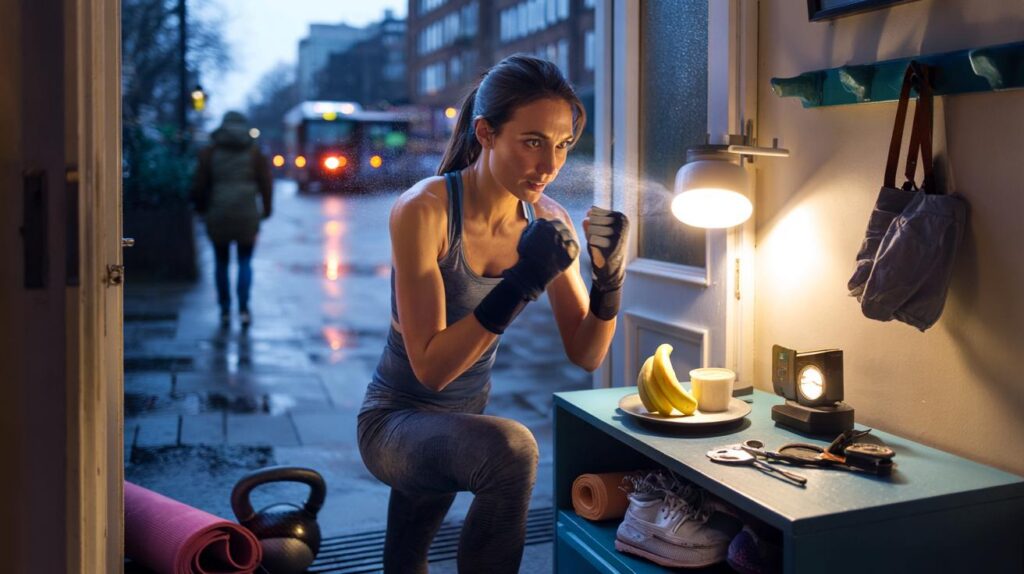
Create a “commute-to-move” ritual that starts before your willpower gets a vote. Lay out kit at lunch, set a 5.15pm alarm called Move First, and clip your house keys to your gloves so the front door becomes a starting gun, not a stop sign. Two songs of shadow boxing, thirty bodyweight squats, then decide if you go heavier or head out.
We’ve all had that moment when the dark hits the window and the day slips through your fingers like warm water. The trap is aiming for a perfect session and ending up with no session at all, because the gap between sofa and sprint feels like a canyon. Let’s be honest: nobody does that every day.
Name the plan out loud, then shrink it until your shoulders drop. A ten-minute “ignition” is enough to melt friction and wake your nervous system; once heat builds, choices feel lighter and routes open up. Action before motivation isn’t a slogan, it’s biology—movement flips on dopamine and makes the next step easier.
“Motivation follows the first minute, not the other way round. Start, then decide,” says a London performance coach who trains night-shift nurses and new parents through winter.
- Warm start: two songs, simple moves, no restarts.
- Light hack: switch on a bright lamp near eye level for ten minutes at 5pm.
- Fast fuel: banana + yoghurt or toast + peanut butter.
- Safety kit: reflective band, small torch, bus route in your pocket.
- Plan B: 20-minute indoor circuit saved as your winter default.
Leave room for the season
Winter isn’t a test you pass; it’s a weather system you move through with a kinder map. Your target can contract without your identity shrinking, which keeps the habit alive until the sky remembers colour again. Swap long hard sessions for shorter, warmer ones, and let the standard be consistency you can repeat, not heroics that burn like a match.
Your winter self is not lazy; it’s seasonal biology doing its job. That doesn’t mean surrendering to the sofa; it means designing friction down for the first five minutes and trusting momentum for the next fifteen. If you anchor the start—light, kit, one song—the rest often writes itself, even on the darkest Tuesday in February.
On paper this looks tiny—five minutes, then maybe ten, then maybe twenty—but tiny is the doorway that actually opens at dusk. Protect that doorway. Reward the exit, not the distance, and let the streak be “I began after dark” rather than “I crushed an hour”. Your future spring legs will thank your present winter brain for playing the long game with tiny wins.
| Point clé | Détail | Intérêt pour le lecteur |
|---|---|---|
| Light before movement | Use a bright lamp near eye level for 10 minutes at 5pm | Primes alertness and cuts that end-of-day slump |
| Start ritual | Two-song warm-up, keys clipped to gloves, kit by the door | Removes friction and makes starting almost automatic |
| Flexible Plan B | Saved 20-minute indoor circuit for foul weather nights | Keeps the habit alive when outdoors feels unsafe or grim |
FAQ :
- Is it safe to exercise after dark?Choose lit routes, wear reflective kit, run facing traffic where possible, and keep a phone with battery. If outdoors feels wrong, switch to an indoor circuit or stair session and save the night run for weekends.
- What if I only have 20 minutes?Great. That’s a perfect winter dose. Try 5 minutes of warm-up, 12 minutes of intervals (30 seconds on, 30 seconds easy), 3 minutes of calm down. Small, repeatable, done.
- Should I move my workouts to mornings?If morning light suits you, lean into it. Many people find earlier sessions easier in winter because daylight nudges alertness. Keep it simple: clothes by the bed, one track, out the door.
- How do I stop bailing after work?Decide at lunch, not at 6pm. Message a friend, book a class with a fee, or meet someone outside the gym. The more your plan lives outside your head, the harder it is to wriggle free.
- What indoor workouts feel good when it’s freezing?Bodyweight circuits, skipping, kettlebell ladders, yoga flows, or a turbo trainer ride by the radiator. Pair with heat—warm room, hot drink waiting—and your brain won’t fight the start.



This made me feel seen—the line about “start smaller” and the two-song warm-up changed my after-work slump. Tried the bright lamp trick tonight and it actually worked 🙂 Saved me from skipping entirely.