
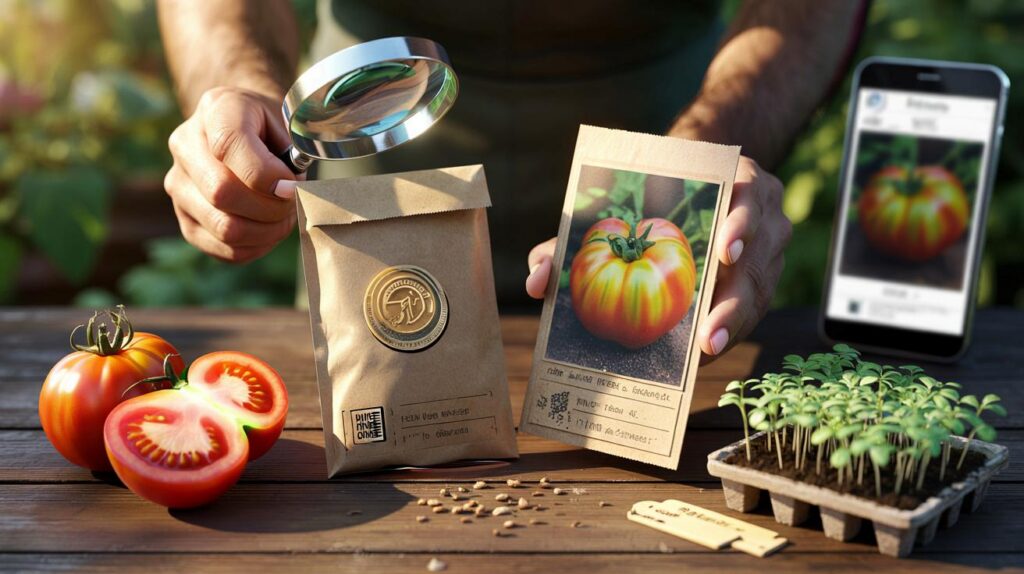
You type “organic heirloom seeds” and a thousand promises bloom on your screen—old-world flavours, sustainable growing, tomatoes that taste like August sunshine. Somewhere between nostalgia and marketing, the truth blurs. And when packets arrive with glossy photos and vague names, the question returns, quietly practical and a little urgent: how do you know what’s real?
I saw it at a Sunday market, the kind where bread still crackles on the table and stallholders remember your name. A man in a flat cap held up a brown envelope stamped “Heritage Tomato — Organic”, his voice warm as tea, the story warmer still: saved by a grandmother, grown on a hillside, a taste like summers that lasted longer. People leaned in, heads tilting, buying not just seeds but a feeling.
On the walk home, I kept the packet turning in my hand, as if the paper would confess its lineage. My grandfather swore by marigolds and moon cycles, yet even he liked a label with facts. I looked at the tiny print, then at my own impatience, and felt the tug between romance and rigour. There’s a line worth finding.
Spot the claim: organic, heirloom, or marketing?
Look closely at the language on a seed packet and you’ll see where myths sneak in. “Organic” describes how the parent plants were grown and processed, under a certified standard, not the age or purity of the variety itself. “Heirloom” signals an open‑pollinated variety, stable through many seasons, usually decades old and passed along by gardeners with stubborn affection. Put together on one glossy label, the words can sound like a halo, yet they are different truths that need different proofs.
I once spoke to an allotmenteer in Leeds who bought “Heirloom Rainbow Strawberries” from an online marketplace and ended up with vigorous, flavourless runners that looked suspiciously modern. The listing had dreamy photos and no Latin name, no lot number, no certifier code—just a promise. She laughed about it later, but not before losing a bed to plants that never matched the picture. Trading standards officers and horticultural groups hear versions of this story every season—mislabelled seeds, misleading names, clever photography.
Heirloom, simply put, means open‑pollinated and genetically stable so that saved seed grows “true to type” across generations; many gardeners use 50 years, pre‑1970, or pre‑hybrid era as a rough marker. Organic is a production claim: the crop was raised and processed without synthetic inputs, verified by a named certifier (think Soil Association, OF&G, EU leaf, USDA). A packet can be organic without being heirloom, heirloom without being organic, both, or neither. “Non‑GMO” on garden seed is mostly noise in the UK and EU retail context—GM seed isn’t on the counter for home growers.
A simple buyer’s check: from packet to provenance
Start with the label, then keep going one small step further. Seek a named variety (not just “Rainbow Mix”), a Latin binomial, and clear absence of “F1” if you intend to save seed. Real organic packets carry a certifier’s name and code (e.g., GB‑ORG‑02), a lot or batch number, “packed for” year, and a germination standard. Flip the packet and look for a real address and a phone or email. Now type the variety into a reputable database—RHS Plant Finder, Seed Savers Exchange, or a long‑standing seed house—to see if it exists as an open‑pollinated heirloom with a traceable history. Labels tell a story, but questions reveal the truth.
We’ve all had that moment where a too‑good‑to‑be‑true photo pings the dopamine and you click before reading the small print. It’s human. Pause for two minutes: reverse‑image search the listing photo, scan reviews for words about germination and trueness (not just delivery time), and peek at the seller’s “About” page for how they produce or source seed. Beware vague “heritage style” phrasing, suspiciously low prices, and fantasy colours—blue strawberries, rainbow roses, neon succulents. Let’s be honest: nobody does that every day.
Buyers make fewer mistakes when they use a tiny mental checklist, not a hunch. Ask: who bred it, who maintains it, and who vouches for it?
“Heirloom isn’t a sticker, it’s a chain of hands,” said a community seed librarian in Bristol, as we sorted envelopes too creased to lie. “You should be able to tug the thread and find a person, a place, a season.”
- Green flags: named cultivar, OP or heirloom stated, certifier code, lot number, real address, documented history.
- Amber flags: “heritage mix”, no Latin name, stock photos, no batch data, oddly cheap for the rarity claimed.
- Red flags: impossible colours, F1 labelled yet sold as heirloom, no contact details, “secret ancient variety” with no trace anywhere.
Why it matters for your garden and the future
Heirloom seed isn’t just about flavour; it’s about resilience handed down like recipes. When you choose a true open‑pollinated variety, you’re curating a living library that can adapt to your soil, your wind, your quiet corner by the shed. Organic provenance adds another layer—soil life cared for, pollinators spared, fields managed with an eye beyond this season. The right seed is a promise that pays interest, not a gamble you forget by next spring.
There’s also joy in the proof. You grow a ‘Brandywine’ tomato, save seed from the best fruit, and next year’s vines taste like memory, with your weather’s signature stitched into the flesh. The story becomes yours. Share it at a swap, label it with more than a name: the year the drought came, the bed that stayed cool, the bee that wouldn’t leave the blossoms alone. This is how authenticity multiplies—quietly, in envelopes with fingerprints and dates and a little pride.
| Key points | Details | Interest for reader |
|---|---|---|
| Organic ≠ Heirloom | Organic is a certified growing method; heirloom is an open‑pollinated, stable variety with history | Buy what you actually want: purity for saving, or production standard for growing |
| Check the packet and the provenance | Look for variety name, Latin name, certifier code, lot number, and cross‑check in trusted catalogues | Fast steps that filter hype from truth before you spend |
| Spot red flags | Fantasy colours, vague “mix” names, no contact details, or “F1” sold as heirloom | Avoid wasted beds and disappointing harvests |
FAQ :
- What’s the difference between organic and heirloom seed?Organic refers to how the seed crop was grown and processed under a certified standard; heirloom refers to the variety being open‑pollinated and historically maintained so it breeds true.
- Can a seed be both organic and heirloom?Yes. An heirloom variety grown under an approved organic scheme can be sold as organic heirloom if the packet lists the certifier and the variety is documented as OP.
- How do I tell if a seed labelled heirloom is actually a hybrid?Look for “F1” on the packet or in the listing; that indicates a hybrid. Cross‑check the named cultivar in a trusted database. If there’s no specific cultivar name, treat it with scepticism.
- Is there a home test to prove a seed is heirloom or GMO?No practical home test exists. Heirloom status comes from documented history and open‑pollinated behaviour over generations. GM seeds aren’t sold for home gardens in the UK/EU retail space.
- What about saving seed—will it come true?From heirloom/open‑pollinated varieties, yes, if you prevent cross‑pollination where needed and select from good plants. From F1 hybrids, offspring will be variable and unlikely to match the parent.



Great breakdown separating “organic” from “heirloom.” I’ve been mixing those up for years—this guide is clear and super practical. Definately bookmarking.
Quick question: for buyers outside the UK/EU, what certifier codes should we look for besides the EU leaf—USDA, CCOF, Oregon Tilth? And is there a reliable way to verify those numbers online when sellers list them on marketplaces like Etsy or AliExpress? I loved the reverse-image search tip, and the “who bred/maintains/vouches” checklist is gold, but alot of small sellers don’t publish full addresses. How hard should we push before walking away?