
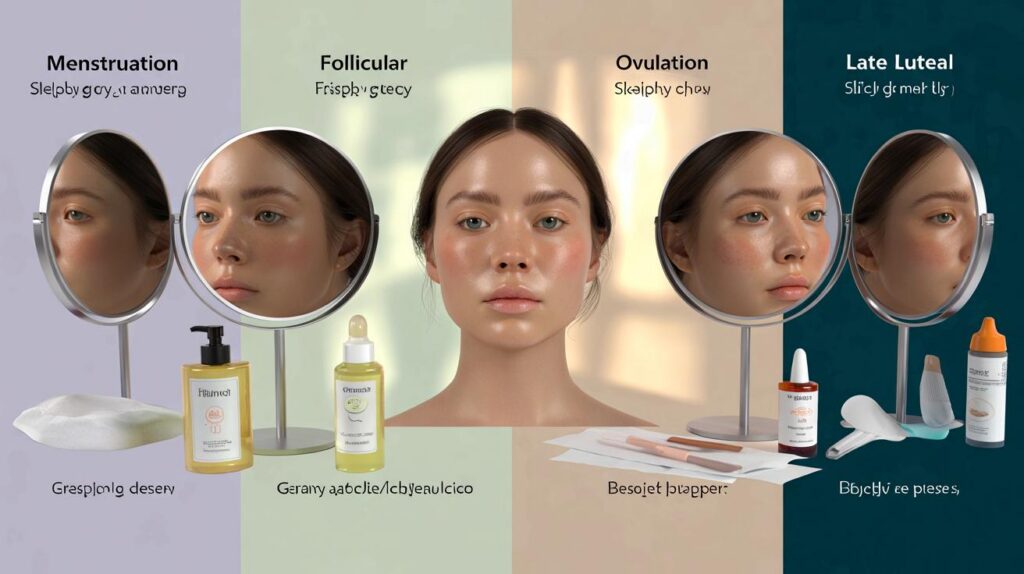
Skin that glows one week, sulks the next? Pimples that seem to set their calendar by your calendar? You’re not imagining it. Your cycle is scribbling notes across your face, and your moisturiser can learn to read them. The trick is rhythm, not war.
On a grey Tuesday in London, I watched a woman on the bus tilt her phone like a mirror, hunting a tiny spot on her chin. She dabbed, rolled her eyes, and returned to scrolling. Across the aisle, another woman pulled a beanie lower, the universal gesture for “don’t ask about my skin”. I thought of my own bathroom shelf, of bottles that felt like promises when I bought them and like accusations when a breakout arrived anyway. The day before my period, my jawline always gets loud. Then, like a switch flipping, my skin softens, drinks water, and plays nice. It felt random for years.
Your skin isn’t misbehaving; it’s messaging.
And the message has a timetable.
Phase by phase: how hormones write on your skin
Here’s the simple truth: your hormones set the mood, your pores follow the beat. Rising oestrogen leans into glow and bounce. Progesterone can nudge puffiness and sensitivity. A whisper of testosterone around ovulation boosts oil, which can be a lovely sheen or a shiny T‑zone depending on the day. You’re not flaky or oily as a personality trait — you’re cycling through states. Once you notice the pattern, the mirror stops feeling like a test and starts feeling like a weather report. Pack the right coat, and you’re fine.
Take Jade, 29, who started logging skin notes on her phone alongside her period dates. Week one, she wrote “dull but calm”. Week two, “glow, vitamin C loves me”. Mid‑cycle, “shine, one whitehead near nose”. The days before bleeding: “jawline revolt, do not pick”. After three months she could call it: the same two or three days before her period were the flashpoint. She wasn’t alone. Many people report premenstrual flares, often on the chin and jaw. When Jade saw the rhythm, she stopped panicking. She started planning.
Biologically, it tracks. Menstruation begins when oestrogen and progesterone are at their lowest, which can leave skin feeling dry, a bit grey, and more reactive to strong actives. In the follicular phase, oestrogen climbs, collagen synthesis perks up, and skin often looks brighter and clearer. Around ovulation, a small rise in androgens can dial up sebum — that means either a flattering “healthy sheen” or congestion if pores are already crowded. During the luteal days, progesterone dominates, water retention can nudge puffiness, and many see an uptick in oil plus micro‑inflammation that tips pores into blockages. Ovulation is your glossiest week — until it isn’t.
What to do, week by week
Match your routine to the week you’re in. Menstruation: think repair. Go gentle with a creamy cleanser, then layer a humectant (hyaluronic acid or glycerin) and a ceramide‑rich moisturiser. A few drops of squalane if you’re parched. Follicular: bring in a brightening serum — vitamin C in the morning, lactic acid once or twice a week at night if your skin is up for it. Ovulation: keep SPF at full throttle and add niacinamide to steady oil and shrink the look of pores. Late luteal: switch to a 0.5–2% salicylic acid toner or a benzoyl peroxide spot treatment; keep textures light; choose non‑comedogenic sunscreen. Simple moves, strong timing.
Common traps? Overcorrecting. The week before your period, a face full of active acids and drying spot gels can shred your barrier and create more redness. Also, don’t overhaul your entire routine on a bad day. Pick one lever to pull. Swap the foaming cleanser for a gel‑cream. Or park the heavy face oil until next week. We’ve all had that moment when you stare at a mirror and want to scrub the stress away. Breathe. Drink some water. Take a walk. Sunscreen is non‑negotiable, even when the sky is grey. Let’s be honest: nobody really cleans their makeup brushes every single day.
Think of this as a cycle‑smart toolkit you can grab when needed, not a rigid rulebook.
“Treat your skin like weather, not a permanent postcode. Pack layers, and you’ll be fine.”
- Menstruation: creamy cleanse, ceramides, panthenol, fragrance‑light formulas.
- Follicular: vitamin C AM, lactic or mandelic acid once or twice weekly PM.
- Ovulation: niacinamide 4–10%, clay mask for 10 minutes, blotting papers in your bag.
- Luteal: 0.5–2% salicylic acid, benzoyl peroxide for spots, green‑tea or azelaic acid to calm.
- Always: daily SPF 30+, kind removal at night, hands off healing spots.
A different way to read your face
Here’s the bigger invitation: treat your skin like part of your body’s conversation, not a separate problem to fix. When your cycle dips, build a nest — richer cream, softer towel, less faff. When your cycle peaks, ride the glow — vitamin C, a brisk walk, a big glass of water. Keep a tiny log on your phone for three cycles and watch the map appear. Patterns beat panic. *Your period isn’t the villain; it’s the narrator.* Share the chart with a friend, swap what works, laugh at the timing of that one spot that always arrives on date night. Your face is not a battleground. It’s a calendar you can read.
| Point clé | Détail | Intérêt pour le lecteur |
|---|---|---|
| Match skincare to your week | Repair during menstruation, brighten in follicular, balance at ovulation, calm pre‑period | Less trial‑and‑error, faster results, fewer flare‑ups |
| Use a light touch with actives | Gentle acids mid‑cycle, salicylic/benzoyl close to period, pause heavy peels when reactive | Stronger barrier, fewer setbacks, clearer routine |
| Log skin alongside cycle | Two lines a day: oil/dry/sensitive + products used | Spots stop feeling random; you predict and prevent |
FAQ :
- Does hormonal acne mean I have PCOS?Not automatically. PCOS has a cluster of signs (irregular cycles, excess hair growth, ovulation issues). If breakouts are severe or cycles are erratic, speak with your GP for proper testing.
- Can I use retinoids all month?Yes for many, but dial back frequency if your skin feels tight during menstruation or late luteal. Buffer with moisturiser, and avoid layering with strong acids on the same night.
- What actually helps pre‑period spots?Salicylic acid to clear pores, benzoyl peroxide for bacteria, sulphur or azelaic acid for redness. Keep the rest of your routine soothing and skip heavy oils on the jawline.
- Does diet change anything?Lower‑GI meals, plenty of fibre, and omega‑3s can help steady swings. Watch the salty snacks and late coffees if puffiness or sleep goes wobbly. Hydration matters more than you think.
- Will birth control flatten skin ups and downs?Some methods can, some won’t. Combined pills may reduce hormonal acne for certain people, while others prefer non‑hormonal options. Your GP can walk you through risks, benefits, and fit.



Tellement utile, merci ! Je n’avais jamais pensé à synchroniser ma routine avec mes phases — le rappel “SPF même sous la pluie” m’a fait rire 🙂. J’essaie le niacinamide à l’ovulation dès ce mois-ci.
Je reste dubitative: est‑ce qu’il y a des études solides qui comparent vraiment l’efficacité d’adapter sa routine par phase vs. garder la même toute l’année? Les anecdotes (Jade etc.) c’est sympa, mais j’aimerais des sources.