
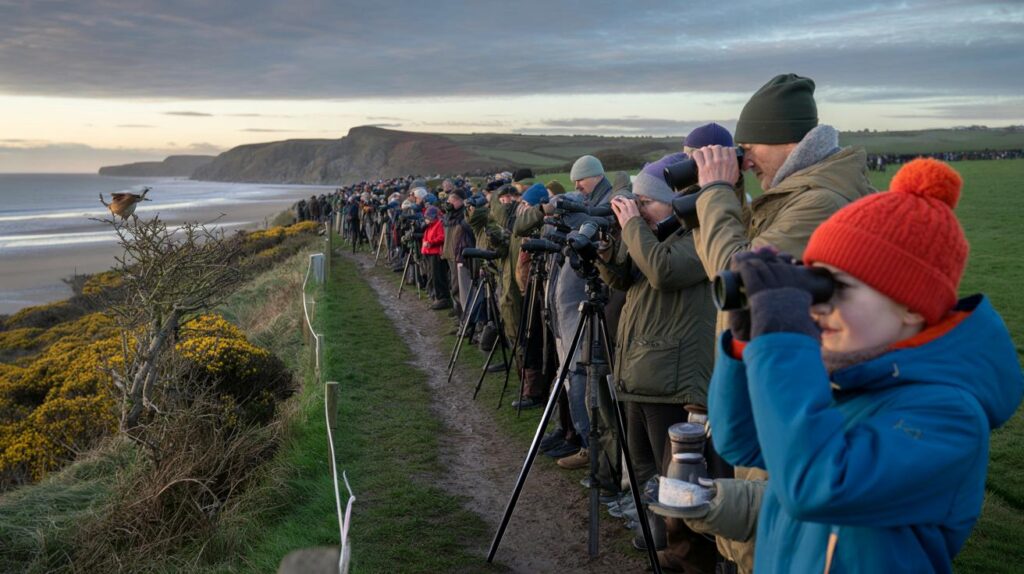
A huge throng lined a chilly coastal path at first light, drawn by a whisper that moved faster than the wind: a bird Britain hadn’t logged in **34 years** had dropped onto our shores. Cars kept coming. Flasks clicked open. Nobody really knew how long the moment would last.
The first thing I noticed wasn’t the bird. It was the quiet. Dozens of people breathing in unison, the rustle of waterproofs, the chink of tripod legs. Then a low murmur rolled up the line like a ripple on a pond — “There.” A speck with a heartbeat landed on a wind-bent hawthorn and the day tilted. Binoculars rose as if pulled by string. A child in a red hat squeaked. Someone a few yards down started crying, sudden and unguarded, like they’d been holding their breath for 30 years and finally exhaled. Phones hovered but nobody dared speak above a whisper. The bird flicked its tail. Wings flashed. It perched, and for a minute the world felt smaller. Then it moved.
The day Britain stopped for a bird
By mid-morning the bridleway had the feel of a festival minus the music. Folding stools, thermos steam, camera lenses as long as your forearm. The bird showed on and off, a brushstroke of rarity against gorse and sky, and every appearance sent a shiver through the crowd. There was laughter when the sun broke through, groans when a cloud of gulls spooked everything, and a shared, wordless relief each time the tiny traveller materialised again.
Numbers swelled. By noon, locals spoke of a queue back to the main road. A farmer set up a hand-written tea stall. A dad arrived, wide-eyed, after an overnight drive from Leeds; his daughter saw the bird first and tugged his sleeve, beaming. We’ve all had that moment when you point at wonder and someone you love sees it too. On social feeds, shaky clips sluiced across timelines, timestamps marked like lifers in a battered notebook. “Mega,” read the captions, and for once the word felt small.
Why this much fuss for a fleeting visitor? In British birding, such arrivals are both lottery win and pilgrimage. A species gone from national view since 1990 carries a gravity that pulls people toward the coast, toward each other. Twitching is part detective work, part rally, part meditation. Confirmation will sit with the rarities committee in due course, but the human story writes itself in the meantime: a once-in-a-lifetime tick for some, a reconnection for others, an afternoon where strangers pass binoculars along a hedge and share a biscuit without asking names.
How to see a mega without causing chaos
If you’re tempted to go, plan like a local. Check live updates from trusted news services rather than rumour maelstroms. Time your arrival to avoid the early crush; late morning can give calmer views when the first wave thins. Pack light but smart: binoculars first, camera second, layers in the boot, a charged phone, cash for the honesty box. Learn the vantage points before you arrive — a quick scan of OS Maps or the reserve board can save you hours of wandering.
Respect the line. Keep to paths, stay behind the tape if wardens have posted one, and hold your nerve when the bird drops out of sight. It will come back; pushing closer usually means nobody sees it. Don’t block farm gates, don’t stand in the road, don’t fly a drone, and leave the sound lures at home. Let’s be honest: nobody really nails flawless fieldcraft on zero sleep and two coffees, but you can choose not to make the day harder for everyone else.
“We want people to enjoy the bird. Give it space, listen to the marshals, and you’ll likely get your view — and so will the next hundred folk behind you,” said Elaine Walker, a volunteer warden with a voice like a friendly bell.
- Keep to marked footpaths and any taped viewing lines.
- Car-share if you can; park only in designated areas.
- Use whispers, not shouts; silence helps the bird settle.
- Bring snacks and patience; don’t rely on local shops alone.
- Do not trespass — a single shortcut can end public access for everyone.
What this rare visitor tells us
There’s a larger weather pattern behind the thrill. Vagrants often ride storms, carried on tailwinds that bend the rules of migration for a day or a season. Some species are straying farther, some are popping up more often as climate and habitat shift under our feet. That’s the science. The feeling is something else. A bird that shouldn’t be here arrives anyway, and all at once you’re part of a planetary story that started long before breakfast. The faces in the crowd tell you as much: teenagers in skate shoes, retirees with notebooks, a nurse fresh off nights, a delivery driver on his break. The rarest thing isn’t always the bird. It’s a field full of people deciding, for a few hours, to look in the same direction. The bird was smaller than I expected.
When the light began to lean and the air picked up that metallic hint of evening, the bird did what birds do. It fed. It preened. It vanished into a thicket, then returned, then paused as if remembering something from a continent away. A boy near me counted under his breath. A woman dabbed at her eyeliner with the corner of a scarf. Someone offered someone else the last chocolate biscuit with the solemnity of a treaty. There was no grand finale. Just a quiet dispersal, boot-scrapes on gravel, a tide of satisfied chatter pulling back toward the car park. **Once-in-a-generation** had started as a headline. By dusk it felt like a shared secret.
The next day tends to be kinder. Fewer people. More time to breathe. But the first day held a hum that only happens when the country, briefly, points its attention at a hedgerow. If you went, you’ll know the joy of marking the date in your head like a birthday. If you missed it, you’ll know the twinge of a story told second-hand and the almost itchy desire to be part of the next one. Birds are good at that — inviting us to turn up, to look, to share the same patch of sky for a minute. That’s not just a hobby. That’s a way of being here together.
| Key points | Details | Interest for reader |
|---|---|---|
| Rare UK first-in-decades sighting | First confirmed national record since 1990 pending committee acceptance | Why the crowd formed and why it mattered |
| Crowd dynamics and etiquette | How hundreds watched without flushing the bird or blocking access | Practical tips to see a mega responsibly |
| Context beyond the buzz | Weather patterns, migration quirks, and community culture | Deeper meaning behind a headline-grabbing rarity |
FAQ :
- What species was it?Local birders are reporting a vagrant not recorded nationally in 34 years; formal identification sits with the British Birds Rarities Committee.
- Where was it seen?On a coastal headland with managed access and clear viewing lines; exact spots were shared on official channels to avoid disturbance.
- Is the bird still there?These visitors can vanish between hourly updates; check real-time news services or the reserve’s feed before you travel.
- Why do such rarities turn up?Strong winds, disorientation during migration, and shifting climate patterns can push birds far beyond their usual routes.
- How can I watch responsibly?Keep distance, stick to paths, listen to wardens, car-share, and leave no trace — you’ll get better views and keep access open.



What a piece—could almost feel the hush and cold air. Haven’t twitched in years, but this makes me want to dust off the bins and head out. Once-in-a-generation moments like this remind me why we look up from our screens.
Cool story, but what was the actual species? Without a confirmed identificaiton it’s kinda all vibes. Any photos with field marks—wing bars, tail pattern, call? Otherwise this is definately premature to celebrate.