
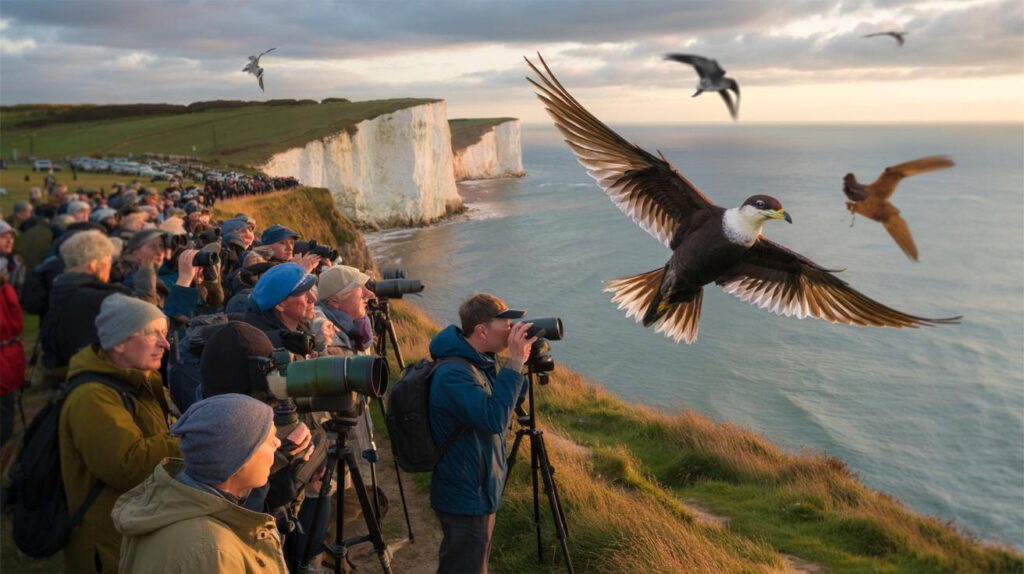
Word spread along the hedgerows and coastal cliffs as binoculars tilted skyward and Yorkshire’s birding community held its breath today.
Within hours, a white-throated needletail — a swift-like traveller most at home in Asia and Australia — drew crowds to two Yorkshire hotspots after vigilant visitors raised the alarm. The appearance marks England’s first confirmed sighting in 34 years and sent pulses racing across Tophill Low Nature Reserve and RSPB Bempton Cliffs.
A once-in-a-generation visitor
The white-throated needletail is a muscular, scimitar-winged swift known for relentless, high-speed foraging flights. It is not a British breeder. It occasionally wanders far from its usual range, and when it does, birders drop everything. This week’s bird first showed at Yorkshire Water’s Tophill Low Nature Reserve before reappearing along the towering ledges of Bempton Cliffs near Bridlington, where the evening light and onshore winds lifted hopes of more views.
First confirmed sighting in England since 1991 — and only the second recorded in Yorkshire after Ferrybridge in 1985.
Word travelled quickly through local networks and social media. By late afternoon, car parks filled and footpaths bristled with scopes, as the region’s swift lovers scanned the sky for a thickset, rocket-shaped silhouette cutting a different line from the familiar common swift.
How the drama began
Two visitors to Tophill Low, Mandy Gregory and Ray Maddison, raised the first alert after photographing a bird with long sabre-like wings and a compact, bullet-shaped body. Staff at the reserve checked the images and realised the magnitude of the find. Phones lit up, and the message burst beyond local groups to the national birding grapevine.
Around 50 people arrived at Tophill Low within the hour after the initial alert, with hundreds more heading to Bempton by evening.
For Tophill Low, the bird ranks as an extraordinary arrival. Staff there reckon it is the second-rarest visitor in six decades, behind a famed Amur falcon that paused over the site in 2008. The reserve’s wildlife résumé already reads like a nature-lover’s wish list — otters, barn owls, kingfishers, bitterns and grass snakes — and last year it welcomed a pair of blue-winged teal, a North American dabbling duck that strays only occasionally to Britain.
What to look for
Even experienced watchers can hesitate when a needletail zips into view. It looks broader and heftier than a common swift, with an impression of raw power. The key is to stay calm and note shape and pattern rather than chasing it through your viewfinder.
- Shape: thick, cigar-like body with long, sabre-shaped wings and a blunt rear end.
- Markings: clean white throat contrasting with darker head and body; pale under-tail area can flash as it banks.
- Flight: purposeful, slicing, often lower than expected; less fluttery than common swifts.
- Size: marginally larger and chunkier than a common swift, giving a more muscular profile.
- Behaviour: loops back along hedgelines and cliff faces to feed on insects, especially in warm, still spells.
Look for a chunky, sabre-winged swift with a gleaming white throat and a hard-charging flight line.
Why here, why now
Vagrant swifts turn up in Britain when weather and winds combine to divert them far from expected routes. Spring and early summer can pull fast-flying aerial insectivores into the North Sea basin, with warm southerlies or easterlies funneling migrants towards the east coast. When conditions settle, these birds may linger and hawk insects over reservoirs, river valleys and sea cliffs — exactly the places Yorkshire’s watchers scanned this week.
The needletail’s usual haunts lie thousands of miles away, yet the species appears on a tiny handful of British records. England’s previous confirmed sighting dates back to 1991, while Yorkshire last logged one near Ferrybridge in 1985. This context explains the intensity — and the crowds — when the alert went out.
A reserve that keeps springing surprises
Tophill Low’s varied habitats — open water, reedbeds, woodland and grassland — draw in migrants on wind-shift days. So does Bempton, where updrafts along the cliffs support aerial feeders. That mix, plus diligent local observers, makes the county a recurring stage for headline finds.
| Year | Species | Location | Note |
|---|---|---|---|
| 1985 | White-throated needletail | Ferrybridge, Yorkshire | First Yorkshire record |
| 1991 | White-throated needletail | England | Last confirmed English sighting until now |
| 2008 | Amur falcon | Tophill Low | Among the site’s rarest visitors |
| Last year | Blue-winged teal (pair) | Tophill Low | North American dabblers on tour |
| This week | White-throated needletail | Tophill Low and Bempton Cliffs | Sparks county-wide rush |
Planning a visit without causing chaos
Rare birds draw crowds. The trick is to see the bird while keeping the site safe and calm for wildlife and people.
- Arrive early or late to spread pressure on parking and paths; avoid blocking gates and farm access.
- Keep to marked paths and viewing areas; cliffs and reservoir banks can be hazardous.
- Use bins first, then deploy scopes; chasing a fast swift through a long lens often loses you the moment.
- Watch for gull and swift flocks; the needletail may cut through them on regular feeding loops.
- Listen for gasps, not calls; this bird gives few clues by sound, so eyes matter.
- Follow warden guidance; dogs on short leads, no drones, and no playback.
This spectacle exists because watchers reported swiftly, staff acted fast and visitors behaved well — keep it that way.
How rare arrivals get confirmed
In Britain, credible photographs and detailed field notes underpin rare-bird claims. Observers record shape, plumage, behaviour and conditions. Local recorders collate reports and assess whether the features match the species beyond reasonable doubt. Multiple observers and consistent images strengthen the case. That process builds the long-term record and helps separate genuine vagrants from honest mistakes.
What today’s frenzy tells us
Moments like this show how public reservoirs and managed coastal reserves double as migration service stations. They offer open skies and insect-rich air, which appeal to wandering swifts. They also hinge on people power. Visitors who know what to look for can turn a glancing encounter into county history, and rapid communication can give hundreds the chance to witness the same bird without trampling sensitive ground.
For anyone bitten by the bug, set up a simple routine over the coming days. Check the skyline above water at warmest times, especially from mid-afternoon to early evening. Scan for a chunky, white-throated shape powering along wind lines. If you see it, take a breath, grab a sharp record shot if you can, and share your sighting with wardens on site. Your alert may be the next trigger that gets people moving — and brings a once-in-a-generation visitor back into view.



Absolutely buzzing to see this after 34 years! Huge thanks to Mandy Gregory and Ray Maddison — what a spot. I’m definitley heading for Bempton this evening; any local advice on the best pull-ins or less crowded viewpoints? Is it hugging the cliff face or cutting higher over the fields when the wind drops? Would love to grab a record shot without getting in anyone’s way.