
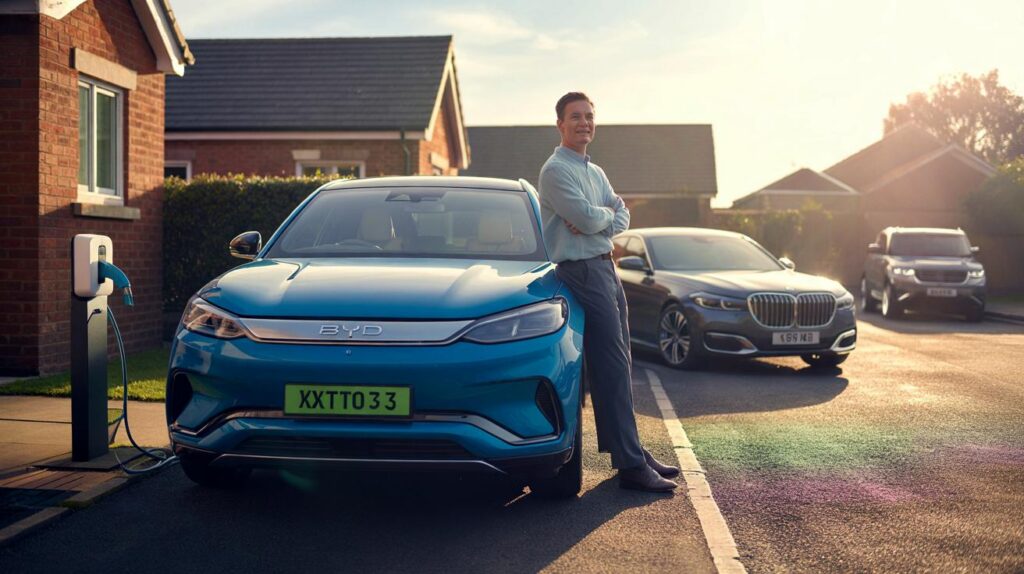
Britain’s driveways are changing fast, and not with badges most drivers grew up trusting. Cheaper new names now fill the gaps.
Two years after swapping a familiar German badge for a Chinese EV, one UK driver says he’d do it again tomorrow. His view captures a bigger shift: BYD has surged into Britain’s sales charts, undercutting premium rivals on price while testing nerves on parts, insurance and data concerns.
One driver’s verdict
Dr Dimitar Ormanov traded a Honda Civic for a Chinese-built EV after eyeing a Tesla. He found stronger value in the dealership for a BYD and says the build quality and everyday tech beat his old BMW experience. He’s not alone in that calculation, as a wave of buyers moves from familiar marques to lower-cost EVs with long warranties and kitchen-socket practicality.
For many drivers, the new pitch is simple: near-premium tech and usable range for about £31,000, not £45,000.
His neighbourhood now shows the trend on the kerb: multiple BYDs and newer Chinese brands like Omoda popping up in quick succession. Early adopters talk less about badge prestige and more about what the cars can do for the price.
Sales surge shakes the market
BYD says the UK is now its second-biggest market. September registrations jumped by 880% compared with a year ago. Last month alone, the brand delivered 11,271 cars here, pushing past Land Rover, Mini and Tesla in the monthly race. Only a handful of mainstream marques stayed ahead.
11,271 UK registrations last month; BYD sits above Land Rover and Tesla in Britain’s monthly tally.
How the numbers stack up
| Brand | UK registrations (last month) |
|---|---|
| Vauxhall | 12,120 |
| Skoda | 11,925 |
| BYD | 11,271 |
| Volvo | 11,570 |
Across the year, BYD has shifted 24,333 vehicles in the UK, drawing close to Tesla’s 26,951 total. That gap narrows as buyers reach for smaller budgets that still deliver the electric step-up they want.
Why buyers are tempted
Price and value
BYD’s Atto 2 starts just under £31,000. Tesla’s Model Y lands around £45,000. With mortgage costs and energy bills piling up, that £14,000 gap makes decisions easy for families trying to future-proof on a budget. BYD says vertical integration lowers costs: in-house batteries, a tight grip on supply chains, and fewer mark-ups.
About £31,000 for a new EV with modern driver tech and family space has redrawn the value map.
Tech that solves real problems
Owners rave about “V2L” capability, which lets the car power tools, camping gear or even give a top-up to another EV. Practicality wins arguments at service stations and campsites. The brand’s LFP “Blade” battery chemistry also counters charging anxiety: drivers can charge to 100% more often without the degradation warnings common on many rivals.
The sticking points
Parts and servicing pipeline
The bill for servicing can run higher than for a petrol hatch, and some owners report delays sourcing parts. A UK warehouse backed by DHL exists, and the brand has begun using dedicated shipping to Europe and Britain, but availability still varies by model and repair complexity. Workshops also need training time to match the pace of cars hitting the road.
Six to eight weeks for certain parts remains a risk when a car sits undriveable; a local warehouse helps, not cures.
Several established groups are building or partnering on Chinese-platform production in Europe to meet rules-of-origin and reduce logistics drag. That brings shorter parts routes in time, but the benefit won’t arrive everywhere at once.
Insurance gaps are narrowing, slowly
Some early owners struggled to find cover at launch, or had policies withdrawn at renewal. Insurers say they are still assessing risk profiles for new-to-Britain models. Thatcham Research has been working with manufacturers to share repair data, set parts pricing norms and align on approved repairers. As those networks thicken, quotes tend to fall, but the experience remains uneven.
A cultural difference complicates repairs: in China, low labour costs often make full panel replacements economical; in the UK, that approach can push a car toward write-off status. Insurers want modular, repair-friendly design and consistent parts pricing before opening the gates fully.
Range, resale and the reality check
Range anxiety is softer than it was, yet it still shapes buying. Tesla tends to offer longer motorway legs than equivalent BYD models, which can change how often you stop on a Cambridge–Milton Keynes run. Chinese brands counter with hybrids boasting quoted ranges beyond 700 miles, signalling that efficiency and flexibility are moving fast in that camp.
Depreciation remains a big fear. Data on the Atto 3 shows around a 51% drop over several years, from about £37,640 to roughly £19,196 after 36,000 miles. Rapid tech cycles compress residuals as newer battery packs and infotainment suites roll out. Over-the-air updates help keep software fresh, yet used values still reflect brand recognition and repair confidence. Porsche and Ferrari keep their premiums; newer badges must earn them.
Privacy and geopolitics aren’t going away
Security and data worries frame many kitchen-table debates. The US has banned certain Chinese components in vehicles on safety grounds. In Britain, military sites such as RAF Wyton have advised staff to keep distance from sensitive areas if a car contains specific connected tech. A sizeable share of over-55s say they hesitate over data handling in Chinese products.
Owners we spoke to shrug off the fear for everyday use, citing the same privacy caveats they already accept with smartphones and sat-nav apps. Still, buyers want transparent statements on data storage, software updates, and how UK rules apply if a supplier changes hands or laws shift.
What to check before you switch
- Insurance: get quotes for the exact trim; verify approved repairers within reach.
- Parts: ask your dealer about the local warehouse, typical wait times and courtesy car policy.
- Charging: map your weekly routes and identify reliable rapid chargers; compare to brand-native networks.
- Battery: look for LFP chemistry if you want regular 100% charges; check warranty terms in years and miles.
- Resale: examine independent residual forecasts; assess finance options that protect against sharp drops.
A market moving under your feet
Britain’s appetite for lower-cost EVs has created a lane where BYD, Omoda and Jaecoo can thrive. The pitch pairs usable tech with prices that rival mid-spec petrol crossovers. Dealers see shoppers who once saved for a German badge walk out with a Chinese key fob and £10,000 still in the bank.
For traditional brands, the message is blunt: cut prices or add tangible value. A TV-famous dealer predicts exactly that outcome, with Western makers forced to sharpen pencils as Chinese line-ups expand. The near-term winners will be drivers who treat spreadsheets and software updates with equal attention.
Extra context for your decision
Run a simple total-cost-of-ownership simulation before you sign. Add the finance, home charging installation, public charging rates, servicing, tyres, insurance and the likely resale price in three years. Do the same calculation for a petrol SUV you could afford today. Many households find the Chinese EV comes out ahead over 36 months, even if depreciation stings, because low electricity costs and fewer moving parts ease running bills.
If you live far from a brand-approved bodyshop, factor travel time for repairs into the equation. If you drive long motorway legs daily, prioritise models with strong real-world range and a reliable rapid-charging curve. If you camp or work on-site, V2L functions turn the car into a rolling generator and could save the cost of separate kit.
Big numbers grab attention — 11,271 sales and an 880% surge — but the best reason to switch sits in your own maths.



I test-drove the Atto and honestly the cabin tech feels more useable than my 3 Series ever did. V2L is actually handy (powering tools on site), and the LFP battery means 100% charges without the usual scolding. Not fussed about the badge any more; value wins.