
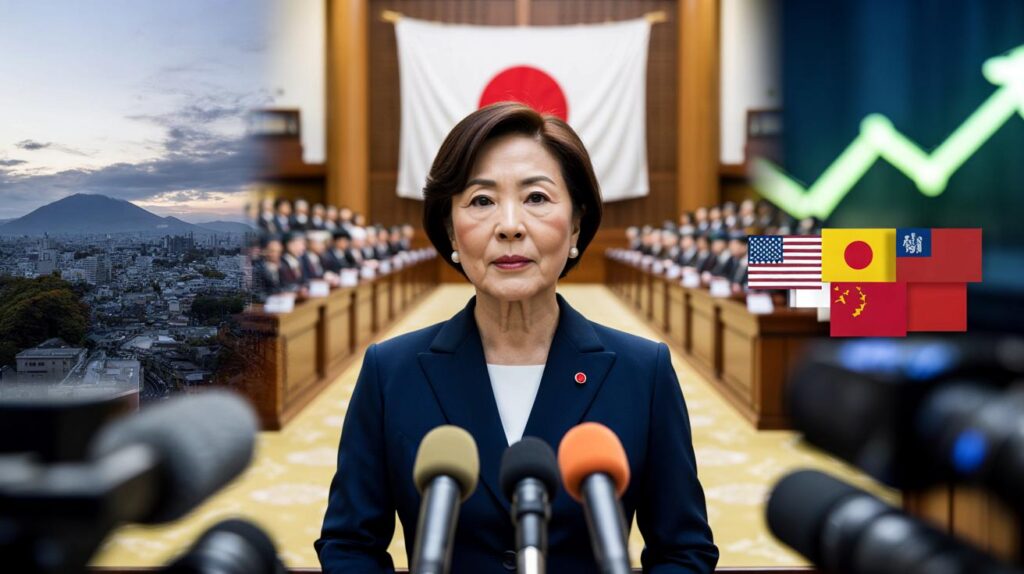
A political jolt in Tokyo leaves markets upbeat, rivals coaxed and neighbours watchful, as a new leader sketches her moves.
Sanae Takaichi secured parliament’s backing with 362 votes and is set to be sworn in as Japan’s 104th prime minister on Tuesday evening. The Liberal Democratic Party stalwart, often labelled the “Iron Lady,” now faces a demanding in-tray: pinched household finances, fractious regional geopolitics and a party nursing bruises from scandal.
How the vote was won
Lawmakers in both chambers rallied behind Takaichi, handing her 237 votes in the Lower House and 125 in the Upper House. That cleared the bar for a simple majority and ended a terse day of manoeuvring inside a ruling party eager to project stability after months of controversy.
Japan’s fourth leader in five years takes office with a mandate from both houses and expectations running high.
Numbers that tell the story
| Measure | Figure |
|---|---|
| Lower House votes | 237 |
| Upper House votes | 125 |
| Total parliamentary votes | 362 |
| Population served | 120 million |
| Prime ministerial count | 104th |
| Leaders in past five years | 4 |
| WEF gender gap rank | 118/148 |
| Planned cut to Lower House seats | 10% |
A cabinet built for a bruising year
Takaichi will unveil a cabinet before heading to the Imperial Palace for the attestation ceremony, then convene a first cabinet meeting. Local reports point to Satsuki Katayama as the likely finance minister — a watershed if confirmed, as Japan has never had a woman in that post. Rising star Shinjiro Koizumi is tipped for defence, while trade minister Ryosei Akazawa may be kept on to drive a still-delicate tariff settlement with Washington.
By offering roles to former faction rivals, Takaichi signals a unity pitch inside a scandal-scarred LDP.
Economic promises and the Abenomics imprint
Takaichi has long championed Abenomics, the late Shinzo Abe’s formula of fiscal stimulus, accommodative policy and reform. She argues for tax cuts and targeted spending to cushion households struggling with stubbornly high prices. She has criticised recent interest rate rises by the Bank of Japan, warning that higher borrowing costs can choke investment and push up retail prices.
That stance appeals to voters feeling the squeeze, but it collides with a hard reality: public debt already sits among the highest in the industrialised world. Investors, for now, favour the growth tilt. Japanese equities jumped to record highs as markets priced in continuity and fresh fiscal support.
- Cost of living: relief through tax cuts and energy support packages.
- Debt management: review of spending timelines to steady the trajectory.
- Business confidence: clarity on tariffs to aid pricing and investment plans.
- Structural reform: labour participation and productivity upgrades to lift potential growth.
A first week shaped by Washington
The first foreign test arrives fast. US President Donald Trump is due in Tokyo later this month. Takaichi aligns closely with Washington on security and says she will honour an investment and tariff deal built through a flurry of recent visits by Japanese negotiators. The alliance, once described by Trump as “one sided,” will need careful tending as both capitals wrangle over defence spending, market access and technology safeguards.
Personal rapport will matter: the White House rate of change is rapid, but trust can lock in steadier policy.
China, Taiwan and the shrine question
Beijing’s first response was measured, calling the vote an internal matter while urging Tokyo to honour commitments on history and Taiwan. Takaichi, a noted China hawk, has described Taiwan as a vital partner. That positioning, paired with her past ties to the Yasukuni Shrine, has often stirred anger in China and South Korea. Last week she sent a ritual offering but avoided a visit, a nod to regional sensitivities as she prepared to take office.
Expect her security team to tighten coordination with partners across the Indo-Pacific, while pursuing channels to manage tensions with Beijing in the East China Sea and across critical supply chains.
Gender milestone with mixed reception
Japan’s first woman to lead the government steps into a country that ranks 118th out of 148 on the World Economic Forum’s gender gap index. For many, her rise offers visibility that Japan’s boardrooms and cabinet tables have often lacked. Young women interviewed in Tokyo voiced pride at the breakthrough but questioned whether her conservative views — support for male-only imperial succession, opposition to separate surnames for married couples and resistance to same-sex marriage — will deliver concrete advances.
Role model or continuity figure? For many young voters, policy will answer that question, not symbolism.
Scandal, unity and the LDP’s repair job
Takaichi inherits a governing party bruised by fundraising revelations and sagging trust. She must pass a supplementary budget for the 2025 fiscal year aimed at blunting price rises, while shepherding a bill that trims Lower House seats by 10% under a coalition accord with the Japan Innovation Party. Local media say she has approached all four of her leadership rivals with roles, betting that a big tent will stabilise her legislative base.
The person behind the politics
Takaichi’s backstory is unconventional for a Japanese premier. She worked briefly as a TV host, paid her own university fees after her parents declined to fund a daughter’s degree, and once pounded heavy metal drums with such force she carried spare sticks. She scuba dives, loves cars — a Toyota Supra she adored sits in a Nara museum — and has spoken publicly about raising her husband’s children and supporting him after a stroke.
Such experiences may shape her approach to family policy, elder care and the labour market — areas where small changes can ripple through a society that is ageing quickly and short of workers.
What happens in the next 10 days
- Cabinet announcement, followed by the Imperial Palace attestation ceremony.
- First cabinet meeting sets an early timetable for cost-of-living measures.
- Signals on the US tariff deal to guide automakers and manufacturers.
- Preparations for President Trump’s visit and alliance messaging.
- Outline of the 2025 supplementary budget and seat-reduction bill strategy.
Why it matters to households and businesses
For families, the policy path on prices, energy and taxes will decide whether pay packets stretch further. For businesses, clarity on rates, tariffs and labour supply will drive investment plans. A soft touch on interest rates combined with focused relief could ease pressure quickly, yet the debt arithmetic will demand discipline later in the year.
Scenario to watch
If the government front-loads tax cuts and energy support, households may see relief within months, reinforcing the stock market’s optimism. If imported costs spike or the yen wobbles, pressure could return fast, forcing tougher choices on spending and the pace of reform.



Historic moment, but will her Abenomics-leaning tax cuts really ease prices without piling on more debt? The BoJ just nudged rates; reversing that risks a weaker yen and pricier imports. Color me hopeful, but cautios.
Iron Lady on drums and markets on a high — Rockonomics in action?