
After two decades of tyre smoke and dry wit, Britain’s favourite motoring trio change lanes again as fresh projects beckon.
Jeremy Clarkson, Richard Hammond and James May have quietly closed the book on their long-running business partnership, formally winding up their joint company, W Chump & Sons. Documents at Companies House confirm a members’ voluntary winding up, bringing to a tidy close a 23-year television alliance that began on the BBC and roared on at Amazon. The business ended with £24,087,100 on its balance sheet, leaving an estimated £6m each for Clarkson, Hammond, May and their producing partner, Andy Wilman.
A 23-year road comes to a gentle halt
The trio first joined forces on Top Gear in 2002, turning a dusty car show into a global entertainment juggernaut. After Clarkson’s 2015 exit from the BBC, the foursome launched W Chump & Sons and decamped to Prime Video for The Grand Tour, which premiered in 2016 and ran across six series before its final instalment last September.
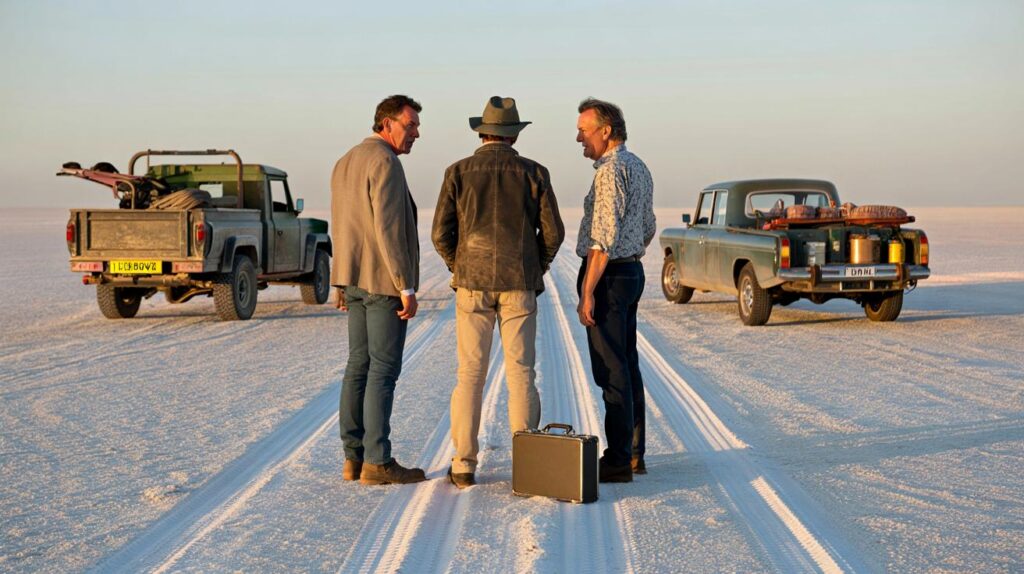
The last film closed where so many of their great stories began: on the Makgadikgadi salt pans in Botswana. Rather than a crash, the partnership chose a soft landing. Clarkson has said the trio preferred to finish on calm terms, not in a gale of headlines. Age, appetite and the physical demands of clambering in and out of low-slung exotics played their part.
The partnership ends by choice, not scandal: a members’ voluntary winding up, a £24,087,100 balance, and roughly £6m each.
What a voluntary winding up actually means
A members’ voluntary winding up is a solvent closure. Directors state the company can pay its debts, a liquidator realises assets, and remaining cash goes to shareholders. It is a housekeeping move that often follows the end of a major project or a change in strategy, rather than a sign of distress.
| Item | Detail |
|---|---|
| Company | W Chump & Sons |
| Process | Members’ voluntary winding up (solvent) |
| Closing balance | £24,087,100 |
| Shareholders | Jeremy Clarkson, Richard Hammond, James May, Andy Wilman |
| Indicative distribution | About £6.02m each before fees and tax |
In practical terms, the move draws a line under their television business together. Rights, residuals and any outstanding liabilities are handled as part of the winding up. For viewers, it changes nothing already on screen, but it signals no new joint shows are in the pipeline under this banner.
Where the three go next
Clarkson remains on the land with Clarkson’s Farm, a series that follows the fits, starts and bureaucracy of running Diddly Squat. The fourth season maintained its mix of mud, mishaps and surprising candour, and reviewers noted its deft balance between staged set-ups and genuine agricultural headaches.
James May’s Great Explorers on Channel 5 keeps the travelogue spirit alive, swapping supercars for stories, maps and deadpan curiosity. Richard Hammond continues to feed a different corner of the car audience with Richard Hammond’s Workshop on Discovery+, charting the fortunes of a real restoration business and the craft of rebuilding metal one bolt at a time.
- Clarkson: farming reality series, ongoing filming schedules and retail spinoffs at Diddly Squat.
- May: travel and history projects, lighter on horsepower, heavier on narrative.
- Hammond: classic car restoration, small-business drama and nuts-and-bolts engineering.
No new Grand Tour is coming, but the trio are not disappearing: they have simply split the convoy into three distinct routes.
How the money could shake out
While the headline figure is hefty, cash extracted during a liquidation can carry tax consequences. Depending on advice and timing, shareholder returns may be treated as capital rather than income, with liabilities varying by individual. Fees, residual obligations and any final bills reduce the headline split. Fans might picture a single wire transfer; in reality, it is a supervised process with staged distributions.
A partnership that reshaped car television
From 2002 to the mid-2010s, the trio turned car content into event television. They took a magazine studio format, spliced it with travel capers, and applied a sitcom’s rhythms: chemistry first, engines second. Budgets grew, locations widened, and the banter became the pitch. Moving to Amazon opened the throttle on scale—longer specials, fewer censorship concerns, bigger stunts.
The arc finished where it began: on wide, shimmering salt. Rather than chase new highs, they opted to lock in a neat legacy. Many crews end with NDAs and bruised egos; this one ended with paperwork and a polite wave.
What viewers should watch for next
Expect occasional crossovers in the future—guest appearances, charity slots, or one-off specials outside the W Chump & Sons framework. Joint rights are complex; once a business dissolves, commissioning a new project requires a new corporate vehicle, new contracts and clear ownership lines. That is not impossible. It just requires intent and a buyer with a reason to sign the cheque.
Meanwhile, the streaming economy has shifted since 2016. Budgets are tighter, travel logistics cost more, and risk appetites have cooled. If a platform wanted a new three-hander from this crew, it would likely be shorter, more targeted, and built around a single high-concept run rather than an open-ended series.
For fans, what changes—and what doesn’t
Your back catalogue remains untouched. Top Gear-era highlights circulate legally on broadcast and digital schedules, and The Grand Tour specials sit in streaming libraries. The difference lies behind the scenes: the umbrella company that once housed the trio’s joint projects has completed its journey.
If you want a sense of what replaces the big set-piece road trips, sample the trio’s separate lanes. Farming delivers stakes, mud and gallows humour. Travel and history trade horsepower for curiosity. Workshop storytelling gives engineering a human scale. Together, they cover more ground than a single format ever could.
A practical note for business watchers
This case doubles as a tidy case study in how UK creatives close the book on a profitable era. A solvent winding up protects reputations, pays creditors in full, and allows principals to move on with clean cap tables. For smaller production outfits, the lesson is simple: plan for closure as carefully as launch. Keep archives in order, document rights, and structure shareholder exits before fatigue sets in.
For those wondering what a future reunion might look like, model it on a limited series: three episodes, one continent, one clear mechanical theme—say, £10k used EVs across Southern Europe, or biofuel experiments across rural Britain. Tight scope, clean rights, one new company, one sponsor who wants global attention. The appetite is there; the admin just needs a new coat of paint.



So it’s a voluntary, solvent wind‑up and roughly £6m each—tidy. But why no on‑screen goodbye? Even a 30‑minute ep to wave us off would’ve been lovely.