
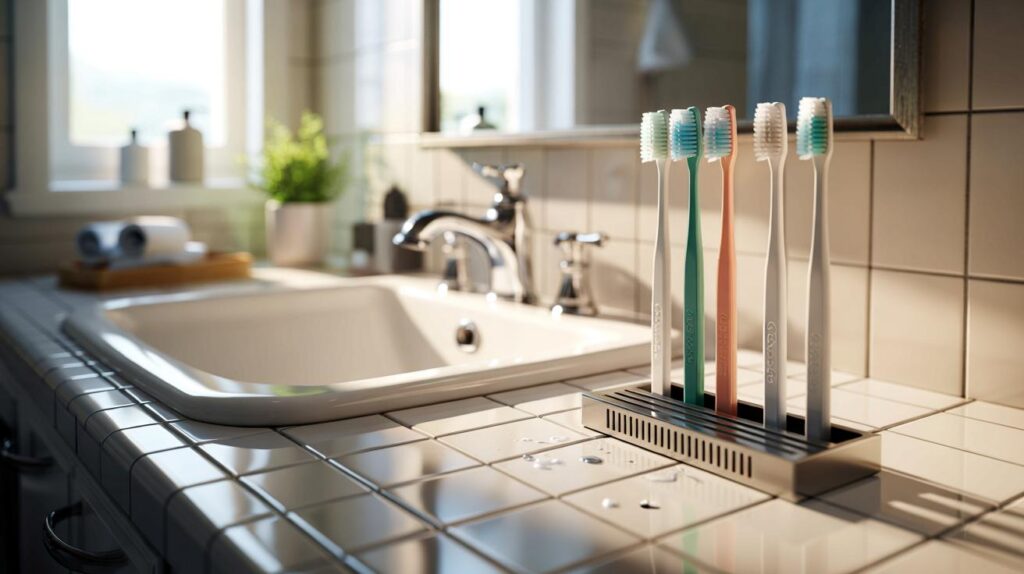
There’s the toothbrush balanced on the edge of the sink, the toothpaste cap somewhere under the tap, a smear of minty foam that somehow migrated to the mirror. We’ve all had that moment when the bathroom feels like a tiny storm just blew through. The mess is visual, sure — but the hidden problem sits in the bristles.
The other morning, in a small flat with a steamed-up mirror and a kettle shrieking in the kitchen, I watched a toothbrush slide into the soap dish with a soft, grim flop. Someone had just flushed. Tiny droplets hung in the air, barely there, and I remember thinking how much of our day hides in these quiet details. The brush was rescued, shaken, put back on the sink like nothing had happened. It looked innocent and damp. The fix was hiding in plain sight.
The quiet power of a proper toothbrush holder
Your toothbrush doesn’t belong flat on the sink. Elevating it — literally — changes the way it dries, the way it breathes, the way it stays out of splash zones. A simple holder lifts the bristles, lets gravity and air do their slow, clean work, and ends the tiny puddles that turn a bathroom into a petri dish.
A few years back, a university study presented at a microbiology conference reported that a large share of toothbrushes stored in shared bathrooms carried coliform bacteria. In one family I visited in Kent — two kids, one small sink — the switch to a vented, wall-mounted rack did something oddly satisfying. The morning rush softened, the counter cleared, and the bristles stopped kissing each other.
Here’s the logic: airflow and separation keep bristles dry, and dry bristles are a harsh place for germs to settle. Vented holders, magnetic stands and self-draining cups each create space between brushes and away from splash paths. If you like covered holders, make sure they breathe; a sealed cap is a tiny greenhouse for moisture, not your friend.
Choosing and using: simple steps that actually work
Start with position. Fix a holder at head height, at least a metre from the toilet and a hand’s width from the tap’s splash arc, so water doesn’t rebound onto bristles. *It takes 20 seconds to set this up, and it pays you back every single day.*
Clean the holder like you clean a kettle: quick, regular, no fuss. A weekly rinse with warm soapy water, then a wipe with diluted white vinegar or 3% hydrogen peroxide, keeps biofilm from settling. Let’s be honest: nobody does that every day. So set a calendar nudge for Sundays and call it done. Germs love moisture; give them none.
Think habits over hardware. If kids drop brushes in the sink, go for magnetic hangers; if you share a flat, pick a rail with spaced slots so bristles can’t touch. Rotate brushes every three months or after illness, and give the holder a quick once-over when you change the loo roll. Small rituals create big calm.
“Airflow is your friend. Pooling water breeds smell, stains and the sort of grime that makes a clean bathroom feel grubby,” a hygienist once told me — and once you hear it, you can’t unsee it.
- Wall-mounted adhesive racks: zero drilling, immediate declutter.
- Self-draining cups: choose ones with slits at the base to stop standing water.
- Magnetic stands: fast to dock, brilliant for kids and slippery-hand moments.
- Vented travel caps: only for the commute or gym bag, not long-term storage.
Less clutter, fewer germs, more headspace
A tidy sink does something gentle to your brain at 7am. You reach for the brush, it’s where you left it, it feels dry, and there’s no small scramble for counter space or a clean bit of porcelain. Your day starts without a friction point you’d stopped noticing, and your mouth feels weirdly fresher because the whole ritual feels cleaner. The holder becomes a cue — like placing trainers by the door — and the habit takes care of itself. One tiny station, some air, and a bristle that never lies in a puddle again. That’s the kind of quiet upgrade a home loves to keep.
| Key points | Details | Interest for reader |
|---|---|---|
| Lift and ventilate | Use vented, self-draining or magnetic holders to keep bristles dry and separate | Drier bristles discourage germs and stop that damp, musty smell |
| Place smartly | Mount at head height, away from taps and at least 1 m from the toilet | Reduces splash contamination and daily mess on the sink |
| Simple upkeep | Weekly quick clean; replace brushes every 3 months or after illness | Easy routine that keeps the holder fresh and your mouth routine calmer |
FAQ :
- How far should a toothbrush be from the toilet?At least one metre. Close the lid before flushing and store the brush out of the splash path to cut down on airborne droplets.
- Do UV toothbrush holders really work?Some can reduce surface microbes when used as directed, yet they don’t replace rinsing, drying and spacing. Think of UV as a nice-to-have, not a magic wand.
- What’s the best holder for a tiny bathroom?Wall-mounted adhesive racks or slim magnetic rails. They free counter space and keep bristles high and dry without drilling.
- How often should I clean the holder itself?Once a week is plenty for most homes. Warm soapy water, then a wipe with diluted white vinegar or 3% hydrogen peroxide, and let it air-dry.
- Is a closed cap safe for everyday storage?Only if it’s vented. Fully sealed caps trap moisture and can encourage odour and residue. Use caps for travel, not for life on the sink.



I switched to a vented wall rack last month and my sink finally looks like an adult lives here. The airflow tip and weekly clean are simple enough even for me—definately keeping this routine. Thanks for writing something actually usable.
Interesting read, but do you have a citation for the microbiology conference finding on coliforms? Not doubting, just want to see the sample size and methodology. Also, how much does “toilet plume” actually contribute versus just leaving a brush wet on the sink?