
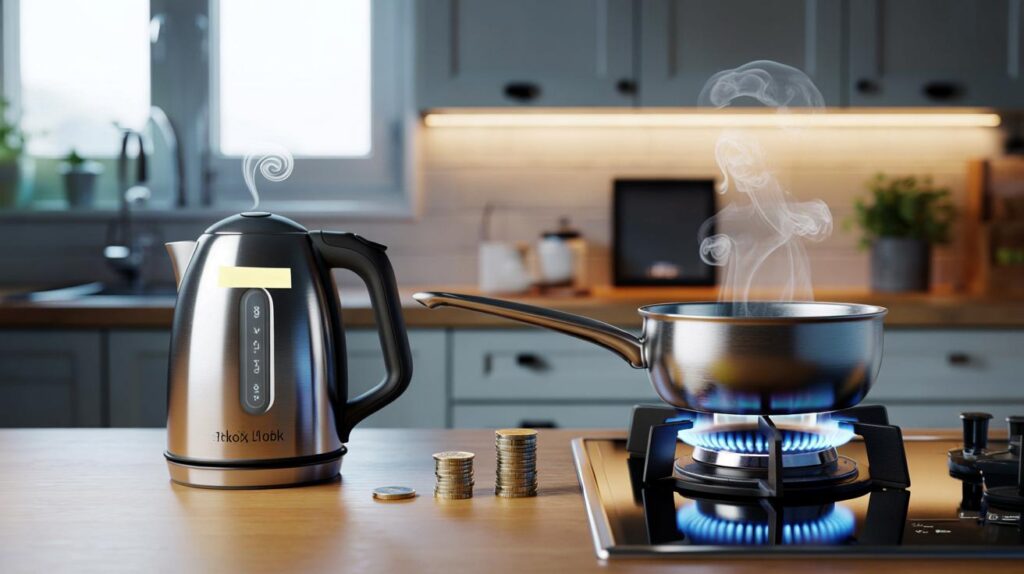
Energy prices have turned ordinary kitchen choices into quiet maths problems. So which boils water cheaper in Britain right now — the trusty electric kettle or the hob flame?
At 7.12 on a grey Tuesday, the kettle clicked into life and the kitchen filled with that small, comforting hum. I set a timer, watched the steam bead on the spout, then glanced at the smart meter as the numbers ticked up. Ten minutes later I repeated the dance with the hob — first a gas ring, then an induction zone — same water, same jug, same nerves. *I could feel the tiny pause before the kettle clicked, like a held breath.*
The flame looked romantic. The induction looked clinical. The kettle felt inevitable. The numbers didn’t line up the way I expected.
The kitchen test: what really costs less?
I ran the test like a curious neighbour, not a lab. One clean litre of tap water, measured to the meniscus. Starting temperature a cool 20°C. A 3 kW kettle, a medium saucepan with a lid on the hob, and an induction ring set to a steady boil rather than full blast. I boiled a single mugful as well, because that’s daily life. I watched the smart meter for gas, a plug-in monitor for electricity, and timed to the second. The room felt hilariously tense for what was, basically, tea.
Here’s what jumped out. For a full litre, the kettle used roughly 0.10–0.11 kWh and took just over three minutes, costing around 2.7–3.0p on a typical 27p/kWh electricity tariff. Induction needed about 0.11–0.12 kWh, landing near 3.0–3.2p, and four minutes. The gas ring, with lid on and flame neatly under the pan, burned about 0.23 kWh of gas — roughly 1.6p at 7p/kWh — while taking a shade under five minutes. For one mug (300 ml), the kettle hovered near 0.8–0.9p; the gas pan swung between 0.5p and 1.2p depending on how politely the flame behaved. The ceramic hob I borrowed for a pass was the costliest and slowest of the lot.
The physics explains the mood swings. It takes around 0.093 kWh to heat one litre from 20°C to boiling. The trick is how much extra energy each method wastes. A good kettle or an induction ring can be ~85–90% efficient. Gas hobs scatter heat into the air, often nearer ~40–50% in home conditions. Yet UK gas is usually far cheaper per kWh than electricity, so the arithmetic tilts back. Add limescale and a carelessly overfilled kettle, and your neat advantage fizzles. Add a snug lid and a right-sized pan on gas, and it sharpens. **The surprise? Gas can come out cheapest per litre, while the kettle stays the slick everyday winner.**
How to boil for pennies: simple tweaks that pay off
Think like a barista with a budget. Mark your favourite mug’s fill line on the kettle window with a tiny dot of tape. Descale monthly if you live in a hard-water area; a crusted element can nudge usage up, and the boil lingers. On the hob, pick a pan whose base matches the ring, keep a lid on, and set the flame just within the pan’s edge. If you use induction, go to “boost” only to push past lukewarm, then drop a notch to hold a brisk approach to boil. For pasta or veg, pre-boil in the kettle, then finish on the hob — it splits the job neatly.
Common traps are small, familiar, and easy to fix. Overfilling the kettle “just in case” so two cups become four. Leaving the gas flame licking round the sides of a tiny pan. Boiling hard for a full minute after the water already hit 100°C because you were scrolling. We’ve all had that moment when the kettle screams and the teabag still isn’t in the cup. **Let’s be honest: nobody measures 250 ml on a Tuesday night.** So build lazy discipline: the right pan, the lid on, the kettle filled for today’s drink — not tomorrow’s.
“The cheapest litre is the litre you don’t overheat,” a veteran home energy auditor told me during our test. “Match the method to the job, and stop the moment you reach the point.”
- Use a lid on the hob. It cuts time and heat loss dramatically.
- Only boil what you need. A mug mark on the kettle window pays back daily.
- Descale the kettle. A clean element is a quick element.
- Pre-boil in the kettle for pasta, then finish on the hob to save minutes and pennies.
- On gas, keep the flame within the pan’s base. No blue tongues round the sides.
The verdict that actually helps at 7am
So where does this land when you’re bleary-eyed and hunting caffeine? **Gas hob can be cheapest per litre** if your tariff sits near the national average and your technique is tidy. **Kettle wins for small amounts and speed**, with practically zero faff and almost no waste when you boil a single mug. **Induction can match a kettle** when the pan fits, the lid’s on, and you don’t let it roar. Ceramic hob fans, I’m sorry: it lagged and cost more in every round I ran. Your tariff, your kettle’s condition, and your habits swing the outcome more than brand names or wattage stickers. Share-house chaos tends to punish the hob. A tidy cook can make gas sing. The best advice I can give is boring and brilliant: boil exactly what you need — and stop the second you’ve got it.
| Key points | Details | Interest for reader |
|---|---|---|
| Kettle vs induction is a near tie | Both around 0.10–0.12 kWh per litre with good technique | Choose by convenience and speed without bill anxiety |
| Gas can be cheapest per litre | Even at ~40–50% efficiency, low gas unit price wins | Use a lid and right-sized pan to unlock the saving |
| Habits beat hardware | Overfilling, no lids, limescale add hidden cost | Free tweaks deliver daily savings without new kit |
FAQ :
- Is it always cheaper to use a gas hob than a kettle?No. For a litre with a lid and tidy flame, gas often wins on cost. For one mug and pure convenience, the kettle usually comes out ahead in practice.
- Does an induction hob beat a kettle on efficiency?They’re very close. A good induction setup can rival a kettle, especially with a snug lid and a pan that fits the zone.
- How much does limescale change kettle costs?Enough to notice. A heavily scaled kettle can take longer to boil and waste a slice of energy. Descale monthly in hard-water areas.
- Is pre-boiling in the kettle for pasta actually cheaper?Yes, often. The kettle brings water to temperature quickly, then the hob maintains it. Time drops, and so can energy use.
- What if my tariffs are different from the figures you used?Results will shift. The method still holds: minimise waste, lid on the pan, match the tool to the task, and boil only what you need.



Brilliant breakdown! The ‘barista with a budget’ tip is gold — the tape dot on the kettle is going on mine tonight. Also, pre-boiling for pasta has defintely saved me time; never thought about the bill side.
When you say gas can be cheapest per litre, are you including standing charges and any ignition/preheat losses? Also which exact tariffs (day/night, Economy 7) did you assume for eletricity vs gas?