
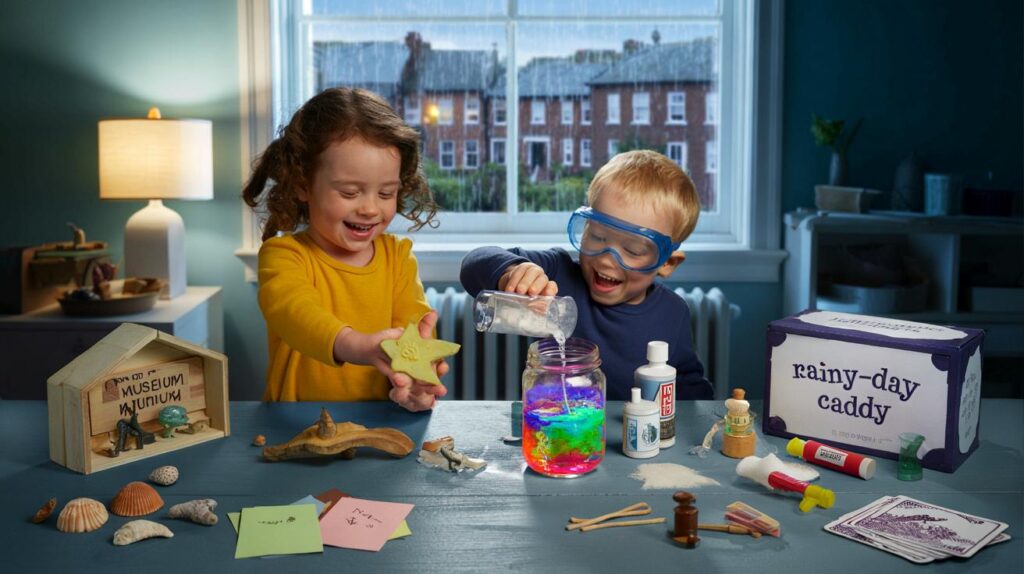
The sky over the UK does this a lot — darkens by lunchtime, drums the windows, and traps families inside. That’s when the day can tilt two ways: into cabin fever, or into the kind of play that leaves the house a little messy and the kids a lot brighter. The trick is turning grey weather into a spark, not a stop sign.
The rain started like radio static, tapping the kitchen skylight while two small humans hovered near the biscuit tin and declared they were bored. Radiators clicked on. A mug of tea steamed by the hob. In that soft, indoor light, we pulled a shoebox from the recycling and called it a museum. Tickets were hand-drawn. Exhibits were seashells and a Lego dinosaur with a missing leg. The curator (aged six) opened the show with a whispery “welcome”, and her brother stamped everyone’s hand with a potato star. The giggles did the rest. Then something unexpected happened.
Rainy-day energy, channelled into curiosity
Kids don’t need a perfect setup to learn; they need a hook. A rainy British afternoon can be a lab, a newsroom, a space station made of blankets if the frame is strong. The simplest shift is to give the day a “job”: become scientists, open a café, run a post office for teddies. When play wears a hat like that, the mood changes. Suddenly, questions are louder than the rain. You notice it in their posture — shoulders up, eyes wide, hands busy. That’s the sweet spot where the living room stops being a sofa park and becomes a small theatre of ideas.
Here’s a reality the Met Office won’t argue with: the UK racks up well over 130 days of rain a year, depending on where you live. That’s a lot of indoor hours to fill. Take Mia in Leeds, who turned a drizzle-soaked Sunday into “Kitchen Lab Live” with vinegar, bicarbonate of soda, and food colouring in jam jars. Timers ticked. Bubbles rose. They logged “findings” in felt-tip on a cereal-box clipboard. When the fizz faded, she pivoted to a tidy-up challenge — who could return tools to the “lab drawer” fastest. One umbrella day, two happy scientists, zero tantrums. The washing-up? That’s what the next kettle boil is for.
Why does this work so well? Play shrinks the distance between a big idea and a small hand. When you give a role and a clear task, you tap into choice, movement, and story. That trio keeps brains alert without turning the lounge into a classroom. It also lowers the stakes. Spilled water isn’t a failure, it’s “rain on Mars”. You’re nudging curiosity while the dopamine of discovery hums along. *The sound of laughter is often the cue that learning is landing.* And once a child feels that, almost anything with a label — museum, newsroom, café — becomes a doorway to “Let’s try.”
Practical play setups you can start in five minutes
Try the Sticky-Note Scavenger Hunt — a doddle to set up, surprisingly clever under the hood. Write 10 clues on sticky notes and post them around one room. Each clue sends kids to find a thing by colour, phonics sound, shape, or number: “Find something with an ‘sh’ sound”, “Find three blue circles”, “Find the book with a map on page 2”. Pop a final note that reads “Show-and-tell at the sofa.” Two sentences of praise at the end helps it land. Rotate the theme: dinosaurs, weather, favourite foods, UK towns. The scaffolding stays the same; the brainwork shifts just enough to keep it fresh.
Common snags? Too many rules, not enough play. Keep instructions tiny and the wins quick. Limit the hunt to one room so the house doesn’t vanish under a tide of toys. If your child is younger, make the clues simple and visual; if older, throw in a riddle or a time limit. And let the mess breathe for a beat. We’ve all experienced that moment when the floor looks like a craft shop exploded. Lean into it, then bring it back with a two-song tidy. Let’s be honest: nobody keeps a Pinterest-perfect craft cupboard on a Tuesday in November.
There’s magic in a “rainy-day caddy” that lives under the stairs — a grab-and-go box that whispers, “We can start now.” Two jam jars, a roll of masking tape, crayons, a dice, pegs, a deck of cards, string, baking soda, vinegar, sticky notes, a glue stick, an old magazine. That’s enough for a newsroom, a lab, a puppet show, and a dozen maths games. Rain becomes an invitation when your kit is within arm’s reach.
“I used to dread wet Saturdays,” says Priya, a mum in Bristol. “Now the caddy comes out and the kids pick our ‘job’ for the day. It’s calmer. More giggles. Less scrolling.”
- Keep it small: a shoebox, not a suitcase.
- Choose tools, not single-use kits.
- Refresh one item a month from the pound shop.
- Tape a simple idea list inside the lid.
A rainy-day mindset that sticks
What if grey skies signalled a micro-ritual instead of a derailment? Light one lamp. Put a blanket on the floor as “base camp”. Pick a role and write it big on a scrap of card — Scientist, Critic, Reporter, Designer. Then run a 20–20–20: twenty minutes of setup and play, twenty minutes of making or testing, twenty minutes of share-and-show. End with three snapshots on your phone: a drawing, a grin, the “exhibit”. It builds a quiet archive of rainy-day wins you can scroll on the next soggy morning. Small rhythms beat big promises when the weather is stubborn.
| Point clé | Détail | Intérêt pour le lecteur |
|---|---|---|
| Name the play | Give the day a “job” — museum, café, newsroom | Instant focus and fewer arguments |
| Keep a caddy | Simple tools in a shoebox ready to go | Less faff, faster starts, more laughter |
| Use 20–20–20 | Play, make, share in bite-size blocks | Flow without fatigue or chaos |
FAQ :
- How do I keep siblings of different ages engaged?Give one role per age: the older child is “editor” or “lead scientist”, the younger is “photographer” or “tester”. Shared goal, different jobs, fewer squabbles.
- What if I’ve got no craft supplies?Work with what’s around you: cushions for a fort theatre, wooden spoons for a band, spice jars for a smell museum, socks for puppets. The story is the engine.
- How long should an activity last?Follow the 10–30 rule: under-fives drift after 10–15 minutes, older kids after 20–30. Stop on a laugh, not a yawn, and they’ll ask to play it again.
- How do I cut screen time without battles?Offer a swap with status: “You’re the critic today — taste test toast toppings.” When kids feel important, the tablet loses its pull.
- What about small flats?Use “zones” instead of rooms: a blanket becomes a lab table, the hallway is a gallery, the sofa is the stage. Tape keeps boundaries tidy and tempers cool.



Loved the idea of naming the day a job—our living room became a ‘newsroom’ and the bickering evaporated. The 20–20–20 rhythm actually kept me sane. Briliant write-up, cheers!
I’m a bit skeptical: doesn’t the sticky-note hunt just spread stuff evreywhere? Any tips for keeping the chaos contained without turning into Sergeant Clean-up?